


Changes in functional performance measures in adults undergoing chemoradiation for primary malignant glioma: a feasibility study
- PMID: 20484122
- PMCID: PMC3227991
- DOI: 10.1634/theoncologist.2009-0265
Changes in functional performance measures in adults undergoing chemoradiation for primary malignant glioma: a feasibility study
Abstract
Purpose: To investigate the feasibility of longitudinal assessment of functional performance measures in newly diagnosed postsurgical malignant glioma patients.
Methods: Patients with histologically confirmed, clinically stable, postsurgical, and previously untreated high-grade glioma (HGG) or low-grade glioma (LGG) were studied. Using a prospective design, all participants performed a cardiopulmonary exercise test with expired gas analysis to assess cardiorespiratory function (VO(2peak)) immediately following surgical resection (mean, 10 days). Additional functional outcomes were skeletal muscle cross-sectional area (CSA) via magnetic resonance imaging, isokinetic muscle strength (isokinetic dynamometry), and body composition (air displacement plethysmography). Quality of life (QOL) was assessed by the Functional Assessment of Cancer Therapy-Brain scale. All study assessments were repeated at 6 and 24 weeks following surgery.
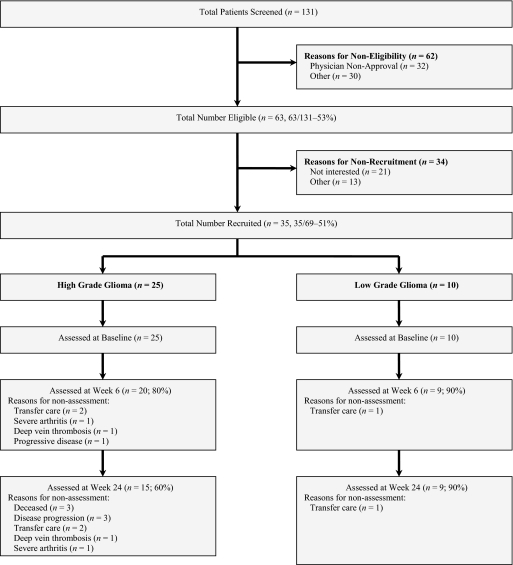
Results: Thirty-five patients (HGG, n = 25; LGG, n = 10) completed baseline assessments. Of these, 20 HGG (80%) and nine LGG (90%) and 15 HGG (60%) and nine LGG (90%) patients completed study assessments at 6 weeks and 24 weeks, respectively. Intention-to-treat analyses indicated several significant time-by-group interactions, with favorable improvements in functional and QOL endpoints from baseline to 24 weeks in the LGG cohort and unfavorable changes in the HGG cohort. Per-protocol analyses including participants assessed at all three study timepoints indicated significant improvements in VO(2peak) and fatigue from baseline to 24 weeks in the HGG cohort; peak workload, body composition, and muscle strength improved from baseline to 6 weeks (all p-values < .05).
Conclusions: Longitudinal quantitative functional assessments are safe and feasible among select patients undergoing chemoradiation for primary malignant glioma. Large prospective studies investigating the clinical importance of these measures appear warranted.
Conflict of interest statement
The content of this article has been reviewed by independent peer reviewers to ensure that it is balanced, objective, and free from commercial bias. No financial relationships relevant to the content of this article have been disclosed by the authors or independent peer reviewers.
References
-
- Stupp R, Mason WP, van den Bent MJ, et al. Radiotherapy plus concomitant and adjuvant temozolomide for glioblastoma. N Engl J Med. 2005;352:987–996. - PubMed
-
- Reardon DA, Desjardins A, Rich JN, et al. The emerging role of anti-angiogenic therapy for malignant glioma. Curr Treat Options Oncol. 2008;9:1–22. - PubMed
-
- Jones LW, Eves ND, Haykowsky M, et al. Exercise intolerance in cancer and the role of exercise therapy to reverse dysfunction. Lancet Oncol. 2009;10:598–605. - PubMed
-
- Curran WJ, Jr, Scott CB, Horton J, et al. Recursive partitioning analysis of prognostic factors in three Radiation Therapy Oncology Group malignant glioma trials. J Natl Cancer Inst. 1993;85:704–710. - PubMed
-
- Scott CB, Scarantino C, Urtasun R, et al. Validation and predictive power of Radiation Therapy Oncology Group (RTOG) recursive partitioning analysis classes for malignant glioma patients: A report using RTOG 90–06. Int J Radiat Oncol Biol Phys. 1998;40:51–55. - PubMed
Publication types
MeSH terms
Grants and funding
LinkOut - more resources
Full Text Sources
Medical
