


Twenty-first century challenges for biomaterials
- PMID: 20484227
- PMCID: PMC2943892
- DOI: 10.1098/rsif.2010.0151.focus
Twenty-first century challenges for biomaterials
Abstract
During the 1960s and 1970s, a first generation of materials was specially developed for use inside the human body. These developments became the basis for the field of biomaterials. The devices made from biomaterials are called prostheses. Professor Bill Bonfield was one of the first to recognize the importance of understanding the mechanical properties of tissues, especially bone, in order to achieve reliable skeletal prostheses. His research was one of the pioneering efforts to understand the interaction of biomaterials with living tissues. The goal of all early biomaterials was to 'achieve a suitable combination of physical properties to match those of the replaced tissue with a minimal toxic response in the host'. By 1980, there were more than 50 implanted prostheses in clinical use made from 40 different materials. At that time, more than three million prosthetic parts were being implanted in patients worldwide each year. A common feature of most of the 40 materials was biological 'inertness'. Almost all materials used in the body were single-phase materials. Most implant materials were adaptations of already existing commercial materials with higher levels of purity to eliminate release of toxic by-products and minimize corrosion. This article is a tribute to Bill Bonfield's pioneering efforts in the field of bone biomechanics, biomaterials and interdisciplinary research. It is also a brief summary of the evolution of bioactive materials and the opportunities for tailoring the composition, texture and surface chemistry of them to meet five important challenges for the twenty-first century.
Figures
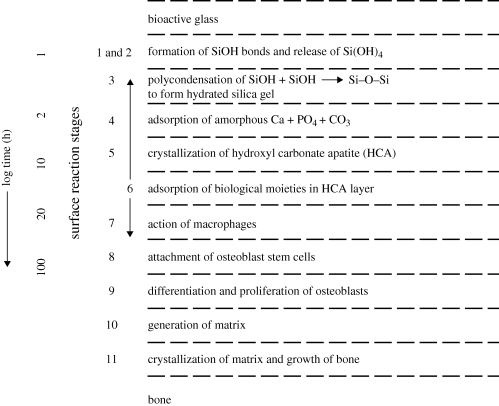
References
-
- Aitasalo K., Kinnunen I., Palmgren J., Varpula M. 2001. Repair of orbital floor fractures with bioactive glass implants. J. Oral Maxillofac. Surg. 59, 1390–1395. - PubMed
-
- Ameri E., Behtash H., Mobini B., Omidi-Kashani F., Nojomi M. 2009. Bioactive glass versus autogenous iliac crest bone graft in adolescent idiopathic scoliosis surgery. Acta Med. Iran. 47, 41–45.
-
- Atwood R., Jones C. J. R., Lee P. D., Hench L. L. 2004. Analysis of pore interconnectivity in bioactive glass foams using X-ray microtomography. Scripta Mater. 51, 1029–1033. ( 10.1016/j.scriptamat.2004.08.014) - DOI
-
- Bellantone M., Hench L. L. 2001. Bioactive behaviour of antibacterial bioactive glass. Key Eng. Mater. 192–195, 617–620. ( 10.4028/www.scientific.net/KEM.192-195.617) - DOI
MeSH terms
Substances
LinkOut - more resources
Full Text Sources
Other Literature Sources
