


SNP microarray-based 24 chromosome aneuploidy screening is significantly more consistent than FISH
- PMID: 20484246
- PMCID: PMC2907219
- DOI: 10.1093/molehr/gaq039
SNP microarray-based 24 chromosome aneuploidy screening is significantly more consistent than FISH
Abstract
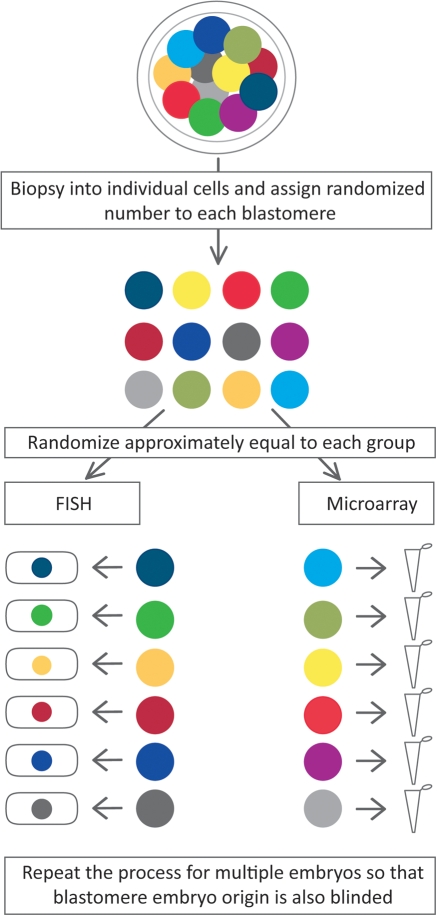
Many studies estimate that chromosomal mosaicism within the cleavage-stage human embryo is high. However, comparison of two unique methods of aneuploidy screening of blastomeres within the same embryo has not been conducted and may indicate whether mosaicism has been overestimated due to technical inconsistency rather than the biological phenomena. The present study investigates the prevalence of chromosomal abnormality and mosaicism found with two different single cell aneuploidy screening techniques. Thirteen arrested cleavage-stage embryos were studied. Each was biopsied into individual cells (n = 160). The cells from each embryo were randomized into two groups. Those destined for FISH-based aneuploidy screening (n = 75) were fixed, one cell per slide. Cells for SNP microarray-based aneuploidy screening (n = 85) were put into individual tubes. Microarray was significantly more reliable (96%) than FISH (83%) for providing an interpretable result (P = 0.004). Markedly different results were obtained when comparing microarray and FISH results from individual embryos. Mosaicism was significantly less commonly observed by microarray (31%) than by FISH (100%) (P = 0.0005). Although FISH evaluated fewer chromosomes per cell and fewer cells per embryo, FISH still displayed significantly more unique genetic diagnoses per embryo (3.2 +/- 0.2) than microarray (1.3 +/- 0.2) (P < 0.0001). This is the first prospective, randomized, blinded and paired comparison between microarray and FISH-based aneuploidy screening. SNP microarray-based 24 chromosome aneuploidy screening provides more complete and consistent results than FISH. These results also suggest that FISH technology may overestimate the contribution of mitotic error to the origin of aneuploidy at the cleavage stage of human embryogenesis.
Figures
References
-
- American Congress of Obstetricians and Gynecologists Committee Opinion. Preimplantation Genetic Screening for Aneuploidy. Obstet Gynecol. 2009;113:766–767. - PubMed
-
- Anderson RA, Pickering S. The current status of preimplantation genetic screening: British Fertility Society Policy and Practice Guidelines. Hum Fertil (Camb) 2008;11:71–75. doi:10.1080/14647270802041607. - DOI - PubMed
-
- Barbash-Hazan S, Frumkin T, Malcov M, Yaron Y, Cohen T, Azem F, Amit A, Ben-Yosef D. Preimplantation aneuploid embryos undergo self-correction in correlation with their developmental potential. Fertil Steril. 2009;92:890–896. doi:10.1016/j.fertnstert.2008.07.1761. - DOI - PubMed
-
- Colls P, Escudero T, Cekleniak N, Sadowy S, Cohen J, Munne S. Increased efficiency of preimplantation genetic diagnosis for infertility using “no result rescue”. Fertil Steril. 2007;88:53–61. doi:10.1016/j.fertnstert.2006.11.099. - DOI - PubMed
-
- Fragouli E, Lensi M, Ross R, Katz-Jaffe M, Schoolcraft WB, Wells D. Comprehensive molecular cytogenetic analysis of the human blastocyst stage. Hum Reprod. 2008;23:2596–2608. doi:10.1093/humrep/den287. - DOI - PubMed
Publication types
MeSH terms
LinkOut - more resources
Full Text Sources
Other Literature Sources
Medical
Molecular Biology Databases
