


Executive control deficits as a prodrome to falls in healthy older adults: a prospective study linking thinking, walking, and falling
- PMID: 20484336
- PMCID: PMC2949331
- DOI: 10.1093/gerona/glq077
Executive control deficits as a prodrome to falls in healthy older adults: a prospective study linking thinking, walking, and falling
Abstract
Background: Executive function (EF) deficits may increase fall risk, even among older adults with no overt cognitive impairment. Indeed, the effects of dual tasking (DT) on gait, a challenge to executive control, are more exaggerated in persons with a history of falls. Prospective evidence is, however, lacking.
Methods: We prospectively evaluated whether EF predicts falls over a 2-year period among 262 community-living, healthy, and well-functioning older adults, focusing on the 201 who reported no falls during the previous year. At baseline, participants completed a computerized cognitive battery that generated an index of EF and other cognitive domains. Gait was assessed using performance-based tests and by quantifying walking during single- and dual-task conditions.
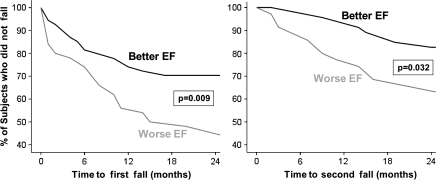
Results: The 262 participants (mean age: 76.3 ± 4.3 years, 60.3% women) had intact cognitive function on testing, a low comorbidity index, and good mobility. The EF index predicted future falls. Among those who reported no previous falls, participants in the worst EF quartile were three times more likely to fall during the 2 years of follow-up, and they were more likely to transition from nonfaller to faller sooner. DT gait variability also predicted future falls and multiple falls, whereas other measures of cognitive function, gait, and mobility did not.
Conclusions: Among healthy older adults, individuals with poorer EF are more prone to falls. Higher-level cognitive functions such as those regulated by the frontal lobes are apparently needed for safe everyday navigation that demands multitasking. Optimal screening, early detection, and treatment of falls should, apparently, also target this cognitive domain.
Figures
References
-
- Rubenstein LZ. Falls in older people: epidemiology, risk factors and strategies for prevention. Age Ageing. 2006;35(suppl 2):ii37–ii41. - PubMed
-
- Kannus P, Sievanen H, Palvanen M, Jarvinen T, Parkkari J. Prevention of falls and consequent injuries in elderly people. Lancet. 2005;366:1885–1893. - PubMed
-
- AGS Guidelines. Guideline for the prevention of falls in older persons. American Geriatrics Society, British Geriatrics Society, and American Academy of Orthopaedic Surgeons Panel on Falls Prevention. J Am Geriatr Soc. 2001;49:664–672. - PubMed
-
- Gates S, Smith LA, Fisher JD, Lamb SE. Systematic review of accuracy of screening instruments for predicting fall risk among independently living older adults. J Rehabil Res Dev. 2008;45:1105–1116. - PubMed
Publication types
MeSH terms
Grants and funding
LinkOut - more resources
Full Text Sources
Other Literature Sources
Medical
