Insulin stimulates human skeletal muscle protein synthesis via an indirect mechanism involving endothelial-dependent vasodilation and mammalian target of rapamycin complex 1 signaling
- PMID: 20484484
- PMCID: PMC2913031
- DOI: 10.1210/jc.2009-2696
Insulin stimulates human skeletal muscle protein synthesis via an indirect mechanism involving endothelial-dependent vasodilation and mammalian target of rapamycin complex 1 signaling
Abstract
Objective: Our objective was to determine whether endothelial-dependent vasodilation is an essential mechanism by which insulin stimulates human skeletal muscle protein synthesis and anabolism.
Subjects: Subjects were healthy young adults (n=14) aged 31+/-2 yr.
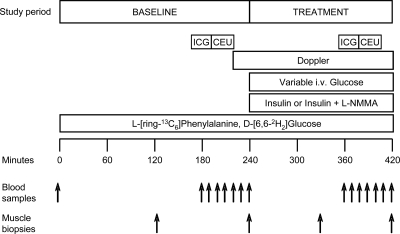
Design: Subjects were studied at baseline and during local leg infusion of insulin alone (control, n=7) or insulin plus the nitric oxide synthase inhibitor NG-monomethyl-L-arginine (L-NMMA, n=7) to prevent insulin-induced vasodilation.
Methods: We measured skeletal muscle protein metabolism with stable isotope tracers, blood flow with indocyanine green, capillary recruitment with contrast enhanced ultrasound, glucose metabolism with stable isotope tracers, and phosphorylation of proteins associated with insulin (Akt) and amino acid-induced mammalian target of rapamycin (mTOR) complex 1 (mTORC1) signaling (mTOR, S6 kinase 1, and eukaryotic initiation factor 4E-binding protein 1) with Western blot analysis.
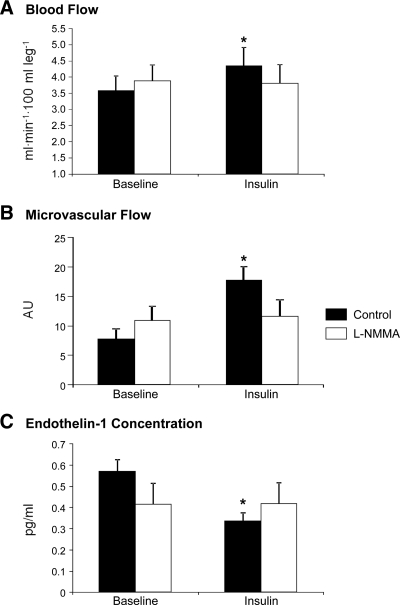
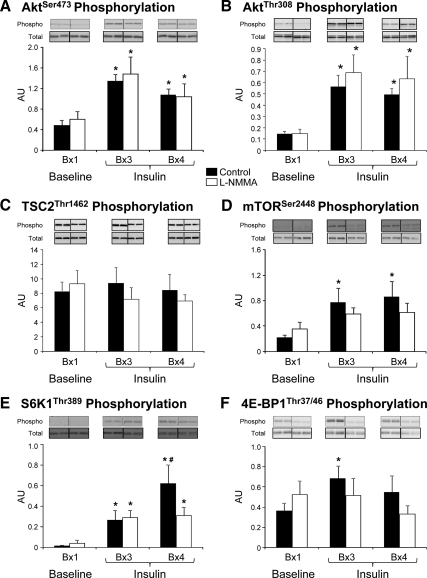
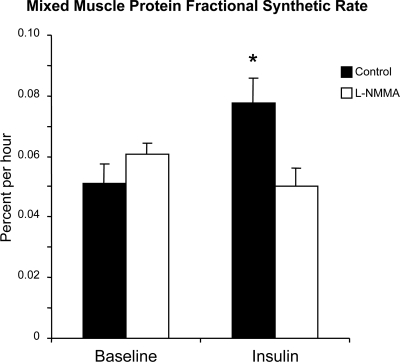
Results: No basal differences between groups were detected. During insulin infusion, blood flow and capillary recruitment increased in the control (P<0.05) group only; Akt phosphorylation and glucose uptake increased in both groups (P<0.05), with no group differences; and mTORC1 signaling increased more in control (P<0.05) than in L-NMMA. Phenylalanine net balance increased (P<0.05) in both groups, but with opposite mechanisms: increased protein synthesis (basal, 0.051+/-0.006 %/h; insulin, 0.077+/-0.008 %/h; P<0.05) with no change in proteolysis in control and decreased proteolysis (P<0.05) with no change in synthesis (basal, 0.061+/-0.004 %/h; insulin, 0.050+/-0.006 %/h; P value not significant) in L-NMMA.
Conclusions: Endothelial-dependent vasodilation and the consequent increase in nutritive flow and mTORC1 signaling, rather than Akt signaling, are fundamental mechanisms by which insulin stimulates muscle protein synthesis in humans. Additionally, these data underscore that insulin modulates skeletal muscle proteolysis according to its effects on nutritive flow.
Figures
References
-
- Kimball SR, Jefferson LS, Fadden P, Haystead TA, Lawrence Jr JC 1996 Insulin and diabetes cause reciprocal changes in the association of eIF-4E and PHAS-I in rat skeletal muscle. Am J Physiol 270(2 Pt 1):C705–C709 - PubMed
-
- Kimball SR, Jurasinski CV, Lawrence Jr JC, Jefferson LS 1997 Insulin stimulates protein synthesis in skeletal muscle by enhancing the association of eIF-4E and eIF-4G. Am J Physiol 272(2 Pt 1):C754–C759 - PubMed
-
- O'Connor PM, Bush JA, Suryawan A, Nguyen HV, Davis TA 2003 Insulin and amino acids independently stimulate skeletal muscle protein synthesis in neonatal pigs. Am J Physiol Endocrinol Metab 284:E110–E119 - PubMed
-
- Bennet WM, Rennie MJ 1991 Protein anabolic actions of insulin in the human body. Diabet Med 8:199–207 - PubMed
Publication types
MeSH terms
Substances
Grants and funding
LinkOut - more resources
Full Text Sources
Other Literature Sources
Medical
Research Materials
Miscellaneous