


Photoperiod and reproductive condition are associated with changes in RFamide-related peptide (RFRP) expression in Syrian hamsters (Mesocricetus auratus)
- PMID: 20484689
- PMCID: PMC3266107
- DOI: 10.1177/0748730410368821
Photoperiod and reproductive condition are associated with changes in RFamide-related peptide (RFRP) expression in Syrian hamsters (Mesocricetus auratus)
Abstract
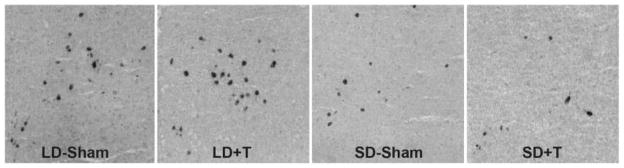
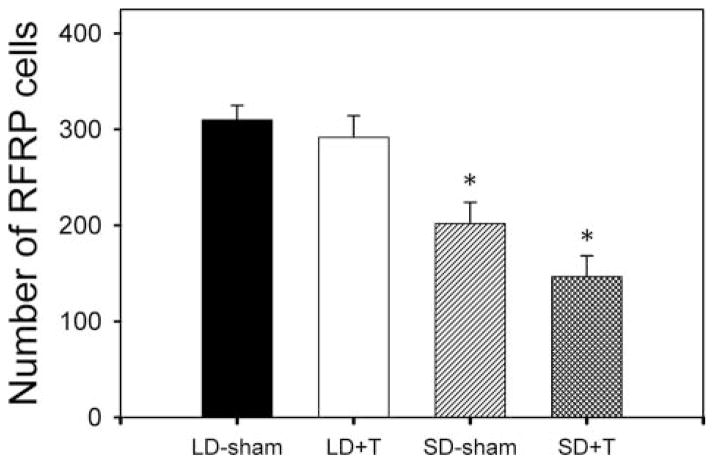
To conserve scarce energetic resources during winter, seasonal breeders inhibit reproduction and other nonessential behavioral and physiological processes. Reproductive cessation is initiated in response to declining day lengths, a stimulus represented centrally as a long-duration melatonin signal. The melatonin signal is not decoded by the reproductive axis directly, but by an unidentified neurochemical system upstream of gonadotropin-releasing hormone (GnRH). The dorsomedial nucleus of the hypothalamus (DMH) has been implicated in seasonal changes in reproductive function in Syrian hamsters (Mesocricetus auratus), although the specific-cell phenotype decoding photoperiodic information remains unknown. RFamide-related peptide (RFRP; the mammalian homolog of the gonadotropin-inhibitory hormone (GnIH) gene identified in birds) has emerged as a potent inhibitory regulator of the reproductive axis and, significantly, its expression is localized to cell bodies of the DMH in rodents. In the present study, the authors explored the relationship between RFRP expression, photoperiod exposure, and reproductive condition/hormonal status. In male hamsters that respond to short days with reproductive inhibition, RFRP-ir and mRNA expression are markedly reduced relative to long-day animals. Replacement of testosterone in short-day animals did not affect this response, suggesting that alterations in RFRP expression are not a result of changing sex steroid concentrations. A subset of the hamster population that ignores day length cues and remains reproductively competent in short days (nonresponders) exhibits RFRP-ir expression comparable to long-day hamsters. Analysis of cell body and fiber density suggests a potential interplay between peptide production and release rate in differentially regulating the reproductive axis during early and late stages of reproductive regression. Together, the present findings indicate that photoperiod-induced suppression of reproduction is associated with changes in RFRP and mRNA expression, providing opportunity for further exploration on the role that RFRP plays in this process.
Conflict of interest statement
The authors have no conflicts of interest that could be perceived as prejudicing the impartiality of the research reported.
Figures
References
-
- Anderson GM, Relf HL, Rizwan MZ, Evans JJ. Central and peripheral effects of RFamide-related peptide-3 on luteinizing hormone and prolactin secretion in rats. Endocrinology. 2009;150:1834–40. - PubMed
-
- Bartness TJ, Powers JB, Hastings MH, Bittman EL, Goldman BD. The timed infusion paradigm for melatonin delivery: what has it taught us about the melatonin signal, its reception, and the photoperiodic control of seasonal responses? J Pineal Res. 1993;15:161–190. - PubMed
-
- Bentley GE, Perfito N, Ukena K, Tsutsui K, Wingfield JC. Gonadotropin-inhibitory peptide in song sparrows (Melospiza melodia) in different reproductive conditions, and in house sparrows (Passer domesticus) relative to chicken-gonadotropin-releasing hormone. J Neuroendocrinol. 2003;15:794–802. - PubMed
-
- Bittman EL, Tubbiola ML, Foltz G, Hegarty CM. Effects of photoperiod and androgen on proopiomelanocortin gene expression in the arcuate nucleus of golden hamsters. Endocrinology. 1999;140:197–206. - PubMed
-
- Bronson F. Mammalian Reproductive Biology. Chicago: The University of Chicago Press; 1989.
Publication types
MeSH terms
Substances
Grants and funding
LinkOut - more resources
Full Text Sources
