


Evaluation of the overweight/obese child--practical tips for the primary health care provider: recommendations from the Childhood Obesity Task Force of the European Association for the Study of Obesity
- PMID: 20484947
- PMCID: PMC6452124
- DOI: 10.1159/000295112
Evaluation of the overweight/obese child--practical tips for the primary health care provider: recommendations from the Childhood Obesity Task Force of the European Association for the Study of Obesity
Abstract
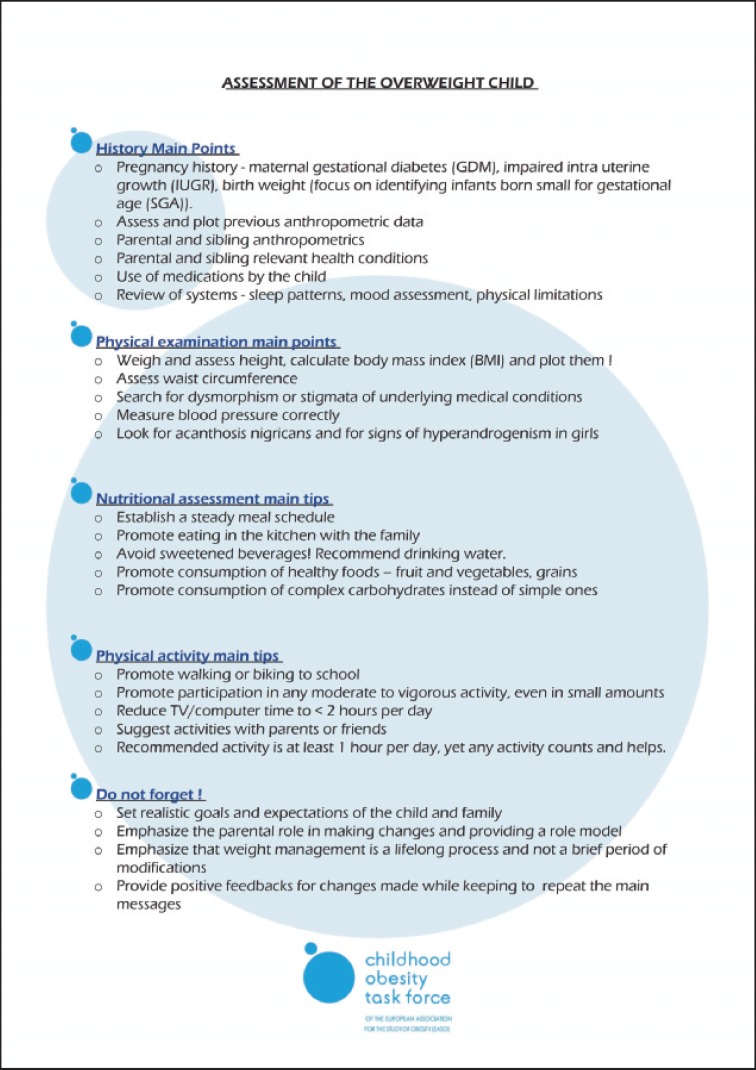
The prevalence of obesity among children and adolescents is on the rise. The majority of overweight or obese children are treated by primary health care providers including paediatricians, family practitioners, dieticians, nurses, and school health services - and not by specialists. The majority of obese children have no underlying medical disorder causing their obesity yet a significant proportion might suffer from obesity-related co-morbidities. This text is aimed at providing simple and practical tools for the identification and management of children with or at risk of overweight and obesity in the primary care setting. The tips and tools provided are based on data from the recent body of work that has been published in this field, official statements of several scientific societies along with expert opinion provided by the members of the Childhood Obesity Task Force (COTF) of the European Association for the Study of Obesity (EASO). We have attempted to use an evidence-based approach while allowing flexibility for the practicing clinician in domains where evidence is currently lacking and ensuring that treating the obese child involves the entire family as well.
Copyright 2010 S. Karger AG, Basel.
Figures
References
-
- Must A, Strauss RS. Risks and consequences of childhood and adolescent obesity. Int J Obes Relat Metab Disord. 1999;23((suppl 2)):S2–S11. - PubMed
-
- Speiser PW, Rudolf MC, Anhalt H, Camacho-Hubner C, Chiarelli F, Eliakim A, Freemark M, Gruters A, Hershkovitz E, Iughetti L, Krude H, Latzer Y, Lustig RH, Pescovitz OH, Pinhas-Hamiel O, Rogol AD, Shalitin S, Sultan C, Stein D, Vardi P, Werther GA, Zadik Z, Zuckerman-Levin N, Hochberg Z. Childhood obesity. J Clin Endocrinol Metab. 2005;90:1871–1887. - PubMed
-
- Barlow SE. Expert committee recommendations regarding the preventionassessment, and treatment of child and adolescent overweight and obesity: Summary report. Pediatrics. 2007;120((suppl 4)):S164–S192. - PubMed
Publication types
MeSH terms
LinkOut - more resources
Full Text Sources
Medical
