


Climate change and the global malaria recession
- PMID: 20485434
- PMCID: PMC2885436
- DOI: 10.1038/nature09098
Climate change and the global malaria recession
Abstract
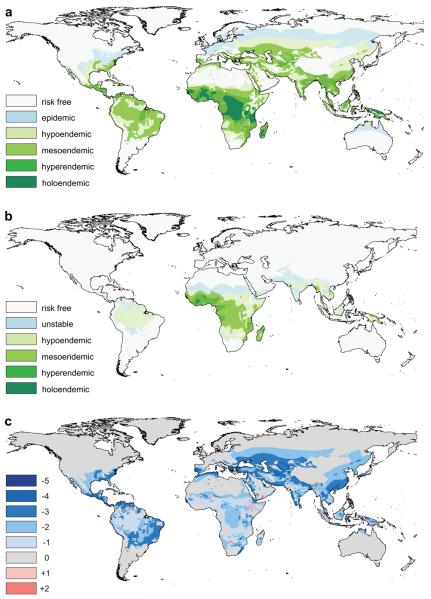
The current and potential future impact of climate change on malaria is of major public health interest. The proposed effects of rising global temperatures on the future spread and intensification of the disease, and on existing malaria morbidity and mortality rates, substantively influence global health policy. The contemporary spatial limits of Plasmodium falciparum malaria and its endemicity within this range, when compared with comparable historical maps, offer unique insights into the changing global epidemiology of malaria over the last century. It has long been known that the range of malaria has contracted through a century of economic development and disease control. Here, for the first time, we quantify this contraction and the global decreases in malaria endemicity since approximately 1900. We compare the magnitude of these changes to the size of effects on malaria endemicity proposed under future climate scenarios and associated with widely used public health interventions. Our findings have two key and often ignored implications with respect to climate change and malaria. First, widespread claims that rising mean temperatures have already led to increases in worldwide malaria morbidity and mortality are largely at odds with observed decreasing global trends in both its endemicity and geographic extent. Second, the proposed future effects of rising temperatures on endemicity are at least one order of magnitude smaller than changes observed since about 1900 and up to two orders of magnitude smaller than those that can be achieved by the effective scale-up of key control measures. Predictions of an intensification of malaria in a warmer world, based on extrapolated empirical relationships or biological mechanisms, must be set against a context of a century of warming that has seen marked global declines in the disease and a substantial weakening of the global correlation between malaria endemicity and climate.
Figures
References
-
- Patz JA, Campbell-Lendrum D, Holloway T, Foley JA. Impact of regional climate change on human health. Nature. 2005;438:310–317. - PubMed
-
- Lafferty KD. The ecology of climate change and infectious diseases. Ecology. 2009;90:888–900. - PubMed
-
- McMichael AJ, et al. Global climate change. In: Ezzati M, Lopez A, Murray C, editors. Comparative Quantification of Health Risks: Global and Regional Burden of Disease due to Selected Major Risk Factors. World Health Organization; Geneva, Switzerland: 2004. pp. 1543–1649.
-
- Tanser FC, Sharp B, Le Sueur D. Potential effect of climate change on malaria transmission in Africa. Lancet. 2003;362:1792–1798. - PubMed
-
- van Lieshout M, Kovats RS, Livermore MTJ, Martens P. Climate change and malaria: analysis of the SRES climate and socio-economic scenarios. Global Environ. Chang. 2004;14:87–99.
Publication types
MeSH terms
Grants and funding
LinkOut - more resources
Full Text Sources
Other Literature Sources
Medical
