


Perception of shadows in children with autism spectrum disorders
- PMID: 20485498
- PMCID: PMC2868020
- DOI: 10.1371/journal.pone.0010582
Perception of shadows in children with autism spectrum disorders
Abstract
Background: Cast shadows in visual scenes can have profound effects on visual perception. Much as they are informative, they also constitute noise as they are salient features of the visual scene potentially interfering with the processing of other features. Here we asked i) whether individuals with autism can exploit the information conveyed by cast shadows; ii) whether they are especially sensitive to noise aspects of shadows.
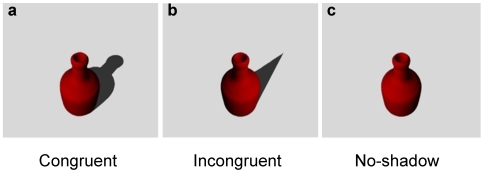
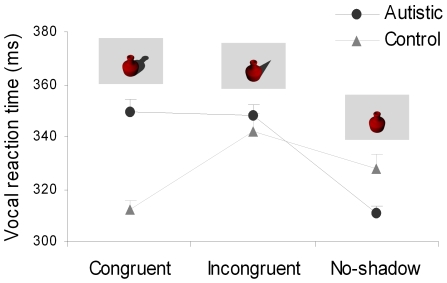
Methodology/principal findings: Twenty high-functioning children with autism and twenty typically developing children were asked to recognize familiar objects while the presence, position, and shape of the cast shadow were systematically manipulated. Analysis of vocal reaction time revealed that whereas typically developing children used information from cast shadows to improve object recognition, in autistic children the presence of cast shadows--either congruent or incongruent--interfered with object recognition. Critically, vocal reaction times were faster when the object was presented without a cast shadow.
Conclusions/significance: We conclude that shadow-processing mechanisms are abnormal in autism. As a result, processing shadows becomes costly and cast shadows interfere rather than help object recognition.
Conflict of interest statement
Figures
References
-
- Mamassian P, Knill DC, Kersten D. The perception of cast shadows. Trends Cogn Sci. 1998;2:32–46. - PubMed
-
- Kersten D, Knill DC, Mamassian P, Bulthoff I. Illusory motion from shadows. Nature. 1996;379:31. - PubMed
-
- Castiello U. Implicit processing of shadows. Vision Res. 2001;41:2305–2309. - PubMed
-
- Casati R. The copycat solution to the shadow correspondence problem. Perception. 2008;37:495–503. - PubMed
-
- Mamassian P. Impossible shadows and the shadow correspondence problem. Perception. 2004;33:1279–1290. - PubMed
Publication types
MeSH terms
LinkOut - more resources
Full Text Sources
Research Materials
Miscellaneous
