Common genetic variants near the Brittle Cornea Syndrome locus ZNF469 influence the blinding disease risk factor central corneal thickness
- PMID: 20485516
- PMCID: PMC2869325
- DOI: 10.1371/journal.pgen.1000947
Common genetic variants near the Brittle Cornea Syndrome locus ZNF469 influence the blinding disease risk factor central corneal thickness
Abstract
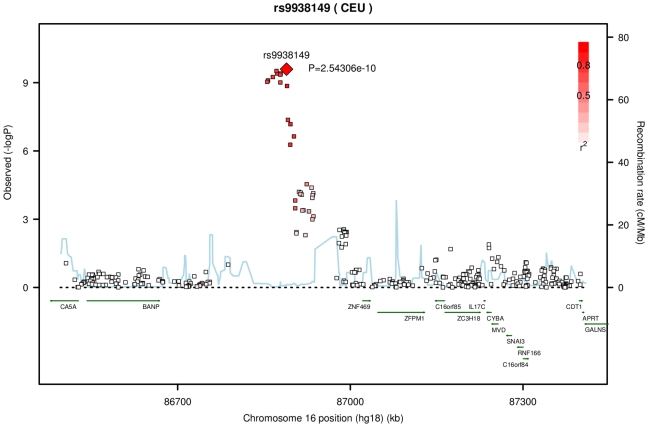
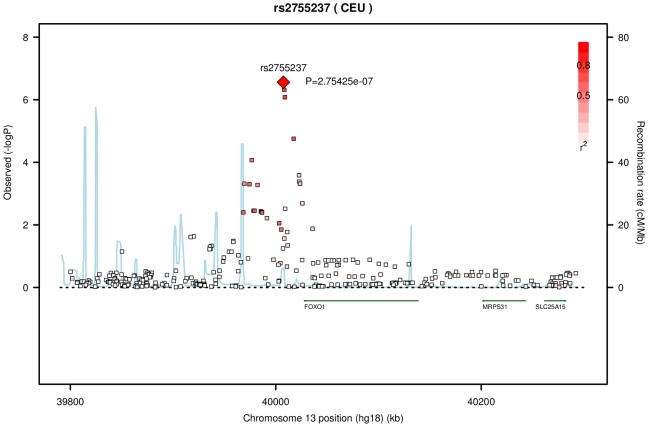
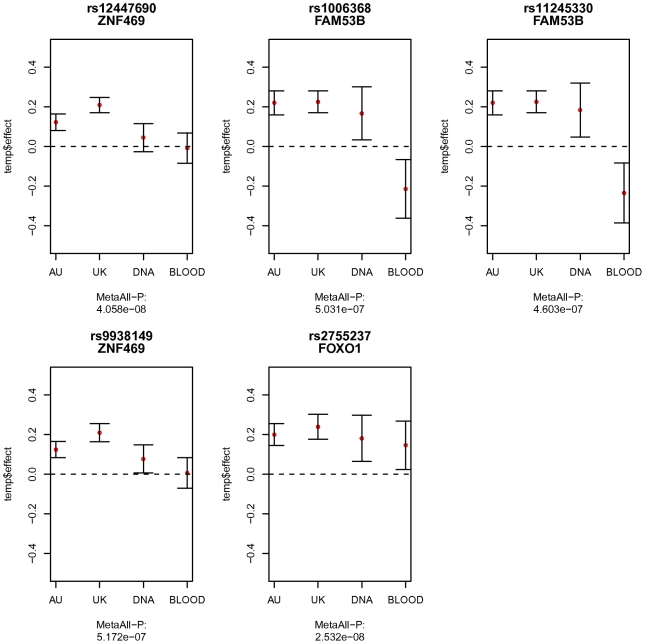
Central corneal thickness (CCT), one of the most highly heritable human traits (h(2) typically>0.9), is important for the diagnosis of glaucoma and a potential risk factor for glaucoma susceptibility. We conducted genome-wide association studies in five cohorts from Australia and the United Kingdom (total N = 5058). Three cohorts were based on individually genotyped twin collections, with the remaining two cohorts genotyped on pooled samples from singletons with extreme trait values. The pooled sample findings were validated by individual genotyping the pooled samples together with additional samples also within extreme quantiles. We describe methods for efficient combined analysis of the results from these different study designs. We have identified and replicated quantitative trait loci on chromosomes 13 and 16 for association with CCT. The locus on chromosome 13 (nearest gene FOXO1) had an overall meta-analysis p-value for all the individually genotyped samples of 4.6x10(-10). The locus on chromosome 16 was associated with CCT with p = 8.95x10(-11). The nearest gene to the associated chromosome 16 SNPs was ZNF469, a locus recently implicated in Brittle Cornea Syndrome (BCS), a very rare disorder characterized by abnormal thin corneas. Our findings suggest that in addition to rare variants in ZNF469 underlying CCT variation in BCS patients, more common variants near this gene may contribute to CCT variation in the general population.
Conflict of interest statement
The authors have declared that no competing interests exist.
Figures
References
-
- Miglior S, Torri V, Zeyen T, Pfeiffer N, Vaz JC, et al. Intercurrent factors associated with the development of open-angle glaucoma in the European glaucoma prevention study. Am J Ophthalmol. 2007;144:266–275. - PubMed
-
- Gordon MO, Beiser JA, Brandt JD, Heuer DK, Higginbotham EJ, et al. The Ocular Hypertension Treatment Study: baseline factors that predict the onset of primary open-angle glaucoma. Arch Ophthalmol. 2002;120:714–720; discussion 829–730. - PubMed
-
- Leske MC, Heijl A, Hyman L, Bengtsson B, Dong L, et al. Predictors of long-term progression in the early manifest glaucoma trial. Ophthalmology. 2007;114:1965–1972. - PubMed
-
- Dimasi DP, Burdon KP, Craig JE. The genetics of central corneal thickness. Br J Ophthalmol 2009 - PubMed
Publication types
MeSH terms
Grants and funding
LinkOut - more resources
Full Text Sources
Medical
Research Materials
Miscellaneous