


Genetic epidemiology of attention deficit hyperactivity disorder (ADHD index) in adults
- PMID: 20485550
- PMCID: PMC2868902
- DOI: 10.1371/journal.pone.0010621
Genetic epidemiology of attention deficit hyperactivity disorder (ADHD index) in adults
Abstract
Context: In contrast to the large number of studies in children, there is little information on the contribution of genetic factors to Attention Deficit Hyperactivity Disorder (ADHD) in adults.
Objective: To estimate the heritability of ADHD in adults as assessed by the ADHD index scored from the CAARS (Conners' Adult ADHD Rating Scales).
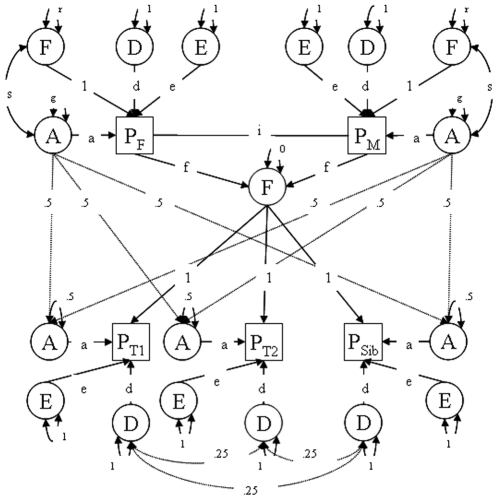
Design: Phenotype data from over 12,000 adults (twins, siblings and parents) registered with the Netherlands Twin Register were analyzed using genetic structural equation modeling.
Main outcome measures: Heritability estimates for ADHD from the twin-family study.
Results: Heritability of ADHD in adults is estimated around 30% in men and women. There is some evidence for assortative mating. All familial transmission is explained by genetic inheritance, there is no support for the hypothesis that cultural transmission from parents to offspring is important.
Conclusion: Heritability for ADHD features in adults is present, but is substantially lower than it is in children.
Conflict of interest statement
Figures
References
-
- Faraone SV, Doyle AE. The nature and heritability of attention-deficit/hyperactivity disorder. Child Adolesc Psychiatr Clin N Am. 2001;10:viii–ix. - PubMed
-
- Derks EM, Hudizak JJ, Boomsma DI. Genetics of ADHD, Hyperactivity, and Attention Problems. In: Kim Y-K, editor. Handbook of Behavior Genetics. New York: Springer; 2009. pp. 361–378.
Publication types
MeSH terms
LinkOut - more resources
Full Text Sources
Medical
