A model for genetic and epigenetic regulatory networks identifies rare pathways for transcription factor induced pluripotency
- PMID: 20485562
- PMCID: PMC2869311
- DOI: 10.1371/journal.pcbi.1000785
A model for genetic and epigenetic regulatory networks identifies rare pathways for transcription factor induced pluripotency
Abstract
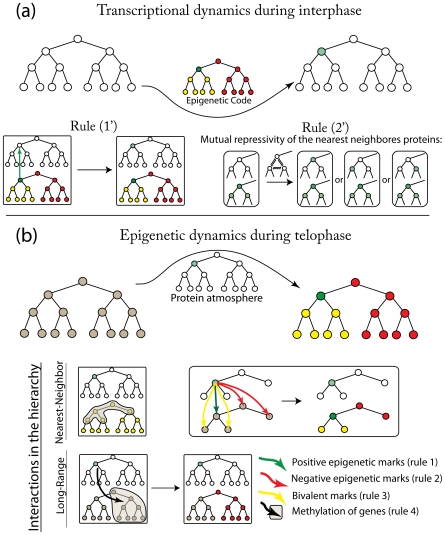
With relatively low efficiency, differentiated cells can be reprogrammed to a pluripotent state by ectopic expression of a few transcription factors. An understanding of the mechanisms that underlie data emerging from such experiments can help design optimal strategies for creating pluripotent cells for patient-specific regenerative medicine. We have developed a computational model for the architecture of the epigenetic and genetic regulatory networks which describes transformations resulting from expression of reprogramming factors. Importantly, our studies identify the rare temporal pathways that result in induced pluripotent cells. Further experimental tests of predictions emerging from our model should lead to fundamental advances in our understanding of how cellular identity is maintained and transformed.
Conflict of interest statement
The authors have declared that no competing interests exist.
Figures




References
-
- Aoi T, Yae K, Nakagawa M, Ichisaka T, Okita K, et al. Generation of pluripotent stem cells from adult mouse liver and stomach cells. Science. 2008;321:699–702. - PubMed
-
- Meissner A, Wernig M, Jaenisch R. Direct reprogramming of genetically unmodified fibroblasts into pluripotent stem cells. Nat Biotechnol. 2007;25:1177–1181. - PubMed
-
- Park IH, Zhao R, West JA, Yabuuchi A, Huo HG, et al. Reprogramming of human somatic cells to pluripotency with defined factors. Nature. 2008;451:141–U141. - PubMed
-
- Takahashi K, Tanabe K, Ohnuki M, Narita M, Ichisaka T, et al. Induction of pluripotent stem cells from adult human fibroblasts by defined factors. Cell. 2007;131:861–872. - PubMed
Publication types
MeSH terms
Substances
LinkOut - more resources
Full Text Sources
Other Literature Sources