


Transcription factors Mat2 and Znf2 operate cellular circuits orchestrating opposite- and same-sex mating in Cryptococcus neoformans
- PMID: 20485569
- PMCID: PMC2869318
- DOI: 10.1371/journal.pgen.1000953
Transcription factors Mat2 and Znf2 operate cellular circuits orchestrating opposite- and same-sex mating in Cryptococcus neoformans
Abstract
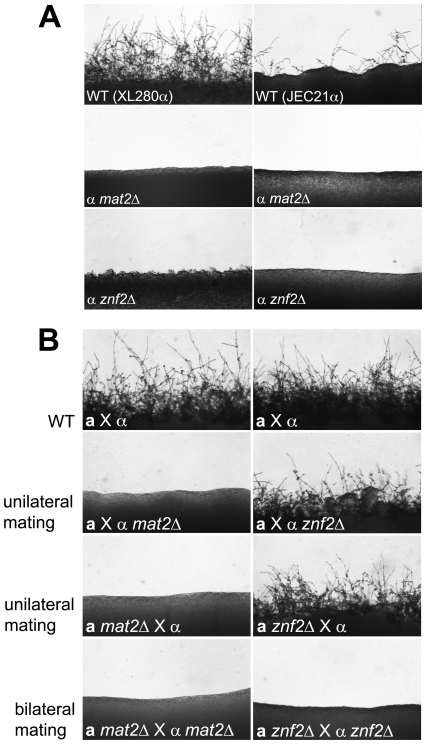
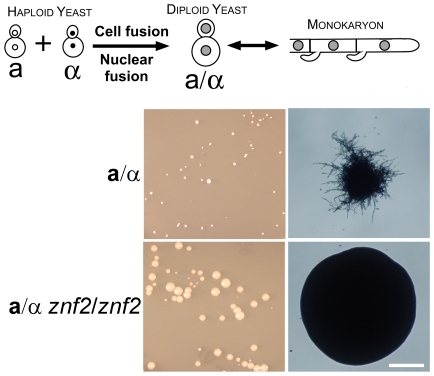
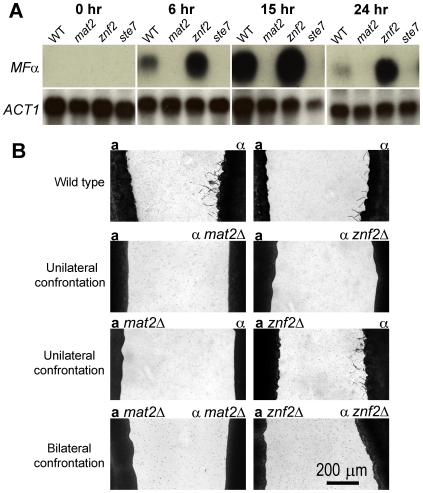
Cryptococcus neoformans is a human fungal pathogen that undergoes a dimorphic transition from a unicellular yeast to multicellular hyphae during opposite sex (mating) and unisexual reproduction (same-sex mating). Opposite- and same-sex mating are induced by similar environmental conditions and involve many shared components, including the conserved pheromone sensing Cpk1 MAPK signal transduction cascade that governs the dimorphic switch in C. neoformans. However, the homeodomain cell identity proteins Sxi1alpha/Sxi2a encoded by the mating type locus that are essential for completion of sexual reproduction following cell-cell fusion during opposite-sex mating are dispensable for same-sex mating. Therefore, identification of downstream targets of the Cpk1 MAPK pathway holds the key to understanding molecular mechanisms governing the two distinct developmental fates. Thus far, homology-based approaches failed to identify downstream transcription factors which may therefore be species-specific. Here, we applied insertional mutagenesis via Agrobacterium-mediated transformation and transcription analysis using whole genome microarrays to identify factors involved in C. neoformans differentiation. Two transcription factors, Mat2 and Znf2, were identified as key regulators of hyphal growth during same- and opposite-sex mating. Mat2 is an HMG domain factor, and Znf2 is a zinc finger protein; neither is encoded by the mating type locus. Genetic, phenotypic, and transcriptional analyses of Mat2 and Znf2 provide evidence that Mat2 is a downstream transcription factor of the Cpk1 MAPK pathway whereas Znf2 functions as a more terminal hyphal morphogenesis determinant. Although the components of the MAPK pathway including Mat2 are not required for virulence in animal models, Znf2, as a hyphal morphology determinant, is a negative regulator of virulence. Further characterization of these elements and their target circuits will reveal genes controlling biological processes central to fungal development and virulence.
Conflict of interest statement
The authors have declared that no competing interests exist.
Figures


References
-
- Dohlman HG, Slessareva JE. Pheromone signaling pathways in yeast. Sci STKE. 2006;2006:cm6. - PubMed
-
- Schwartz MA, Madhani HD. Principles of MAP kinase signaling specificity in Saccharomyces cerevisiae. Annu Rev Genet. 2004;38:725–748. - PubMed
-
- Davidson RC, Nichols CB, Cox GM, Perfect JR, Heitman J. A MAP kinase cascade composed of cell type specific and non-specific elements controls mating and differentiation of the fungal pathogen Cryptococcus neoformans. Mol Microbiol. 2003;49:469–485. - PubMed
-
- Bardwell L, Cook JG, Inouye CJ, Thorner J. Signal propagation and regulation in the mating pheromone response pathway of the yeast Saccharomyces cerevisiae. Dev Biol. 1994;166:363–379. - PubMed
Publication types
MeSH terms
Substances
Grants and funding
LinkOut - more resources
Full Text Sources
