


The value of ultrasonography in predicting arthritis in auto-antibody positive arthralgia patients: a prospective cohort study
- PMID: 20487531
- PMCID: PMC2911885
- DOI: 10.1186/ar3028
The value of ultrasonography in predicting arthritis in auto-antibody positive arthralgia patients: a prospective cohort study
Abstract
Introduction: Ultrasonography (US) has better sensitivity than clinical evaluation for the detection of synovitis in early rheumatoid arthritis (RA). Patients presenting with arthralgia and a positive anti-citrullinated protein antibodies (ACPA) and/or Rheumatoid Factor (IgM-RF) status are at risk for developing RA. In the present study, US utility and predictive properties in arthralgia patients at risk for the development of arthritis were studied.
Methods: 192 arthralgia patients with ACPA and/or IgM-RF were included. Absence of clinical arthritis was confirmed by two physicians. US was performed by one of two trained radiologists of any painful joint, and of adjacent and contralateral joints. Joint effusion, synovitis and power Doppler (PD) signal in the synovial membrane of the joints and tenosynovitis adjacent to the joint were evaluated and classified on a 4-grade semi-quantitative scale. Grade 2-3 joint effusion, synovitis, tenosynovitis and grade 1-3 Power Doppler signal were classified as abnormal.
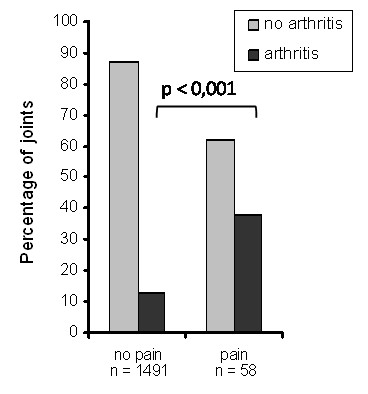
Results: Forty-five patients (23%) developed arthritis after a mean of 11 months. Inter-observer reliability for synovitis and PD was moderate (kappa 0.46, and 0.56, respectively) and for joint effusion low (kappa 0.23). The prevalence of tenosynovitis was too low to calculate representative kappa values. At joint level, a significant association was found between US abnormalities and arthritis development in that joint for joint effusion, synovitis and PD. At patient level, a trend was seen towards more arthritis development in patients who had US abnormalities for joint effusion, synovitis, PD and tenosynovitis.
Conclusions: US abnormalities were associated with arthritis development at joint level, although this association did not reach statistical significance at patient level. US could potentially be used as a diagnostic tool for subclinical arthritis in seropositive arthralgia patients. However, further research is necessary to improve test characteristics.
Figures
References
-
- Nielen MM, van SD, Reesink HW, Stadt RJ van de, Horst-Bruinsma IE van der, de Koning MH, Habibuw MR, Vandenbroucke JP, Dijkmans BA. Specific autoantibodies precede the symptoms of rheumatoid arthritis: a study of serial measurements in blood donors. Arthritis Rheum. 2004;50:380–386. doi: 10.1002/art.20018. - DOI - PubMed
-
- Rantapaa-Dahlqvist S, de Jong BA, Berglin E, Hallmans G, Wadell G, Stenlund H, Sundin U, van Venrooij WJ. Antibodies against cyclic citrullinated peptide and IgA rheumatoid factor predict the development of rheumatoid arthritis. Arthritis Rheum. 2003;48:2741–2749. doi: 10.1002/art.11223. - DOI - PubMed
-
- Bos WH, Wolbink GJ, Boers M, Tijhuis GJ, de Vries N, Horst-Bruinsma IE van der, Tak PP, van de SR, Laken CJ van der, Dijkmans BA, van Schaardenburg D. Arthritis development in arthralgia patients is strongly associated with anti-citrullinated protein antibody status: a prospective cohort study. Ann Rheum Dis. 2010;69:490–494. doi: 10.1136/ard.2008.105759. - DOI - PubMed
-
- Salaffi F, Filippucci E, Carotti M, Naredo E, Meenagh G, Ciapetti A, Savic V, Grassi W. Inter-observer agreement of standard joint counts in early rheumatoid arthritis: a comparison with grey scale ultrasonography--a preliminary study. Rheumatology (Oxford) 2008;47:54–58. doi: 10.1093/rheumatology/kem286. - DOI - PubMed
Publication types
MeSH terms
Substances
LinkOut - more resources
Full Text Sources
Medical
