. 2010 May 20:9:115.
doi: 10.1186/1476-4598-9-115.

Determination of genes and microRNAs involved in the resistance to fludarabine in vivo in chronic lymphocytic leukemia

Affiliations

Determination of genes and microRNAs involved in the resistance to fludarabine in vivo in chronic lymphocytic leukemia

Etienne Moussay et al. Mol Cancer. .

Abstract

Background: Chronic lymphocytic leukemia (CLL) cells are often affected by genomic aberrations targeting key regulatory genes. Although fludarabine is the standard first line therapy to treat CLL, only few data are available about the resistance of B cells to this purine nucleoside analog in vivo. Here we sought to increase our understanding of fludarabine action and describe the mechanisms leading to resistance in vivo. We performed an analysis of genomic aberrations, gene expression profiles, and microRNAs expression in CLL blood B lymphocytes isolated during the course of patients' treatment with fludarabine.

Results: In sensitive patients, the differentially expressed genes we identified were mainly involved in p53 signaling, DNA damage response, cell cycle and cell death. In resistant patients, uncommon genomic abnormalities were observed and the resistance toward fludarabine could be characterized based on the expression profiles of genes implicated in lymphocyte proliferation, DNA repair, and cell growth and survival. Of particular interest in some patients was the amplification of MYC (8q) observed both at the gene and transcript levels, together with alterations of myc-transcriptional targets, including genes and miRNAs involved in the regulation of cell cycle and proliferation. Differential expression of the sulfatase SULF2 and of miR-29a, -181a, and -221 was also observed between resistant and sensitive patients before treatment. These observations were further confirmed on a validation cohort of CLL patients treated with fludarabine in vitro.

Conclusion: In the present study we identified genes and miRNAs that may predict clinical resistance of CLL to fludarabine, and describe an interesting oncogenic mechanism in CLL patients resistant to fludarabine by which the complete MYC-specific regulatory network was altered (DNA and RNA levels, and transcriptional targets). These results should prove useful for understanding and overcoming refractoriness to fludarabine and also for predicting the clinical outcome of CLL patients before or early during their treatment.


Figures
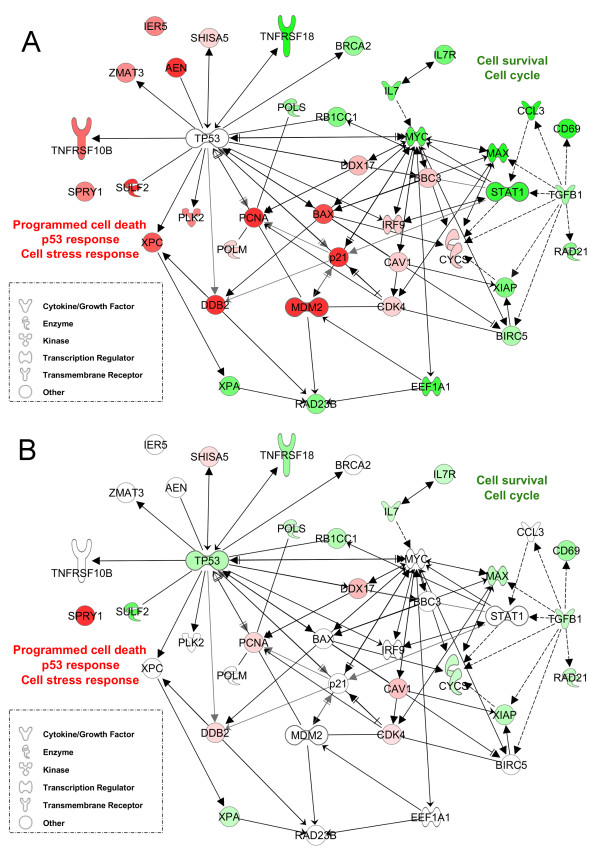
Figure 1
Figure 1
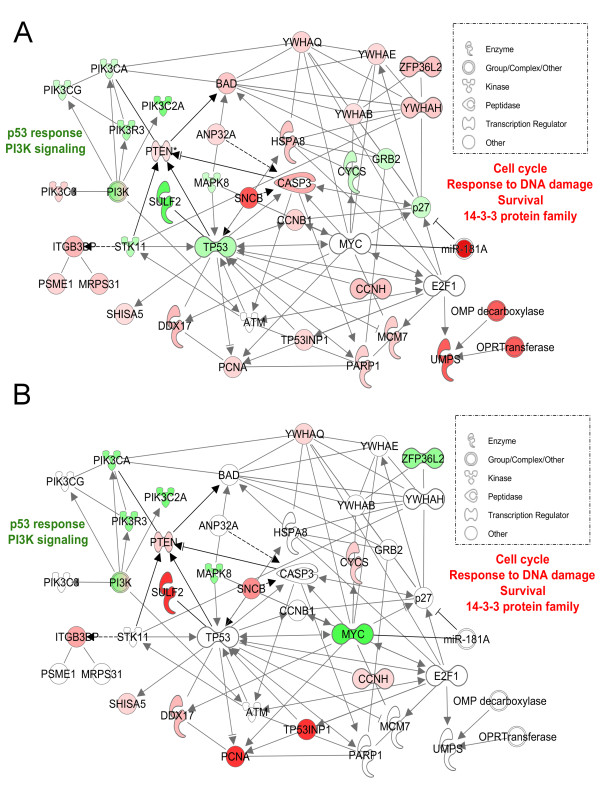
Molecular interaction network of fludarabine-regulated genes in cells of sensitive CLL patients in vivo. A group of genes highly regulated by fludarabine in sensitive patients (following a 24h exposure in vivo) was clustered in a network around the transcription regulators TP53 and MYC using the Ingenuity Pathway Analysis software (IPA 8.0, database Nov 2009). A, Gene expression values obtained from sensitive patients were overlaid on the network. B. Gene expression values obtained from resistant patients were overlaid on the network.
Figure 2
Figure 2
Molecular interaction network of fludarabine-regulated genes in cells of resistant CLL patients in vivo. A group of genes highly regulated by fludarabine in resistant patients (following a 24h exposure in vivo) was clustered in a network around the transcription regulators TP53 and MYC using the Ingenuity Pathway Analysis software (IPA 8.0, database Nov 2009). A. Gene expression values obtained from resistant patients were overlaid on the network. B. Gene expression values obtained from sensitive patients were overlaid on the network.
Figure 3
Figure 3
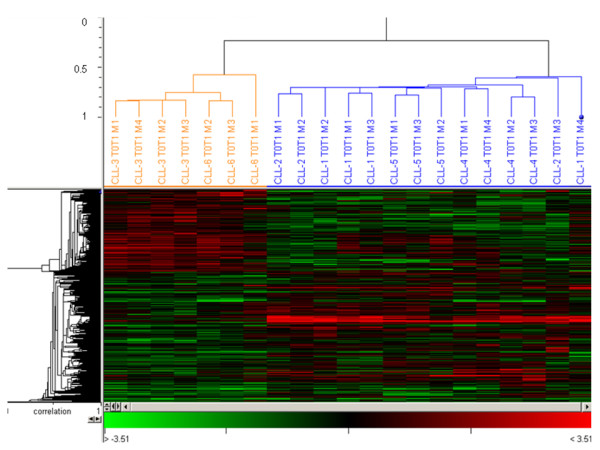
Clusters of differentially expressed genes in CLL B-cells following treatment with fludarabine in vivo. A set of 532 genes were differentially expressed (DE) between CLL B cells of sensitive and resistant patients after 24 hours of treatment. Statistical analysis was performed by SAM 2-class analysis and significant DE genes were clustered using Acuity 4.0 (Pearson hierarchical clustering). Microarray replicates (M1 to M4) from sensitive and resistant patients are depicted in blue and orange, respectively.
Figure 4
Figure 4
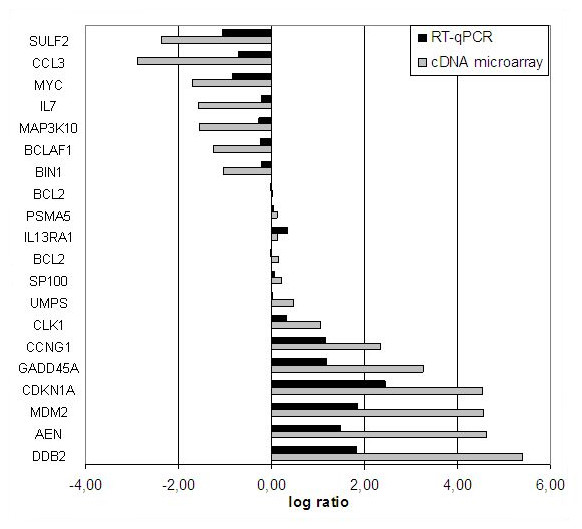
Validation of cDNA microarray gene expression data by RT-qPCR. Twenty differentially regulated genes identified in the microarray analysis were validated in the four CLL cases sensitive to fludarabine by RT-qPCR. B lymphocytes were isolated from blood of patients treated 24h in vivo with fludarabine. Expression levels of the targets were normalized to both housekeeping genes and Ct values obtained before treatment were used as calibrators. See Methods for details.
Figure 5
Figure 5
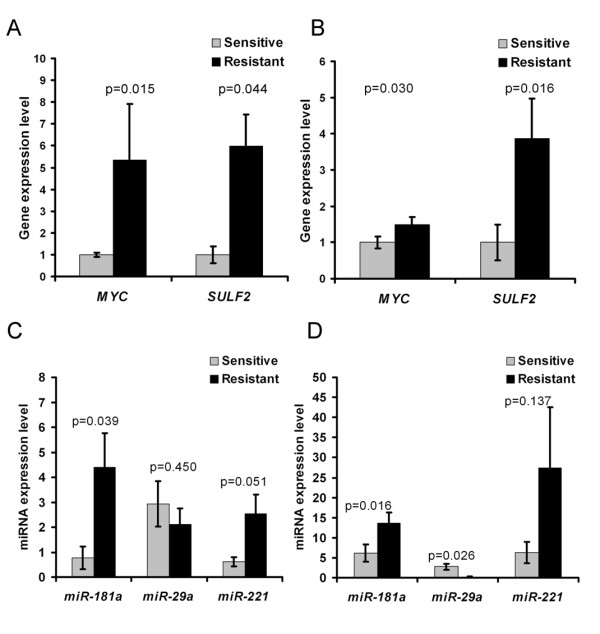
Relationship between gene expression before treatment and sensitivity to fludarabine in CLL patients. Expression levels of the targets were investigated by RT-qPCR and normalized to both housekeeping genes. The average expression level in sensitive patients was used as calibrator. Expression levels presented as mean values ±SEM were investigated on two groups of CLL patients; eighteen patients in vivo (8S and 10R) and twenty-one patients in vitro (16S and 5R). Statistical analysis was performed by 2-sided t-test and levels were considered to be significantly different when p values were lower than 0.05. A and B. The expression of MYC and SULF2 was measured in CLL B cells of patients before their treatment with fludarabine in vivo (A) and in vitro (B). C and D. The expression of miR-29a, miR-181a, and miR-221 was investigated in CLL B cells of patients before their treatment with fludarabine in vivo (C) and in vitro (D).

References

    1. Haferlach C, Dicker F, Schnittger S, Kern W, Haferlach T. Comprehensive genetic characterization of CLL: a study on 506 cases analysed with chromosome banding analysis, interphase FISH, IgV(H) status and immunophenotyping. Leukemia. 2007;21:2442–2451. doi: 10.1038/sj.leu.2404935. - DOI - PubMed
    1. Pettitt AR, Clarke AR, Cawley JC, Griffiths SD. Purine analogues kill resting lymphocytes by p53-dependent and -independent mechanisms. Br J Haematol. 1999;105:986–988. doi: 10.1046/j.1365-2141.1999.01448.x. - DOI - PubMed
    1. Parker WB, Bapat AR, Shen JX, Townsend AJ, Cheng YC. Interaction of 2-halogenated dATP analogs (F, Cl, and Br) with human DNA polymerases, DNA primase, and ribonucleotide reductase. Mol Pharmacol. 1988;34:485–491. - PubMed
    1. Genini D, Adachi S, Chao Q, Rose DW, Carrera CJ, Cottam HB, Carson DA, Leoni LM. Deoxyadenosine analogs induce programmed cell death in chronic lymphocytic leukemia cells by damaging the DNA and by directly affecting the mitochondria. Blood. 2000;96:3537–3543. - PubMed
    1. Sandoval A, Consoli U, Plunkett W. Fludarabine-mediated inhibition of nucleotide excision repair induces apoptosis in quiescent human lymphocytes. Clin Cancer Res. 1996;2:1731–1741. - PubMed

Publication types

MeSH terms