


Rapid identification of chloroquine and atovaquone drug resistance in Plasmodium falciparum using high-resolution melt polymerase chain reaction
- PMID: 20487570
- PMCID: PMC2881075
- DOI: 10.1186/1475-2875-9-134
Rapid identification of chloroquine and atovaquone drug resistance in Plasmodium falciparum using high-resolution melt polymerase chain reaction
Abstract
Background: Drug resistance determination for Plasmodium falciparum infections are important to determining the type of treatment to be given. Besides in vivo experiments, molecular methods, such as sequencing and PCR, are now increasingly being used. Here a cheaper alternative to sequencing or the use of multiplex 5'nuclease PCR assay for detection and differentiation of drug resistance haplotypes for chloroquine and atovaquone using polymerase chain reaction-high resolution melt (PCR-HRM) is reported.
Methods: Separate PCR-HRM assays were designed for the detection and differentiation of chloroquine and atovaquone drug resistance haplotypes in P. falciparum. PCR was conducted on a thermal cycler and melt curves generated using a LightScanner. These were tested against reference strains of P. falciparum from MR4 as well as 53 local isolates.
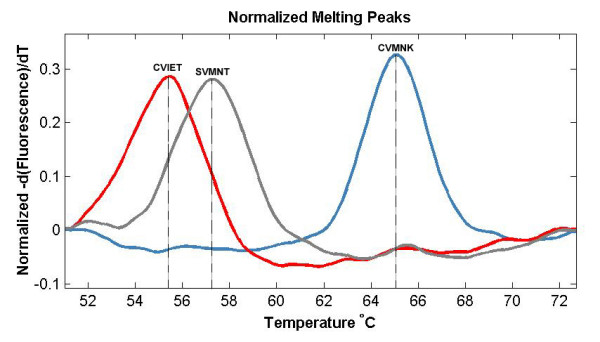
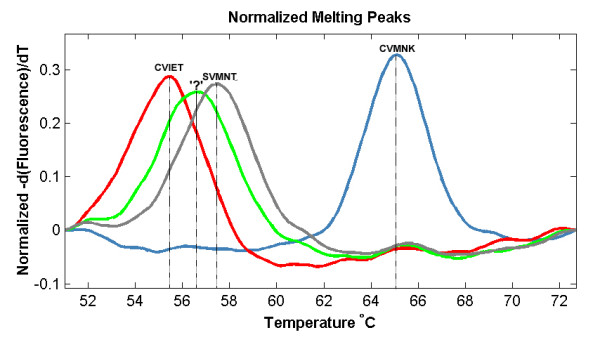
Results: The PCR-HRM assays are able to detect and differentiate between the various haplotypes consistently. These assays can also be used to detect new variants.
Conclusions: PCR-HRM is an inexpensive option for the determination of drug resistance profile in P. falciparum and will see increasing use as an alternative to sequencing and 5'nuclease PCR assays in reference laboratories or once PCR systems that are able to conduct HRM become commonplace.
Figures
References
-
- Korsinczky M, Chen N, Kotecka B, Saul A, Rieckmann K, Cheng Q. Mutations in Plasmodium falciparum cytochrome b that are associated with atovaquone resistance are located at a putative drug-binding site. Antimicrob Agents Chemother. 2000;44:2100–2108. doi: 10.1128/AAC.44.8.2100-2108.2000. - DOI - PMC - PubMed
-
- Schwöbel B, Alifrangis M, Salanti A, Jelinek T. Different mutation patterns of atovaquone resistance to Plasmodium falciparum in vitro and in vivo: rapid detection of codon 268 polymorphisms in the cytochrome b as potential in vivo resistance marker. Malar J. 2003;2:5. doi: 10.1186/1475-2875-2-5. - DOI - PMC - PubMed
-
- Sutherland CJ, Laundy M, Price N, Burke M, Fivelman QL, Pasvol G, Klein JL, Chiodini PL. Mutations in the Plasmodium falciparum cytochrome b gene are associated with delayed parasite recrudescence in malaria patients treated with atovaquone-proguanil. Malar J. 2008;7:240. doi: 10.1186/1475-2875-7-240. - DOI - PMC - PubMed
Publication types
MeSH terms
Substances
LinkOut - more resources
Full Text Sources
Other Literature Sources
