


Co-occurrence of victimization from five subtypes of bullying: physical, verbal, social exclusion, spreading rumors, and cyber
- PMID: 20488883
- PMCID: PMC2980945
- DOI: 10.1093/jpepsy/jsq048
Co-occurrence of victimization from five subtypes of bullying: physical, verbal, social exclusion, spreading rumors, and cyber
Abstract
Objective: To examine co-occurrence of five subtypes of peer victimization.
Methods: Data were obtained from a national sample of 7,475 US adolescents in grades 6 through 10 in the 2005/2006 Health Behavior in School-Aged Children (HBSC) study. Latent class analyses (LCA) were conducted on victimization by physical, verbal, social exclusion, spreading rumors, and cyber bullying.
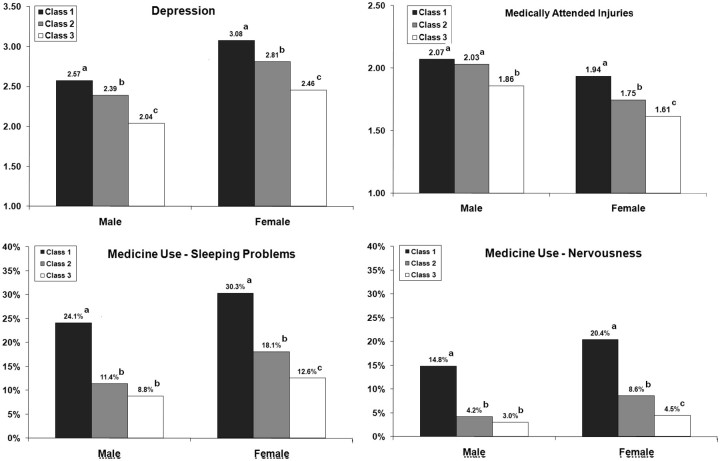
Results: Three latent classes were identified, including an all-types victims class (9.7% of males and 6.2% of females), a verbal/relational victims class (28.1% of males and 35.1% of females), and a nonvictim class (62.2% of males and 58.7% of females). Males were more likely to be all-type victims. There was a graded relationship between the three latent classes and level of depression, frequency of medically attended injuries, and medicine use, especially among females.
Conclusions: Increased co-occurrence of victimization types put adolescents at greater risks for poorer physical and psychological outcomes.
Figures

References
-
- Bjorkqvist K. Sex differences in physical, verbal, and indirect aggression: A review of recent research. Sex Roles. 1994;30:177–188.
-
- Carlyle K E, Steinman K J. Demographic differences in the prevalence, co-occurrence, and correlates of adolescent bullying at school. Journal of School Health. 2007;77:623–629. - PubMed
-
- Crick N R, Grotpeter J K. Relational aggression, gender, and social-psychological adjustment. Child Development. 1995;66:710–722. - PubMed
-
- Currie C, Nic Gabhainn S, Godeau E International HBSC Network Coordinating Committee. The Health Behaviour in School-aged Children: WHO Collaborative Cross-National (HBSC) study: Origins, concept, history and development 1982-2008. International Journal of Public Health. 2009;54:S131–139. - PubMed
-
- Dahlberg L L, Toal S B, Swahn M, Behrens C. Measuring violence-related attitudes, behaviors, and influences among youths: A compendium of assessment tools. Atlanta, GA: The National Center for Injury Prevention and Control; 2005.
Publication types
MeSH terms
Grants and funding
LinkOut - more resources
Full Text Sources
Medical
Research Materials
