. 2010 Jul;20(7):929-37.
doi: 10.1101/gr.102160.109. Epub 2010 May 20.

Genome-wide gene expression regulation as a function of genotype and age in C. elegans

Affiliations

Genome-wide gene expression regulation as a function of genotype and age in C. elegans

Ana Viñuela et al. Genome Res. 2010 Jul.

Abstract

Gene expression becomes more variable with age, and it is widely assumed that this is due to a decrease in expression regulation. But currently there is no understanding how gene expression regulatory patterns progress with age. Here we explored genome-wide gene expression variation and regulatory loci (eQTL) in a population of developing and aging C. elegans recombinant inbred worms. We found almost 900 genes with an eQTL, of which almost half were found to have a genotype-by-age effect ((gxa)eQTL). The total number of eQTL decreased with age, whereas the variation in expression increased. In developing worms, the number of genes with increased expression variation (1282) was similar to the ones with decreased expression variation (1328). In aging worms, the number of genes with increased variation (1772) was nearly five times higher than the number of genes with a decreased expression variation (373). The number of cis-acting eQTL in juveniles decreased by almost 50% in old worms, whereas the number of trans-acting loci decreased by approximately 27%, indicating that cis-regulation becomes relatively less frequent than trans-regulation in aging worms. Of the 373 genes with decreased expression level variation in aging worms, approximately 39% had an eQTL compared with approximately 14% in developing worms. (gxa)eQTL were found for approximately 21% of these genes in aging worms compared with only approximately 6% in developing worms. We highlight three examples of linkages: in young worms (pgp-6), in old worms (daf-16), and throughout life (lips-16). Our findings demonstrate that eQTL patterns are strongly affected by age, and suggest that gene network integrity declines with age.


Figures

Figure 1.
Figure 1.
Heritable transcript-level differences at three different time points. The time points represent juvenile, reproductive and old worms. The upper graphs show the position of the genes with an eQTL (−log10 P > 3.8 ; FDR = 0.01) on the y-axis, and on the x-axis the marker at which the peak of the eQTL was found. (From left to right) Young worms in black, late reproductive worms in green, and old worms in red. The lower graphs show the distribution of eQTL per marker. The height of the bar is the total number of eQTL at that marker; cis-acting eQTLs are indicated in the darker and trans-acting in the lighter color. The constitutive and age specific hotspots can easily be identified by comparing the three panels. Any deleted genes in CB4856 were left out of the analysis. The horizontal yellow lines are the trans-band thresholds to 0.01, as determined by permutation.
Figure 2.
Figure 2.
Gene position (y-axis) plotted against the marker (x-axis) of the peak of the eQTL (P ≤ 0.0001) of genotype-by-age eQTL (gxaeQTL) for that gene. The size of the triangles is relative to the significance of the positive effects of the allele; (red) N2 effect; (blue) CB4856 effect. Chromosomes are separated by the gray dashed lines. Chromosome I is located at the bottom and left of the panels, and chromosome X at the top and right of the panels. (A) Developing worms. (Left) Shows the significant (independent from age) marker (eQTLs) for the developing worms (the juvenile and reproductive worms in one model); (right) shows the significant genotype (marker) by age effects (gxaeQTL) for the developing worms (the juvenile and reproductive worms in one model). (B) Aging worms. (Left) Shows the significant (independent from age) marker (eQTLs) for the aging worms (the reproductive and old worms in one model); (right) shows the significant genotype (marker) by age effects (gxaeQTL) for the aging worms (the reproductive and old worms in one model). Two distinct trans-bands (hotspots) can be observed in the developing eQTLs (upper left) and in the aging gxaeQTLs (lower right), showing that hotspots can be found for genotype-independent eQTLs as well as genotype-by-age interaction gxaeQTLs.
Figure 3.
Figure 3.
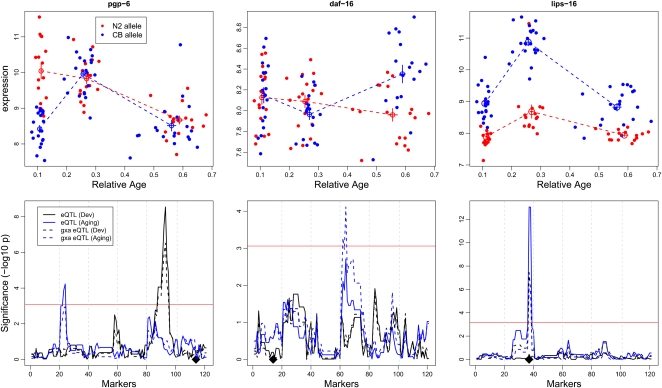
Three gene examples in which gene expression depends on age, genotype, and their interaction. (Upper panel) The relative expression (y-axis) of the N2 allele (red) and the CB4856 allele (blue) of all the RILs at the peak of the major eQTL average and standard errors. Relative age (x-axis) is the time at which the specific RIL was sampled divided by the average age of that RIL. (Lower panels) The eQTL profiles of the different factors affecting gene expression. Gene position indicated by a black diamond. (Black) The eQTL profiles obtained with juvenile/reproductive age groups; (blue) the eQTL profiles found with the reproductive/old age groups. (Solid lines) Independent (from age) genotype effects; (dashed lines) genotype-by-age interaction effects. Chromosomes are separated by vertical dotted lines. (X-axis) Marker positions: (left) chromosome I; (right) chromosome X. (Y-axis) significance level (−log10 P). (Left) pgp-6; (middle) daf-16; (right) lips-16. Thresholds are designated by the red horizontal line.

References

    1. Bahar R, Hartmann CH, Rodriguez KA, Denny AD, Busuttil RA, Dollé MET, Calder RB, Chisholm GB, Pollock BH, Klein CA, et al. 2006. Increased cell-to-cell variation in gene expression in ageing mouse heart. Nature 441: 1011–1014 - PubMed
    1. Brem RB, Yvert G, Clinton R, Kruglyak L 2002. Genetic dissection of transcriptional regulation in budding yeast. Science 296: 752–755 - PubMed
    1. Collins JJ, Huang C, Hughes S, Kornfeld K 2008. The measurement and analysis of age-related changes in Caenorhabditis elegans. In WormBook (ed. The C. elegans Research Community). doi: 10.1895/wormbook.1.137.1 - PMC - PubMed
    1. Dean M, Allikmets R 1995. Evolution of ATP-binding cassette transporter genes. Curr Opin Genet Dev 5: 779–785 - PubMed
    1. de Magalhães JP, Curado J, Church GM 2009. Meta-analysis of age-related gene expression profiles identities common signatures of aging. Bioinformatics 25: 875–881 - PMC - PubMed

Publication types

MeSH terms

Substances

Associated data