Kidney and recipient weight incompatibility reduces long-term graft survival
- PMID: 20488949
- PMCID: PMC2900958
- DOI: 10.1681/ASN.2009121296
Kidney and recipient weight incompatibility reduces long-term graft survival
Abstract
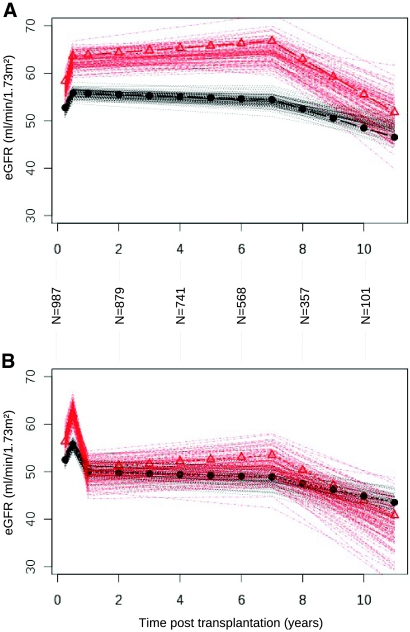
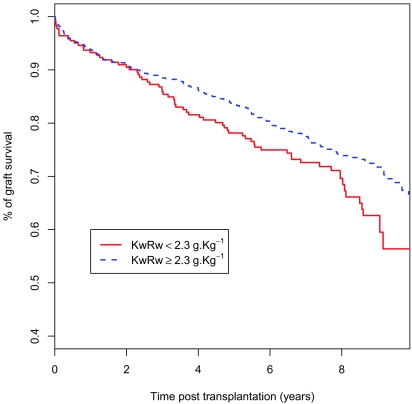
Long-term function of kidney allografts depends on multiple variables, one of which may be the compatibility in size between the graft and the recipient. Here, we assessed the long-term consequences of the ratio of the weight of the kidney to the weight of the recipient (KwRw ratio) in a multicenter cohort of 1189 patients who received a transplant between 1995 and 2006. The graft filtration rate increased by a mean of 5.74 ml/min between the third and sixth posttransplantation months among patients with a low KwRw ratio (<2.3 g/kg; P<0.0001). In this low KwRw ratio group, the graft filtration rate remained stable between 6 months and 7 years but then decreased at a mean rate of 3.17 ml/min per yr (P<0.0001). In addition, low KwRw ratios conferred greater risk for proteinuria, more antihypertensive drugs, and segmental or global glomerulosclerosis. Moreover, a KwRw ratio<2.3 g/kg associated with a 55% increased risk for transplant failure by 2 years of follow-up. In conclusion, incompatibility between graft and recipient weight is an independent predictor of long-term graft survival, suggesting that avoiding kidney and recipient weight incompatibility may improve late clinical outcome after kidney transplantation.
Figures
Comment in
-
Size matters in renal allograft survival.J Am Soc Nephrol. 2010 Jun;21(6):890-1. doi: 10.1681/ASN.2010040380. Epub 2010 May 20. J Am Soc Nephrol. 2010. PMID: 20488950 No abstract available.
-
Transplantation: A low donor kidney weight to recipient weight ratio is associated with decreased long-term graft survival.Nat Rev Nephrol. 2010 Aug;6(8):445. doi: 10.1038/nrneph.2010.89. Nat Rev Nephrol. 2010. PMID: 20690200 No abstract available.
References
-
- Brenner BM: Nephron adaptation to renal injury or ablation. Am J Physiol 249: F324–F337, 1985. - PubMed
-
- Hostetter TH, Olson JL, Rennke HG, Venkatachalam MA, Brenner BM: Hyperfiltration in remnant nephrons: A potentially adverse response to renal ablation. J Am Soc Nephrol 12: 1315–1325, 2001.
-
- Chertow GM, Milford EL, Mackenzie HS, Brenner BM: Antigen-independent determinants of cadaveric kidney transplant failure. JAMA 276: 1732–1736, 1996. - PubMed
-
- Terasaki PI: Deduction of the fraction of immunologic and non-immunologic failure in cadaver donor transplants. Clin Transpl 449–452, 2003. - PubMed
-
- Azuma H, Nadeau K, Mackenzie HS, Brenner BM, Tilney NL: Nephron mass modulates the hemodynamic, cellular, and molecular response of the rat renal allograft. Transplantation 63: 519–528, 1997. - PubMed
Publication types
MeSH terms
LinkOut - more resources
Full Text Sources
Other Literature Sources
Medical