. 2009 Dec;1(1):7-24.
doi: 10.1007/s12566-009-0001-2.

Analysis of Endogenous D-Amino Acid-Containing Peptides in Metazoa

Affiliations

Analysis of Endogenous D-Amino Acid-Containing Peptides in Metazoa

Lu Bai et al. Bioanal Rev. 2009 Dec.

Abstract

Peptides are chiral molecules with their structure determined by the composition and configuration of their amino acid building blocks. The naturally occurring amino acids, except glycine, possess two chiral forms. This allows the formation of multiple peptide diastereomers that have the same sequence. Although living organisms use L-amino acids to make proteins, a group of D-amino acid-containing peptides (DAACPs) has been discovered in animals that have at least one of their residues isomerized to the D-form via an enzyme-catalyzed process. In many cases, the biological functions of these peptides are enhanced due to this structural conversion. These DAACPs are different from those known to occur in bacterial cell wall and antibiotic peptides, the latter of which are synthesized in a ribosome-independent manner. DAACPs have now also been identified in a number of distinct groups throughout the Metazoa. Their serendipitous discovery has often resulted from discrepancies observed in bioassays or in chromatographic behavior between natural peptide fractions and peptides synthesized according to a presumed all-L sequence. Because this L-to-D post-translational modification is subtle and not detectable by most sequence determination approaches, it is reasonable to suspect that many studies have overlooked this change; accordingly, DAACPs may be more prevalent than currently thought. Although diastereomer separation techniques developed with synthetic peptides in recent years have greatly aided in the discovery of natural DAACPs, there is a need for new, more robust methods for naturally complex samples. In this review, a brief history of DAACPs in animals is presented, followed by discussion of a variety of analytical methods that have been used for diastereomeric separation and detection of peptides.


Figures
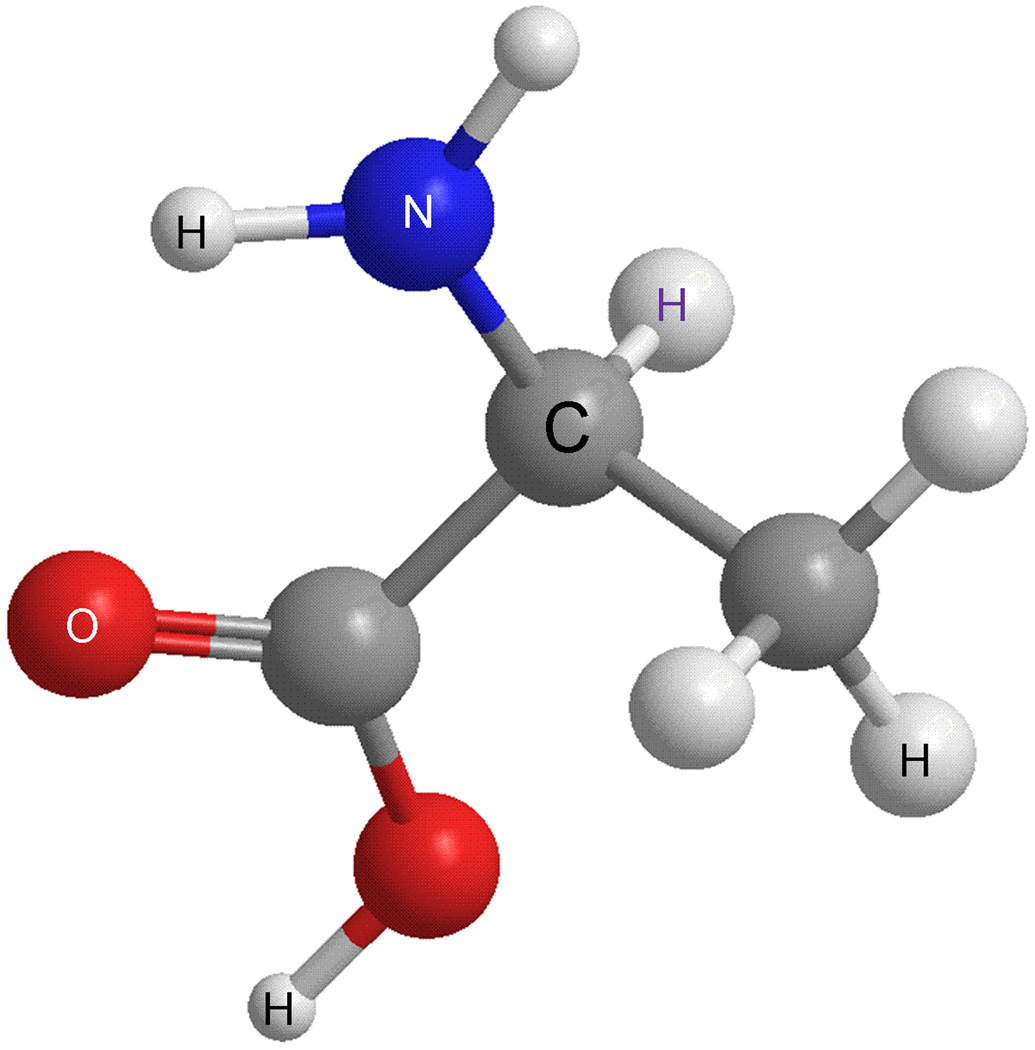
Fig. 1
Fig. 1
Ball-and-stick illustration of an L-amino acid (L-alanine) with -COOH, -NH2 and -R groups arranged clockwise around the carbon chiral center when viewing with -H away from the center. Carbon atoms (grey), nitrogen (blue), hydrogen (white), and oxygen (red). The D-amino acid has the counterclockwise arrangement around the chiral center.
Fig. 2
Fig. 2
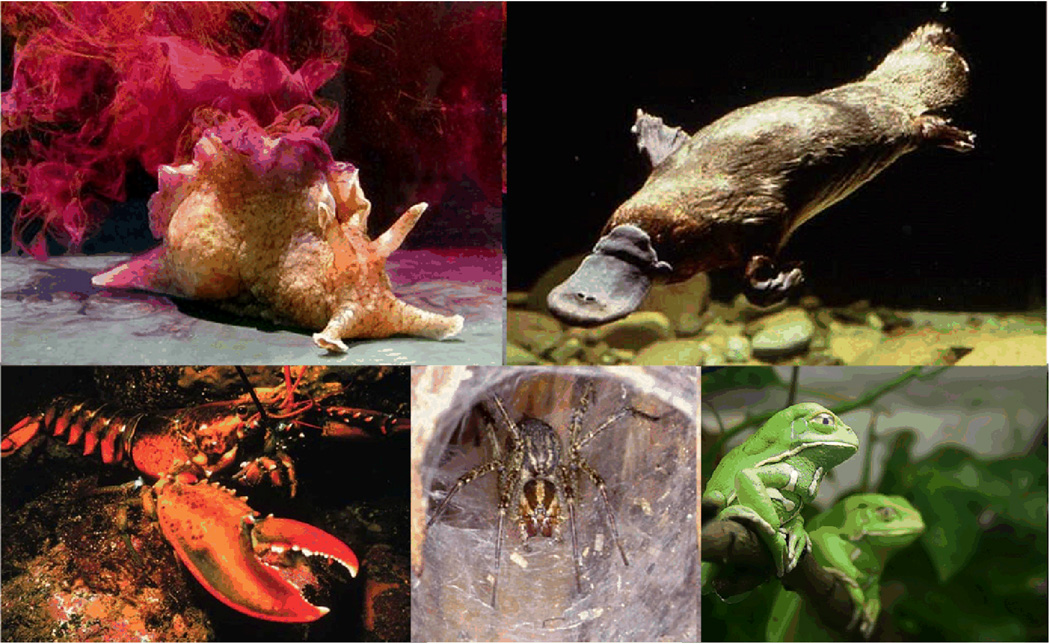
DAACPs have been found in a surprising range of species in Metazoa; for example (top row), sea slug Aplysia californica [114], platypus Ornithorhynchus anatinu [115], (bottom row) lobster Homarus americanus [116], funnel-web spider Agelenopsis aperta [117], and South American tree frog Phyllomedusa sauvagei [118]. Photos used with permission.
Fig. 3
Fig. 3
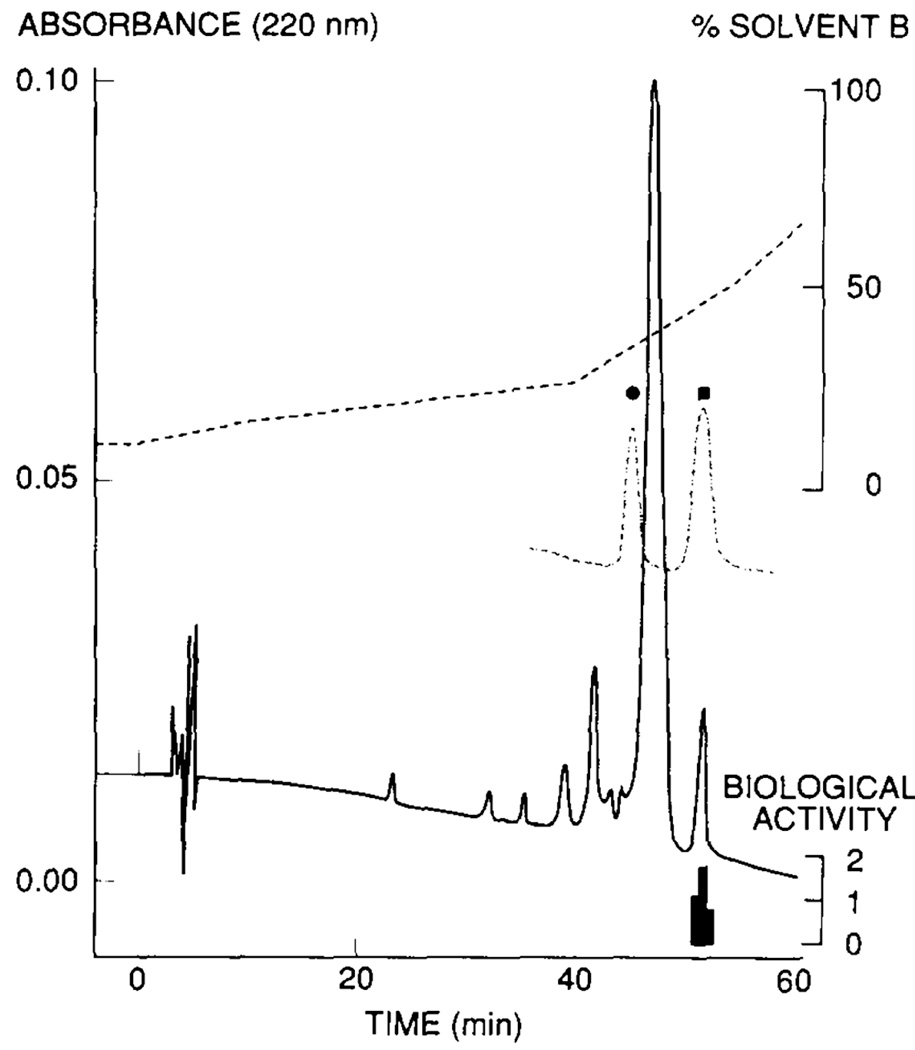
Elution profile of an active fraction isolated from skin secretions of Phyllomedusa sauvagei on a Supelcosil LC18DB column without chiral selectors. Synthetic deltorphin diastereomers, [L-Met2]deltorphin (solid circle) and deltorphin (solid square), were used as reference standards (dashed curves). The active fraction (indicated by the height of the lower black bars underneath) has the same elution time with deltorphin. Reproduced with permission from Elsevier [6].
Fig. 4
Fig. 4
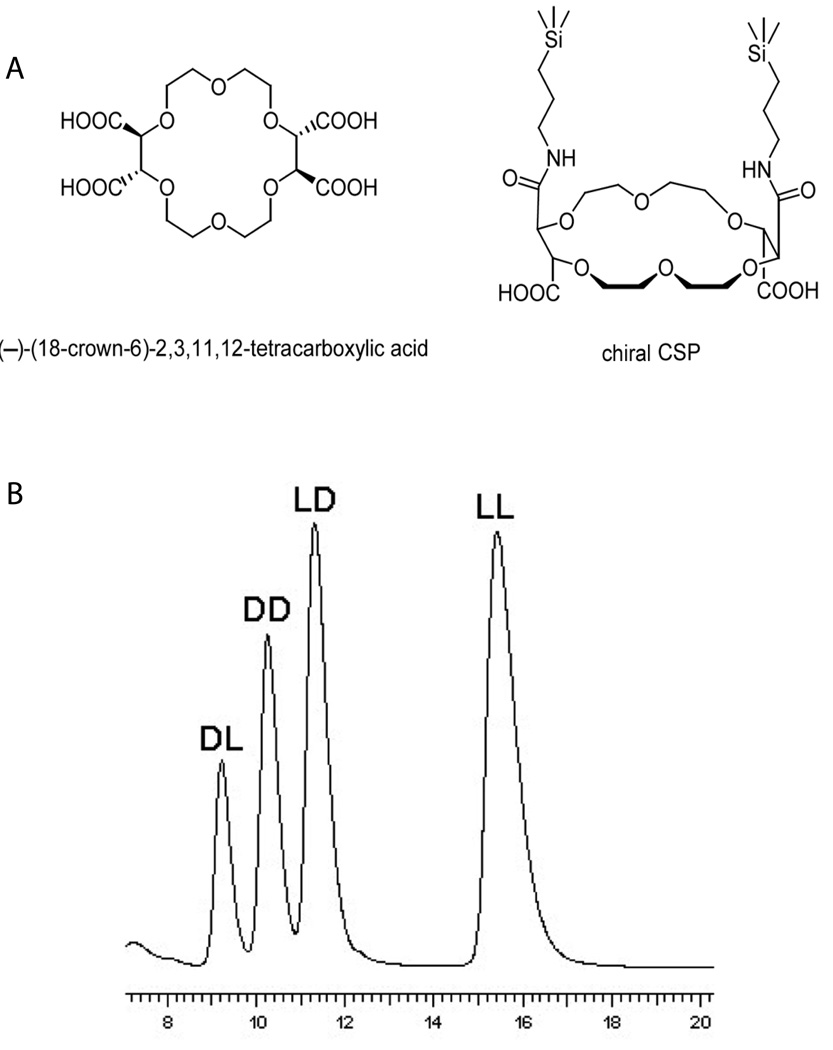
(A) Crown ether (−)-(18-Crown-6)-tetracarboxylic acid. (B) HPLC separation of Ala-Phe stereoisomers on a (−)-(18-Crown-6)-tetracarboxylic acid-based column. Interaction between protonated amine groups in peptides and oxygen atoms lining the inner surface of the crown ether molecule is the basis of chiral selectivity. 10 mM sulfuric acid in 70% methanol-water was used as mobile phase to facilitate protonation of amine groups. Adapted with permission from Wiley-VCH Verlag GmbH & Co. KGaA [62].
Fig. 5
Fig. 5
HPLC separations of enkephalin diastereomers on (A) teicoplanin stationary phase compared to (B) C18 stationary phases. The arrow in (A) indicates the beginning of a step gradient (from isocratic 78% ACN/22% 3 mM ammonium acetate to 70% CAN/30% 0.1% (v/v) formic acid in water at 36 min) found necessary to decrease the elution time of E3 and E4. Arrows in (B) indicate the linear gradient in between (80% 13 mM ammonium acetate/20% ACN at 10 min to 30% ACN at 45min). These two stationary phases are different in selectivity and thus peptides have different retention orders. Enantiomeric pair E0 and E4 and diastereomeric pair E1a and E3were not separated on the non-chiral column, whereas teicoplanin-based CSP was able to resolve every peptide. Adapted with permission from Springer [69].
Fig. 6
Fig. 6
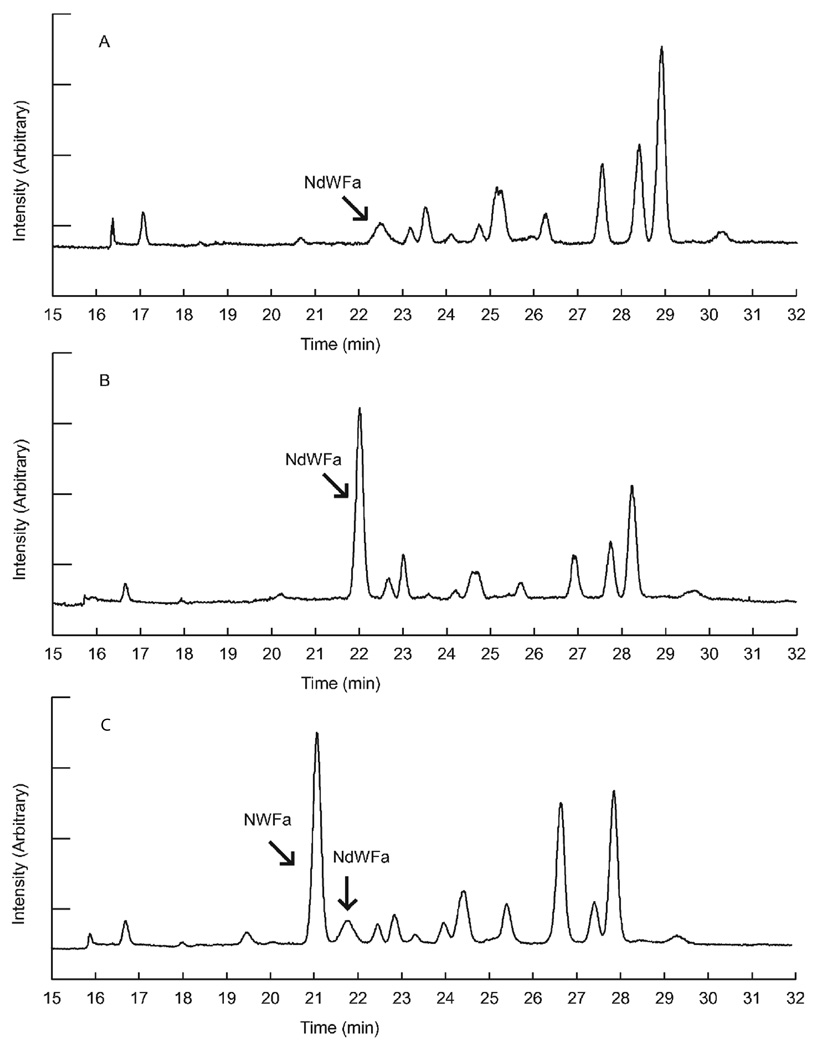
Characterization of NdWFa using CE in a single Aplysia ventral abdominal neuron. (A) Representative electropherogram obtained from a single ventral abdominal neuron. (B) CE electropherogram of a ventral abdominal neuron spiked with synthetic NdWFa standard. (C) Electropherogram of a ventral abdominal neuron spiked with synthetic NWFa standard, which migrates faster than the endogenous NdWFa peak. The measurement has been repeated three times on different peptidergic neurons. Reproduced with permission from the Royal Society of Chemistry [44].
Fig. 7
Fig. 7
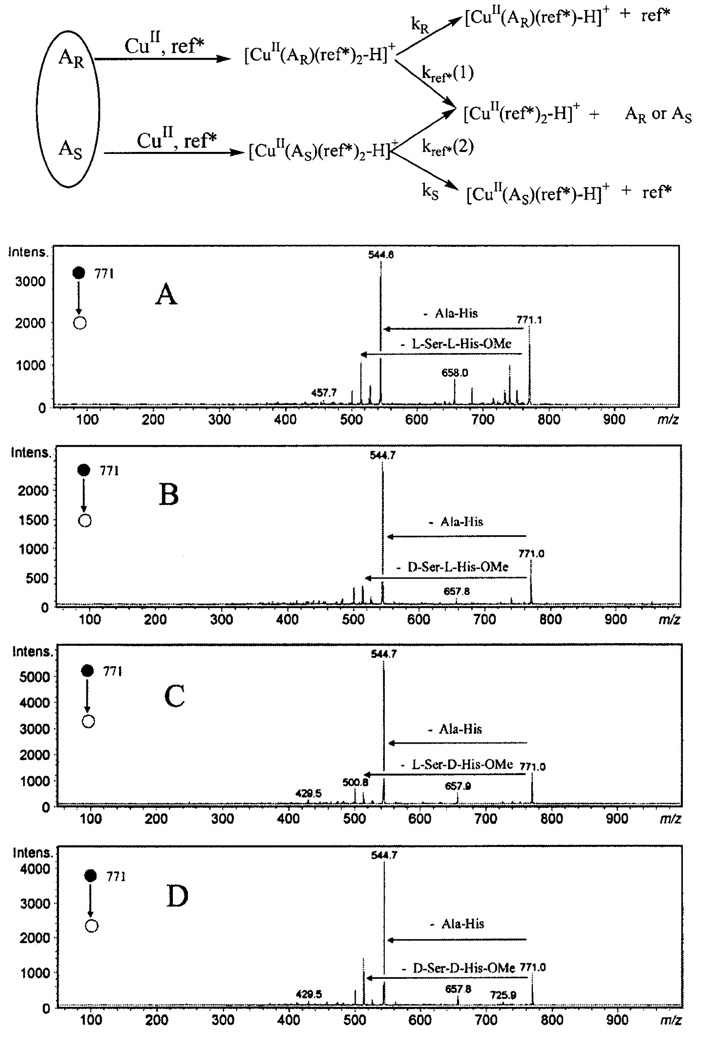
The top scheme illustrates the principle of kinetic method and the bottom multipart figure shows the CID fragmentation patterns of [CuII(A)(ref*)2-H]+ (m/z 771), with the ref* molecule being Ala-His dipeptide, and various analytes: (A) A = L-Ser-L-His-OMe; (B) D-Ser-L-His-OMe; (C) L-Ser-D-His-OMe ; and (D) D-Ser-D-His-OMe. Patterns of competitive collision for each stereoisomeric complex depend on their respective stabilities, therefore, the abundance ratio Re=[CuII(A)(ref*)-H]+ / [CuII(ref*)2-H]+ of different complexes can be used to measure the relative abundance of stereoisomers when a calibration curve is available. Top panel [119] and bottom panel [95] are adapted with permission from Wiley-Blackwell.
Fig. 8
Fig. 8
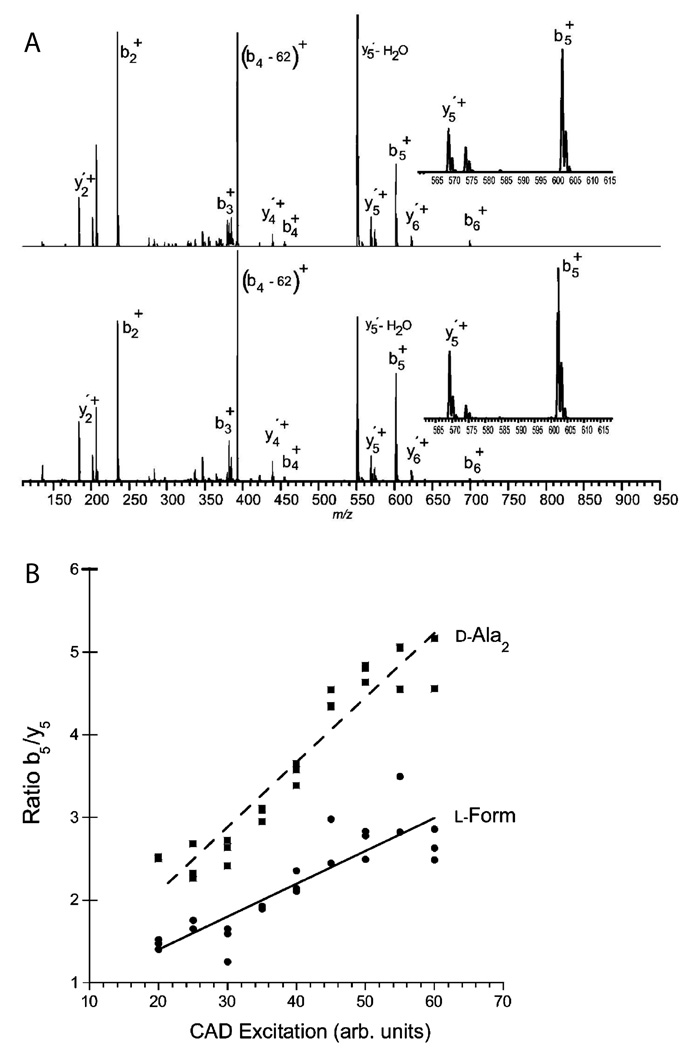
(A) Comparison of CAD fragmentation patterns generated from dermorphins, all-L form (top) and D-Ala2 form (bottom). Relative abundance of b5+ and y5+ fragment ions, shown in upper right insets, is used for chiral composition determination. RL(ratio b5/y5 for L-form) is about 2.3 and RD is about 4.8 at 50 arbitrary CAD excitation units. (B) The ratios of the chirality-reporting fragment ion pairs b5/y5 as a function of CAD excitation intensities in arbitrary units. The chiral recognition factor Rchiral (ratio RD/RL) is relatively constant at different excitation levels. Adapted with permission from the American Chemical Society [101].
Fig. 9
Fig. 9
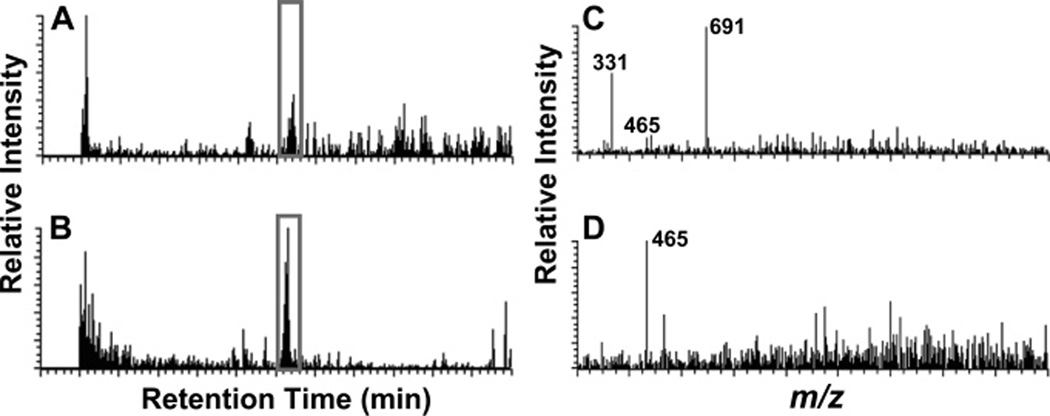
Characterization of DAACPs from a complex mixture of peptides using an enzymatic digestion method. Aplysia abdominal ganglia were used to make extract. (A) and (B) are LC base peak chromatograms showing 465–466 m/z range, which matches the NWFa/NdWFa peak, without enzyme treatment (A) or with 1.0 units of mAAP treatment (B). (C) and (D) are corresponding MS spectra showing NWFa/NdWFa peaks. Enzymatic treatment facilitated detection of otherwise barely detectable peptides. Reproduced with permission from the American Chemical Society [113].

References

    1. D'Aniello A, Lee JM, Petrucelli L, et al. Regional decreases of free D-aspartate levels in Alzheimer's disease. Neurosci Lett. 1998;250:131–134. - PubMed
    1. Fuchs SA, Berger R, Klomp LWJ, et al. D-amino acids in the central nervous system in health and disease. Mol Genet Metab. 2005;85:168–180. - PubMed
    1. Snyder SH, Ferris CD. Novel neurotransmitters and their neuropsychiatric relevance. Am J Psychiatry. 2000;157:1738–1751. - PubMed
    1. Lipmann F, Hotchkiss RD, Dubos RJ. The occurrence of D-amino acids in gramicidin and tyrocidine. J Biol Chem. 1941;141:163–169.
    1. Montecucchi PC, Decastiglione R, Piani S, et al. Amino-acid-composition and sequence of dermorphin, a novel opiate-like peptide from the skin of Phyllomedusa sauvagei. Int J Pept Protein Res. 1981;17:275–283. - PubMed

LinkOut - more resources