. 2010 Jul;60(4):245-57.
doi: 10.1007/s12576-010-0092-0. Epub 2010 May 19.

Late sodium current contributes to diastolic cell Ca2+ accumulation in chronic heart failure

Affiliations

Late sodium current contributes to diastolic cell Ca2+ accumulation in chronic heart failure

Nidas A Undrovinas et al. J Physiol Sci. 2010 Jul.

Abstract

We elucidate the role of late Na+ current (INaL) for diastolic intracellular Ca2+ (DCa) accumulation in chronic heart failure (HF). HF was induced in 19 dogs by multiple coronary artery microembolizations; 6 normal dogs served as control. Ca2+ transients were recorded in field-paced (0.25 or 1.5 Hz) fluo-4-loaded ventricular myocytes (VM). INaL and action potentials were recorded by patch-clamp. Failing VM, but not normal VM, exhibited (1) prolonged action potentials and Ca2+ transients at 0.25 Hz, (2) substantial DCa accumulation at 1.5 Hz, and (3) spontaneous Ca2+ releases, which occurred after 1.5 Hz stimulation trains in ~31% cases. Selective INaL blocker ranolazine (10 microM) or the prototypical Na+ channel blocker tetrodotoxin (2 microM) reversibly improved function of failing VM. The DCa accumulation and the beneficial effect of INaL blockade were reproduced in silico using an excitation-contraction coupling model. We conclude that INaL contributes to diastolic Ca2+ accumulation and spontaneous Ca2+ release in HF.


Figures
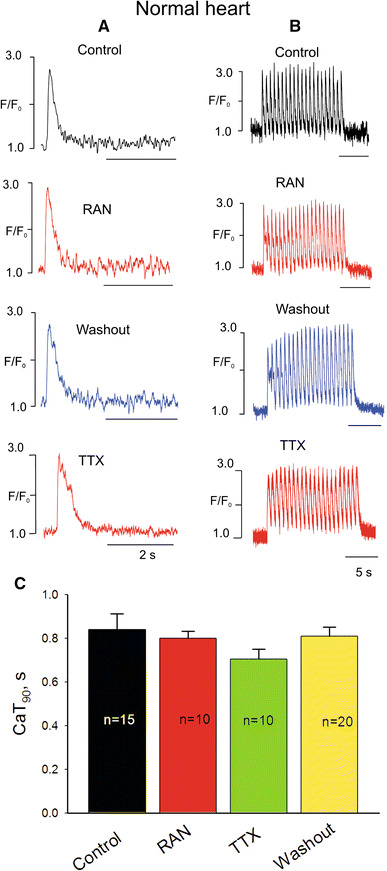
Fig. 1
Fig. 1
Representative examples of Ca2+ transient recordings in normal dog heart ventricular myocytes at low (a) and high (b) pacing rates before and after infusion of ranolazine (RAN) or tetrodotoxin (TTX). c Data summary (mean ± SEM, n = 10–20) for Ca2+ transient duration (CaT90)
Fig. 2
Fig. 2
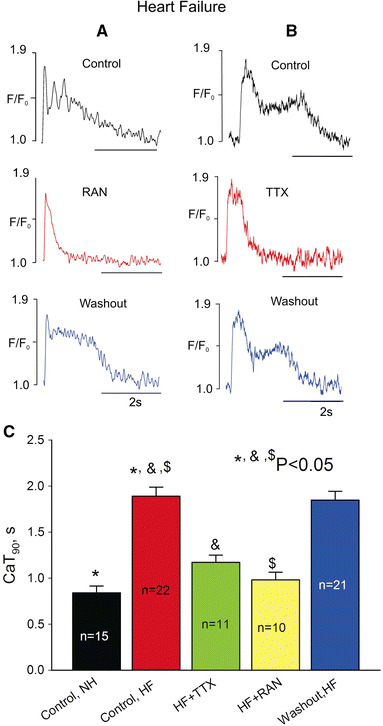
Ranolazine and TTX shorten Ca2+ transient duration (CaT90) in failing dog ventricular myocytes at low pacing rates (0.25 Hz). a, b Representative examples of Ca2+ transient recordings, c summary of the data (mean ± SEM, n = 10–22) for CaT90
Fig. 3
Fig. 3
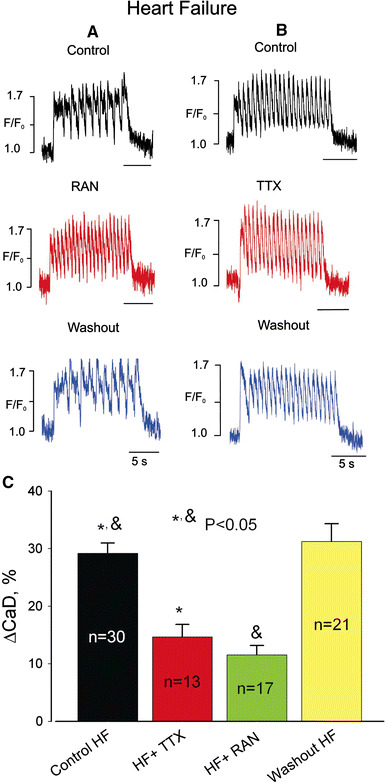
Ranolazine and TTX reduce diastolic Ca2+ elevation at high pacing rates (1.5 Hz) in failing dog ventricular myocytes. a, b Representative examples of Ca2+ transient recordings, c data summary for diastolic Ca2+ (CaD) changes (ΔCaD) during a pulse train. Data are mean ± SEM pooled from 13 to 30 cells
Fig. 4
Fig. 4
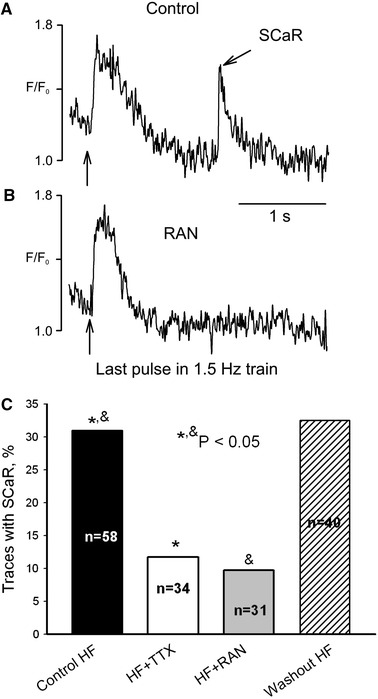
Ranolazine prevents spontaneous Ca2+ releases (SCaR) in myocytes from failing dog heart. Representative traces of Ca2+ signals just after the 1.5 Hz pulse train a in control and b in the presence of 10 μM ranolazine (RAN). Vertical arrows indicate the last pulse in the train. c RAN significantly and reversibly decreases the rate of SCaR. The probability of SCaR occurrence (bars) was evaluated as the percentage of traces that contained SCaR (similar to that shown in a). In control conditions 18 out of total 58 traces contained SCaR, in TTX it was present in 4 out of total 34 traces, in RAN it was present in 3 out of 31 traces, and after washout it was present in 13 out of total 40 traces. Statistical comparison was performed using two-tailed Fisher’s exact tests, and P < 0.05 was considered to be significant. Data were pooled from 31 to 58 cells
Fig. 5
Fig. 5
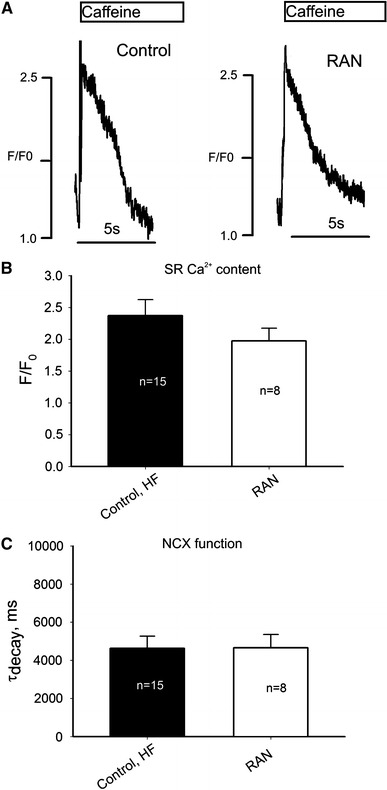
Ranolazine affects SR Ca2+ content or NCX function insignificantly in ventricular myocytes from failing dog hearts. a Original traces of Ca2+ transients during the exposure to caffeine (10 mM) in control (left panel) and in the presence of ranolazine (RAN, 10 μM, right panel). b Average data for SR Ca2+ load, c average data for Ca2+ decay as a measure of NCX function (single exponential fit). Statistical analysis does not reveal a statistical difference between control and RAN for these parameters (ANOVA). Data bars in b and c represent mean ± SEM pooled from 8 to 15 cells
Fig. 6
Fig. 6
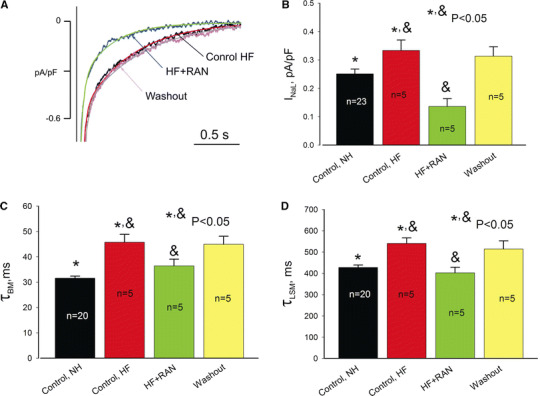
Effects of RAN (10 μM) on INaL in ventricular myocytes from canine failing hearts. a Representative traces along with double-exponential fit of the time course of INaL decay (solid lines). b Summary of the data on INaL density measured as a mean current within 200–220 ms after the depolarization onset, and decay kinetics (c, d) measured at −30 mV in control, in the presence of RAN, and during the washout. Data are mean ± SEM pooled from 5 to 23 cells. See details in text
Fig. 7
Fig. 7
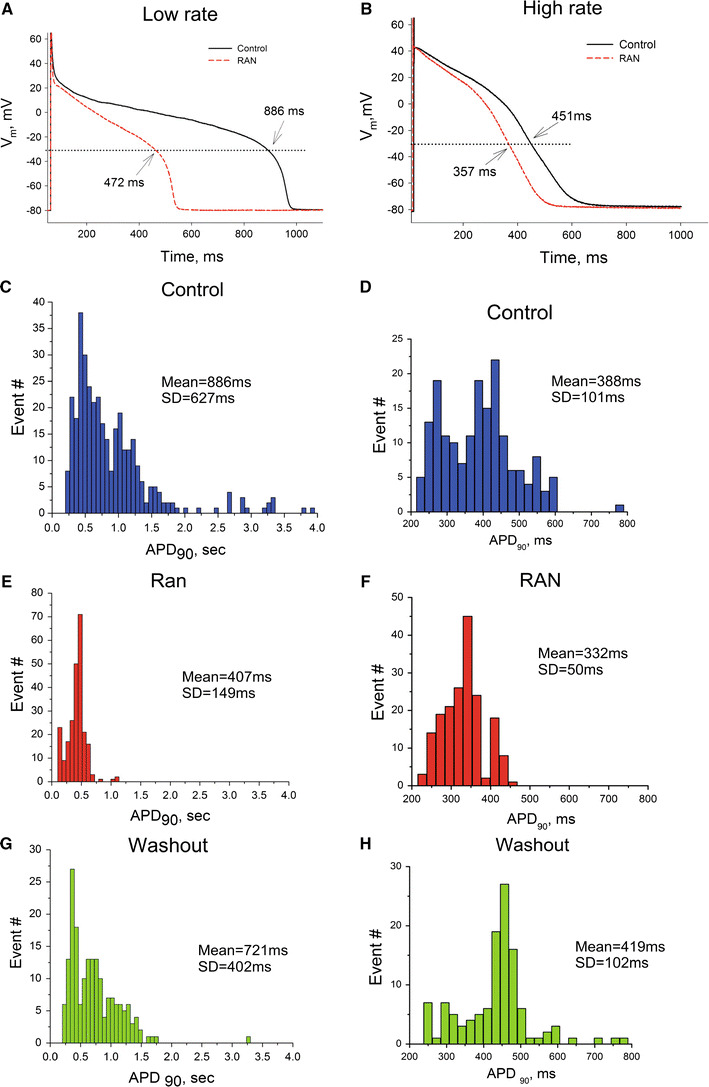
RAN reversibly shortens the AP duration (APD) and reduces the dispersion of APD in ventricular myocytes from canine failing hearts. a, b Representative AP traces at low and high pacing rates recorded at the end of a pulse train, respectively. Dotted line indicates −30 mV level; APD values at this potential are indicated at the traces. ch Histograms of the distribution of the APD measured at 90% of repolarization (APD90). Bin sizes were 50 and 23 ms for c, e, g and for d, f, h, respectively. SD Standard deviation. APs were recorded in control (c, d), in the presence of 10 μM RAN (e, f), and after RAN washout (g, h). Data were pooled from 6 to 12 cells of four failing hearts
Fig. 8
Fig. 8
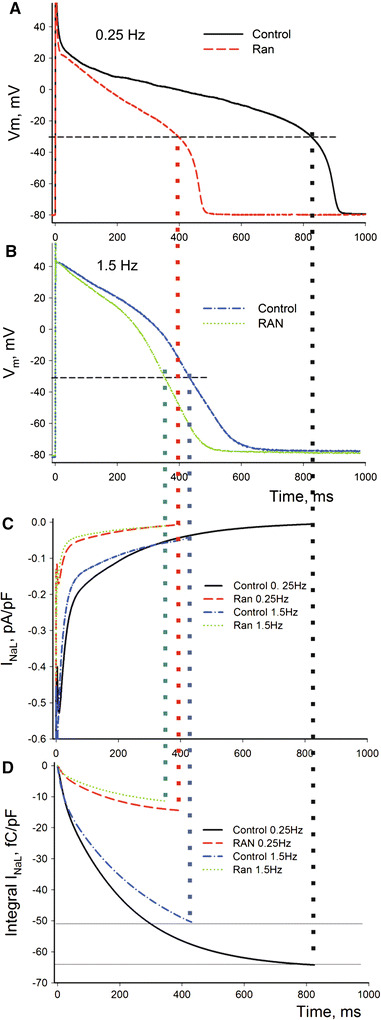
AP-clamp numerical model. A substantial inhibition of INaL and late Na+ influx (77%) during AP plateau by a therapeutic concentration (10 μM) of RAN. a, b Experimental AP recordings at low and high pacing rates in the absence or presence of RAN. c, d Predicted INaL and its integral (~late Na+ influx) during the corresponding AP shapes (Eq. 9 in the ESM)
Fig. 9
Fig. 9
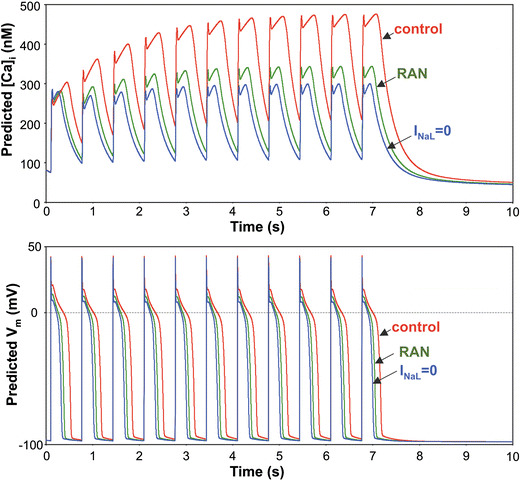
In silico demonstration of the role of the augmented INaL in AP shape and diastolic Ca2+ accumulation in canine failing ventricular myocytes. Numerically simulated dynamics of intracellular Ca2+ concentration ([Ca2+]i) (upper panel) in a train of 11 pulses applied with a rate of 1.5 Hz. Complete INaL elimination or reduction by RAN (10 μM) substantially reduces the diastolic Ca2+ accumulation and shortens AP duration (lower panel). Simulations were performed using a modified Winslow et al. E-C coupling model of failing canine ventricular myocytes [37] (see details in the ESM)

References

    1. Bers DM. Altered cardiac myocyte Ca regulation in heart failure. Physiology (Bethesda) 2006;21:380–387. - PubMed
    1. Hasenfuss G, Schillinger W, Lehnart SE, Preuss M, Pieske B, Maier LS, et al. Relationship between Na+–Ca2+-exchanger protein levels and diastolic function of failing human myocardium. Circulation. 1999;99:641–648. - PubMed
    1. Pieske B, Maier LS, Piacentino V, 3rd, Weisser J, Hasenfuss G, Houser S. Rate dependence of [Na+]i and contractility in nonfailing and failing human myocardium. Circulation. 2002;106:447–453. doi: 10.1161/01.CIR.0000023042.50192.F4. - DOI - PubMed
    1. Hobai IA, Maack C, O’Rourke B. Partial inhibition of sodium/calcium exchange restores cellular calcium handling in canine heart failure. Circ Res. 2004;95:292–299. doi: 10.1161/01.RES.0000136817.28691.2d. - DOI - PMC - PubMed
    1. Maltsev VA, Undrovinas A. Late sodium current in failing heart: friend or foe? Prog Biophys Mol Biol. 2008;96:421–451. doi: 10.1016/j.pbiomolbio.2007.07.010. - DOI - PMC - PubMed

Publication types