


Spatial patterns of bovine corona virus and bovine respiratory syncytial virus in the Swedish beef cattle population
- PMID: 20492637
- PMCID: PMC2898781
- DOI: 10.1186/1751-0147-52-33
Spatial patterns of bovine corona virus and bovine respiratory syncytial virus in the Swedish beef cattle population
Abstract
Background: Both bovine coronavirus (BCV) and bovine respiratory syncytial virus (BRSV) infections are currently wide-spread in the Swedish dairy cattle population. Surveys of antibody levels in bulk tank milk have shown very high nationwide prevalences of both BCV and BRSV, with large variations between regions. In the Swedish beef cattle population however, no investigations have yet been performed regarding the prevalence and geographical distribution of BCV and BRSV. A cross-sectional serological survey for BCV and BRSV was carried out in Swedish beef cattle to explore any geographical patterns of these infections.
Methods: Blood samples were collected from 2,763 animals located in 2,137 herds and analyzed for presence of antibodies to BCV and BRSV. Moran's I was calculated to assess spatial autocorrelation, and identification of geographical cluster was performed using spatial scan statistics.
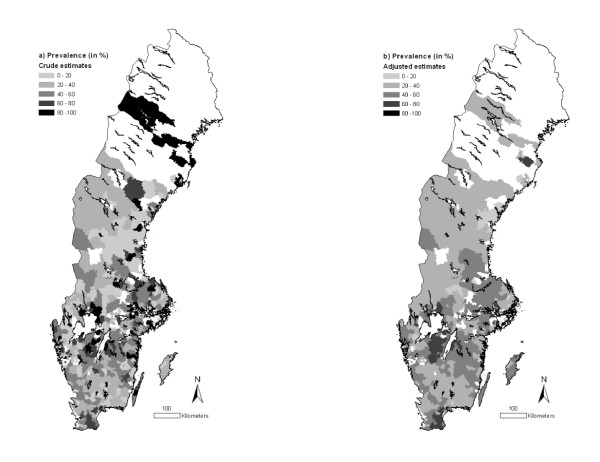
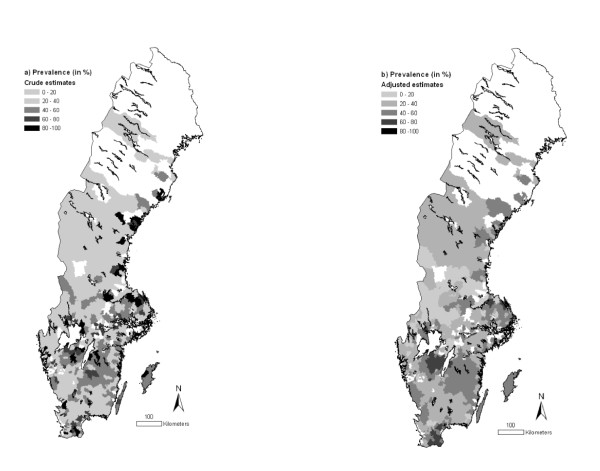
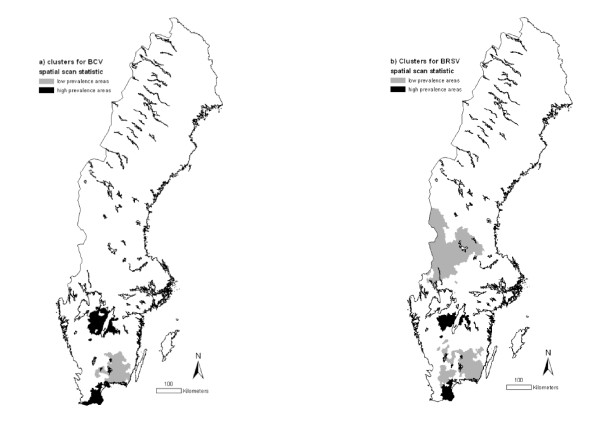
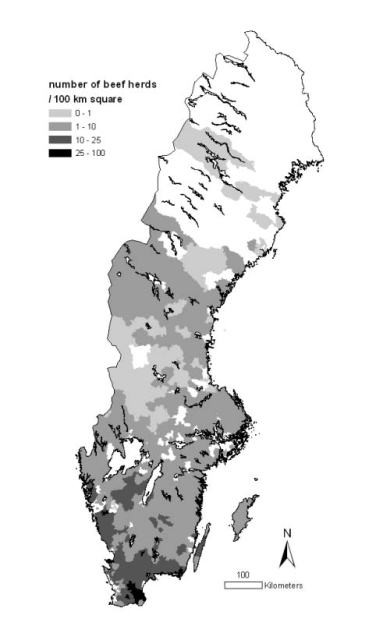
Results: Animals detected positive to BCV or BRSV were predominately located in the central-western and some southern parts of Sweden. Moran's I indicated global spatial autocorrelation. BCV and BRSV appeared to be spatially related: two areas in southern Sweden (Skaraborg and Skåne) had a significantly higher prevalence of BCV (72.5 and 65.5% respectively); almost the same two areas were identified as being high-prevalence clusters for BRSV (69.2 and 66.8% respectively). An area in south-east Sweden (Kronoberg-Blekinge) had lower prevalences for both infections than expected (23.8 and 20.7% for BCV and BRSV respectively). Another area in middle-west Sweden (Värmland-Dalarna) had also a lower prevalence for BRSV (7.9%). Areas with beef herd density > 10 per 100 km(2) were found to be at significantly higher risk of being part of high-prevalence clusters.
Conclusion: These results form a basis for further investigations of between-herds dynamics and risk factors for these infections in order to design effective control strategies.
Figures
References
-
- Saif LJ. A review of evidence implicating bovine coronavirus in the etiology of winter dysentery in cows: an enigma resolved? Cornell Vet. 1990;80:303–311. - PubMed
-
- Stair EL, Rhodes MB, White RG, Mebus CA. Neonatal calf diarrhoea: purification and electron microscopy of a coronavirus-like agent. Am J Vet Res. 1972;33:1147–1156. - PubMed
MeSH terms
Substances
LinkOut - more resources
Full Text Sources
Medical
