


Migraine headache and ischemic stroke risk: an updated meta-analysis
- PMID: 20493462
- PMCID: PMC2900472
- DOI: 10.1016/j.amjmed.2009.12.021
Migraine headache and ischemic stroke risk: an updated meta-analysis
Abstract
Background: Observational studies, including recent large cohort studies that were unavailable for prior meta-analysis, have suggested an association between migraine headache and ischemic stroke. We performed an updated meta-analysis to quantitatively summarize the strength of association between migraine and ischemic stroke risk.
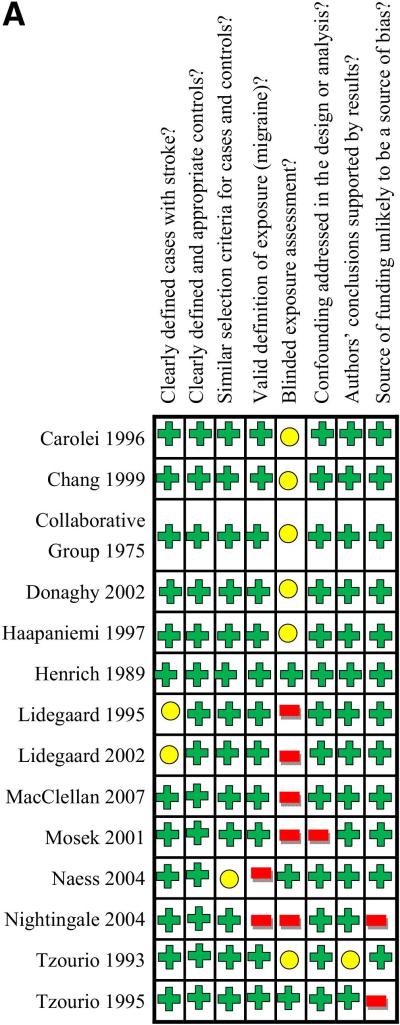
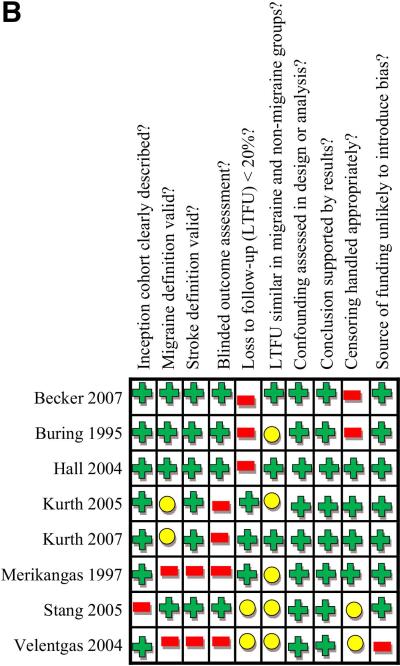
Methods: We systematically searched electronic databases, including MEDLINE and EMBASE, through February 2009 for studies of human subjects in the English language. Study selection using a priori selection criteria, data extraction, and assessment of study quality were conducted independently by reviewer pairs using standardized forms.
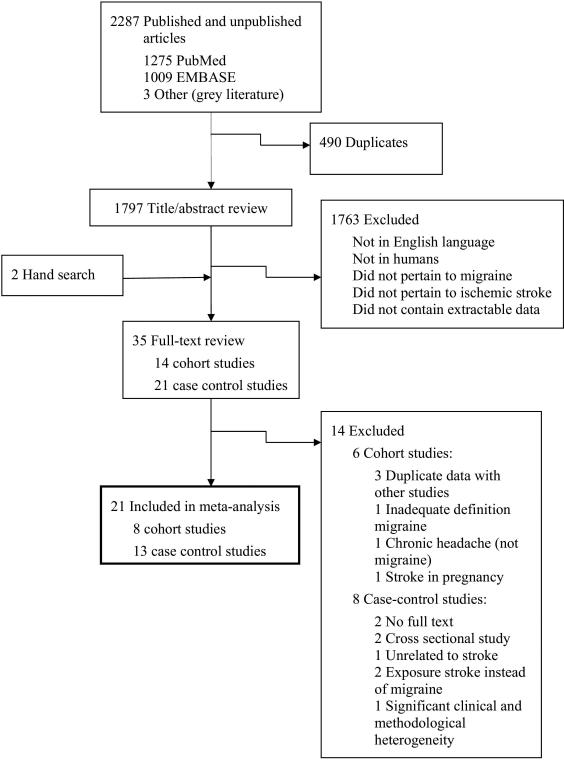
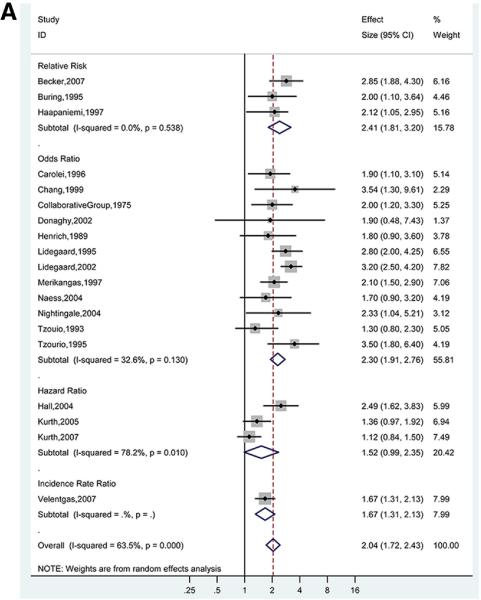
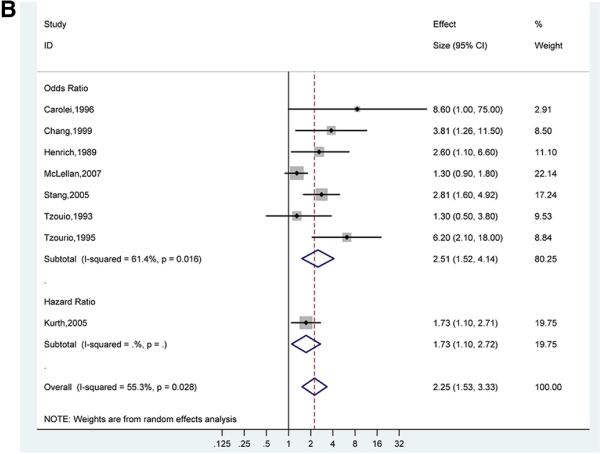
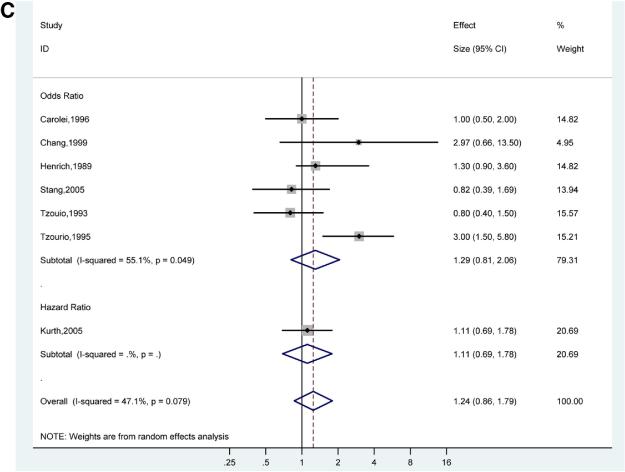
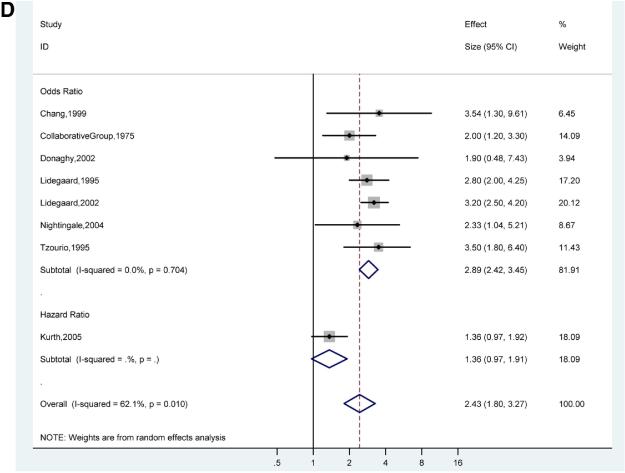
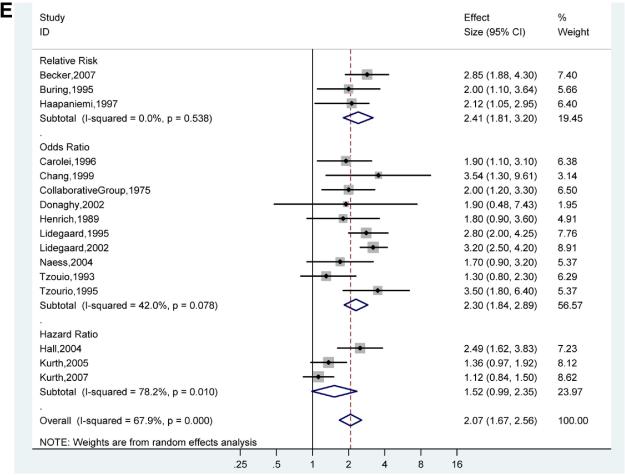
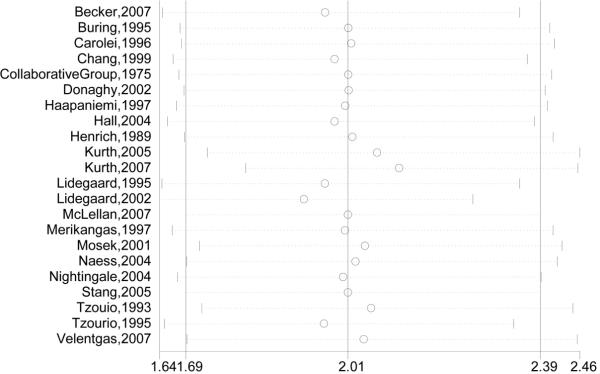
Results: Twenty-one (60%) of 35 studies met the selection criteria, for a total of 622,381 participants (13 case-control, 8 cohort studies) included in the meta-analysis. The pooled adjusted odds ratio of ischemic stroke comparing migraineurs with nonmigraineurs using a random effects model was 2.30 (95% confidence interval [CI], 1.91-2.76). The pooled adjusted effect estimates for studies that reported relative risks and hazard ratios, respectively, were 2.41 (95% CI, 1.81-3.20) and 1.52 (95% CI, 0.99-2.35). The overall pooled effect estimate was 2.04 (95% CI, 1.72-2.43). Results were robust to sensitivity analyses excluding lower quality studies.
Conclusions: Migraine is associated with increased ischemic stroke risk. These findings underscore the importance of identifying high-risk migraineurs with other modifiable stroke risk factors. Future studies of the effect of migraine treatment and modifiable risk factor reduction on stroke risk in migraineurs are warranted.
Copyright 2010 Elsevier Inc. All rights reserved.
Figures
Comment in
-
Meta-analysis of results from case control and cohort studies finds that migraine is associated with approximately twice the risk of ischaemic stroke.Evid Based Med. 2010 Dec;15(6):193-4. doi: 10.1136/ebm1146. Epub 2010 Nov 3. Evid Based Med. 2010. PMID: 21047845 Free PMC article. No abstract available.
-
Is migraine a modifiable risk factor for ischemic stroke? Potentially not.Am J Med. 2011 Aug;124(8):e9; author reply e11. doi: 10.1016/j.amjmed.2010.08.013. Am J Med. 2011. PMID: 21787899 No abstract available.
References
-
- Lopez AD, Mathers CD, Ezzati M, et al. Global and regional burden of disease and risk factors, 2001: systematic analysis of population health data. Lancet. 2006;367:1747–1757. - PubMed
-
- Feigin VL, Lawes CM, Bennett DA, Anderson CS. Stroke epidemiology: a review of population-based studies of incidence, prevalence, and case-fatality in the late 20th century. Lancet Neurol. 2003;2:43–53. - PubMed
-
- Stewart WF, Shechter A, Rasmussen BK. Migraine prevalence. A review of population-based studies. Neurology. 1994;44:S17–23. - PubMed
-
- Lipton RB, Bigal ME, Diamond M, et al. AMPP Advisory Group. Migraine prevalence, disease burden, and the need for preventive therapy. Neurology. 2007;68:343–349. - PubMed
-
- Goldstein LB, Adams R, Alberts MJ, et al. American Heart Association/American Stroke Association Stroke Council, Atherosclerotic Peripheral Vascular Disease Interdisciplinary Working Group, Cardiovascular Nursing Council, Clinical Cardiology Council, Nutrition, Physical Activity, and Metabolism Council, Quality of Care and Outcomes Research Interdisciplinary Working Group, American Academy of Neurology. Primary prevention of ischemic stroke: a guideline from the American Heart Association/American Stroke Association Stroke Council: cosponsored by the Atherosclerotic Peripheral Vascular Disease Interdisciplinary Working Group; Cardiovascular Nursing Council; Clinical Cardiology Council; Nutrition, Physical Activity, and Metabolism Council; and the Quality of Care and Outcomes Research Interdisciplinary Working Group: the American Academy of Neurology affirms the value of this guideline. Stroke. 2006;37:1583–1633. - PubMed
Publication types
MeSH terms
Grants and funding
LinkOut - more resources
Full Text Sources
Medical
Miscellaneous
