Review
. 2010 Jun;16(6):257-67.
doi: 10.1016/j.molmed.2010.04.001. Epub 2010 May 20.

Roles of small RNAs in tumor formation

Affiliations
Review

Roles of small RNAs in tumor formation

Gianpiero Di Leva et al. Trends Mol Med. 2010 Jun.

Abstract

MicroRNAs (miRNAs) are small noncoding RNAs that act as post-transcriptional repressors of gene expression in organisms ranging from plants to humans. A widespread role for miRNAs in diverse molecular processes driving the initiation and progression of various tumor types has recently been described. Here, we discuss the etiology of the aberrant expression of miRNAs in human cancers and their role in tumor metastasis, which might define miRNAs as oncogenes or tumor suppressors. Moreover, we highlight the genomic/epigenetic alterations and transcriptional/post-transcriptional mechanisms associated with the misexpression of miRNAs in cancer. A better understanding of miRNA biology might ultimately yield further insight into the molecular mechanisms of tumorigenesis and new therapeutic strategies against cancer.


Figures

Figure 1
Figure 1
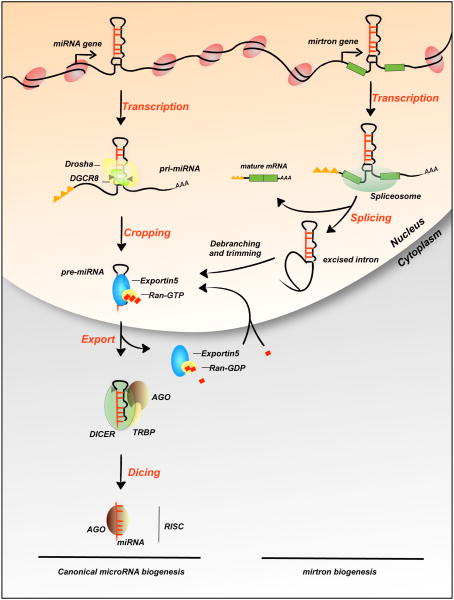
miRNA biogenesis. Canonical miRNAs are transcribed by RNA polymerase II to generate the primary transcript (pri-miRNAs), a long capped and polyadenylated RNA with a hairpin-shaped structure (left). Cropping is the first step in the maturation mediated by the Microprocessor complex, essentially composed of the RNase III enzyme Drosha and the molecular anchor Di George syndrome critical region 8 (DGCR8), and produces a ∼65 nt hairpin RNA called precursor-miRNA (pre-miRNA). Pre-miRNA has a short stem with a 2-3 nt overhang, which is recognized by the Exportin-5-Ran-GTP complex. After export from the nucleus, the pre-miRNA is subjected to the dicing step operated by Dicer with its partner TRBP and Arogonaute proteins 1-4 (AGO). This processing step creates the final duplex and allows the formation of the RNA-Induced Silencing Complex (RISC), which mediates miRNA activity. This multistep process used for independent miRNA transcription units or for intronic miRNAs. In flies and mammals, some miRNAs called mirtrons (right and Box 2) are located in short introns and bypass the Microprocessor complex-dependent step. After the splicing and production of the mature mRNA, the excised intron is debranched and trimmed to produce the pre-miRNA, which follows the canonical pathway for miRNAs biogenesis beginning at the export step.
Figure 2
Figure 2
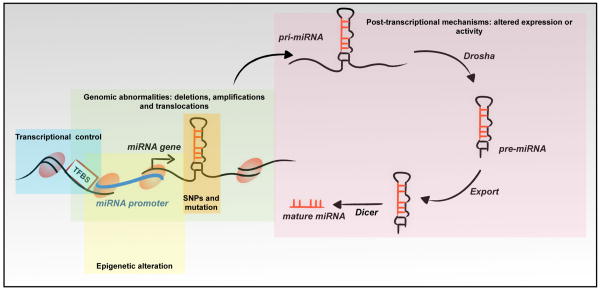
Mechanisms of miRNA dysregulation. MiRNA gene expression is a multistep tightly regulated process and any alteration might contribute to miRNA dysregulation and neoplastic transformation. These mechanisms of miRNA regulation can be differentiated into 1) mechanisms targeting the miRNA genes, including genomic alterations (deletions, amplifications or translocations), epigenetics changes (methylation and histone modification), polymorphisms or mutation, and transcriptional alteration; and 2) mechanisms modulating the activity of the multistep processing enzymes (Drosha, DGCR8, Exportin 5, Dicer and TBRP).
Figure 3
Figure 3
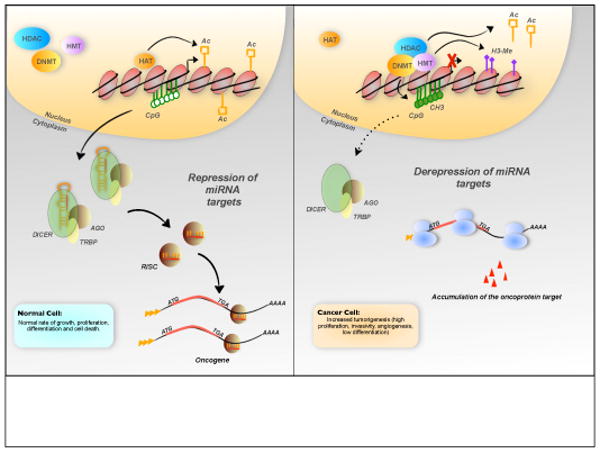
Epigenetic control of miRNA expression. Downregulation of miRNAs that function as tumor suppressors could lead to tumor formation and aggressive phenotypes through the loss of translational repression of several oncoproteins. Different mechanisms could be responsible for these events, and here, we illustrate the effect of epigenetic silencing mediated by methylation and loss of acetylation on the miRNA gene. Gain of repressive histone marks, such as histone tri-methylation (for examples: tri-methylation of lysine 27 on histone H3, H3K27me3), could prevent transcriptional activation of miRNA genes. (Abbreviations: CH3, methyl-cytosine; HMT, histone methyl-transferase; HDAC, histone deacetylase; DNMT, DNA methyl-transferase; HAT, histone acetyl-transferase; CpG, CpG islands; Ac, acetyl group; H3-Me, trimethylation of the histone H3 at the K4 residue; ATG, translation start codon; TGA, translation stop codon)
Figure 4
Figure 4
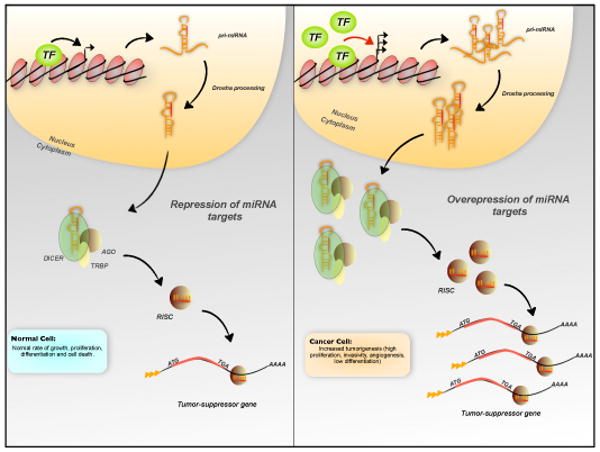
Transcriptional control of miRNA expression. Overexpression of miRNAs might induce tumor formation through the repression of several tumor-suppressor genes. Overexpression and/or activation of a transcription factor at inappropriate times or in the wrong tissues could explain the increased level of miRNAs. (Abbreviations: TF, transcription factor; ATG, translation start codon; TGA, translation stop codon)

References

    1. Kim VN, Nam JW. Genomics of microRNA. Trends Genet. 2006;22:165–173. - PubMed
    1. Bartel DP. MicroRNAs: genomics, biogenesis, mechanism, and fucntion. Cell. 2004;116:281–297. - PubMed
    1. Croce CM. Causes and consequences of microRNA dysregulation in cancer. Nat Rev Genet. 2009;10:704–714. - PMC - PubMed
    1. Kim NV, et al. Biogenesis of small RNAs in animals. Nat Rev Mol Cell Biol. 2009;10:126–139. - PubMed
    1. Calin GA, et al. Frequent deletion and downregulation of microRNA genes miR15 and miR16 at 13q14 in chronic lymphocytic leukemia. Proc Natl Acad Sci USA. 2004;99:15524–15529. - PMC - PubMed