


Varus malalignment negates the structure-modifying benefits of doxycycline in obese women with knee osteoarthritis
- PMID: 20493957
- PMCID: PMC2906621
- DOI: 10.1016/j.joca.2010.03.018
Varus malalignment negates the structure-modifying benefits of doxycycline in obese women with knee osteoarthritis
Abstract
Objective: To estimate the extent to which varus malalignment, a source of abnormal intra-articular stresses in the medial tibiofemoral compartment and risk factor for progression of knee osteoarthritis (OA), may have diminished the structure-modifying benefit of doxycycline in knee OA.
Methods: Post hoc treatment group comparisons from a randomized, placebo-controlled trial of the effect of doxycycline (100mg, twice daily) on medial joint space narrowing (JSN) in subgroups of varus and non-varus OA knees. Subjects (N=379 with X-ray follow-up) were obese 45-64-year-old women with unilateral knee OA at baseline. JSN was measured manually in semiflexed anteroposterior (AP) radiographs acquired with standardized fluoroscopic positioning. The anatomic-axis angle (AAA) was measured in each baseline radiograph and transformed to an estimate of the mechanical-axis angle (MAA(est)) using a validated regression equation. Knees with MAA(est)<178 degrees were classified as varus.
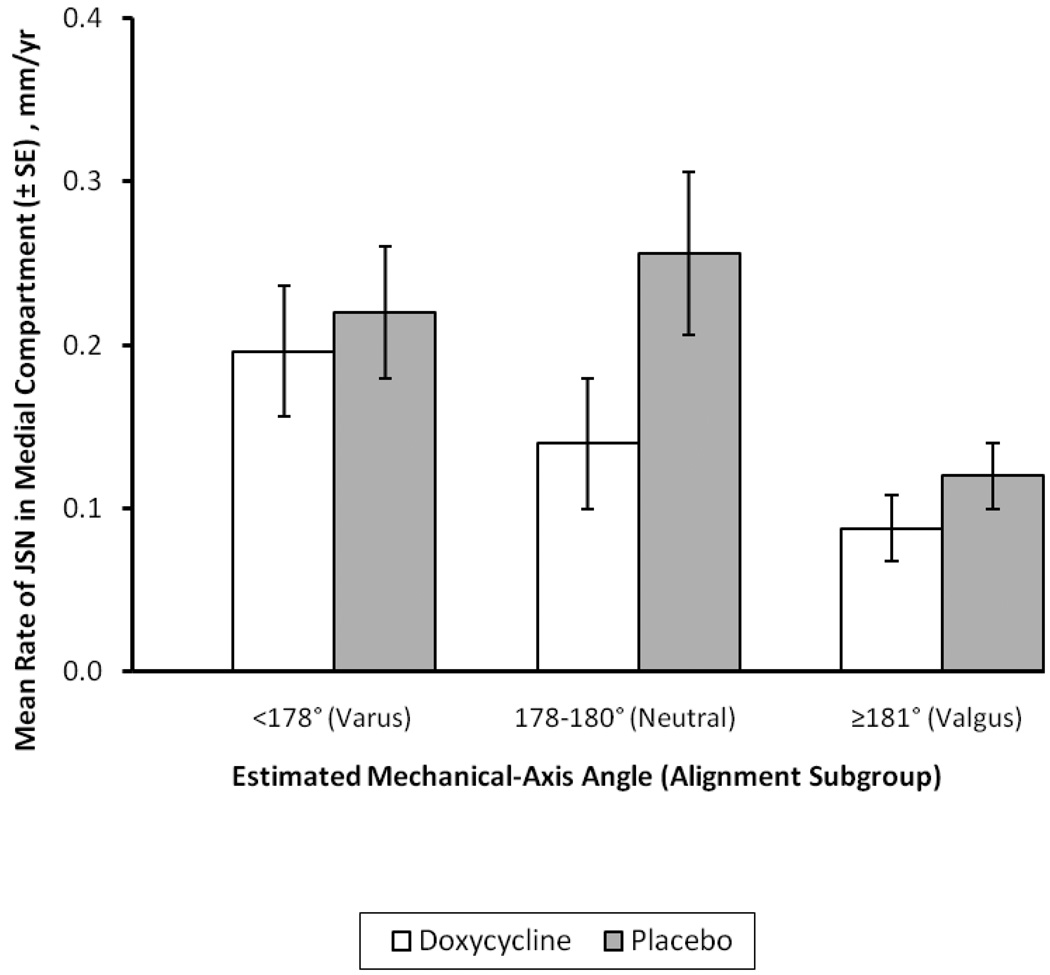
Results: In our original comparison with placebo, doxycycline slowed the rate of medial JSN in OA knees by 38% at 16 months and by 33% at 30 months. Among non-varus OA knees, 16-month JSN in the doxycycline group was 44% slower than in the placebo group (0.09 vs 0.16 mm/year, P=0.080), and 39% slower at month 30 (0.10 vs 0.17 mm/year, P=0.026). JSN in varus knees (0.20-0.27 mm/year) was more rapid than in non-varus knees (P=0.083) and unaffected by doxycycline.
Conclusion: Varus malalignment negated the slowing of structural progression of medial-compartment OA by doxycycline. To our knowledge, this is the first report documenting that static varus angulation can negate a pharmacologic structure-modifying effect.
Copyright 2010 Osteoarthritis Research Society International. Published by Elsevier Ltd. All rights reserved.
Conflict of interest statement
The authors have no conflict of Interest.
Figures
Comment in
-
Comment on: Varus malalignment negates the structure-modifying benefits of doxycycline in obese women with knee osteoarthritis.Osteoarthritis Cartilage. 2010 Aug;18(8):1006-7. doi: 10.1016/j.joca.2010.05.010. Epub 2010 May 21. Osteoarthritis Cartilage. 2010. PMID: 20493958 Free PMC article. No abstract available.
References
-
- Hunter DJ, Hellio Le Graverand-Gastineau MP. How close are we to having structure-modifying drugs available? Med Clin North Am. 2009;93:223–234. - PubMed
-
- Qvist P, Bay-Jensen AC, Christiansen C, Dam EB, Pastoureau P, Karsdal MA. The disease modifying osteoarthritis drug (DMOAD): Is it in the horizon? Pharmacol Res. 2008;58:1–7. - PubMed
-
- Brandt KD, Mazzuca SA. Lessons learned from nine clinical trials of disease-modifying osteoarthritis drugs. Arthritis Rheum. 2005;52:3349–3359. - PubMed
-
- Brandt KD, Dieppe P, Radin E. Commentary: Is it useful to subset “primary” OA? A critique based on evidence regarding the etiopathogenesis of osteoarthritis. Semin Arthritis Rheum. 2009;39:81–95. - PubMed
-
- Brandt KD, Mazzuca SA, Katz BP, Lane KA, Buckwalter KA, Yocum DE, et al. Effect of doxycycline on progression of osteoarthritis. Arthritis Rheum. 2005;52:2015–2025. - PubMed
Publication types
MeSH terms
Substances
Grants and funding
LinkOut - more resources
Full Text Sources
Medical
Research Materials
