


Medial temporal lobe contributions to episodic sequence encoding
- PMID: 20494967
- PMCID: PMC3020579
- DOI: 10.1093/cercor/bhq092
Medial temporal lobe contributions to episodic sequence encoding
Abstract
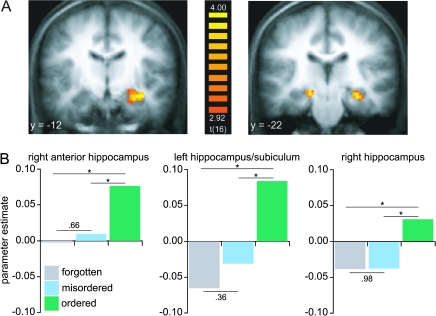
Memory for the order of events within an episode requires mechanisms capable of bridging gaps between those events and laying down memory traces that will support the subsequent retrieval of episodic sequence information. It has been proposed that the hippocampus and surrounding medial temporal lobe (MTL) play a critical role in these processes. Here, using functional magnetic resonance imaging, we examined MTL activation during the encoding of sequentially presented noun triplets. Using performance on a retrieval test, encoding activations predictive of subsequent triplet recognition ("hits" vs. "misses") as well as activations differentiating triplets that were subsequently recognized with (ordered) and without (misordered) memory for the original sequence of presentation were identified. Within the MTL, activations in bilateral hippocampal and parahippocampal cortical regions predicted subsequent order memory, with greater activations observed during encoding of triplets subsequently correctly ordered than those subsequently misordered. Interestingly, activation in these regions did not correlate with old/new triplet identification, suggesting that these MTL regions contributed specifically to encoding of episodic details supporting subsequent recovery of sequence information.
Figures


References
-
- Aminoff E, Gronau N, Bar M. The parahippocampal cortex mediates spatial and nonspatial associations. Cereb Cortex. 2007;17:1493–1503. - PubMed
-
- Badre D, Wagner AD. Left ventrolateral prefrontal cortex and the cognitive control of memory. Neuropsychologia. 2007;45:2883–2901. - PubMed
-
- Clayton NS, Dickinson A. Episodic-like memory during cache recovery by scrub jays. Nature. 1998;395:272–274. - PubMed
-
- Cohen NJ, Eichenbaum H. Memory, amnesia, and the hippocampal system. Cambridge (MA): MIT Press; 1993.
Publication types
MeSH terms
Substances
Grants and funding
LinkOut - more resources
Full Text Sources
Other Literature Sources
