


Improvement in intelligence test scores from 6 to 10 years in children of teenage mothers
- PMID: 20495472
- PMCID: PMC2888273
- DOI: 10.1097/DBP.0b013e3181e121d2
Improvement in intelligence test scores from 6 to 10 years in children of teenage mothers
Abstract
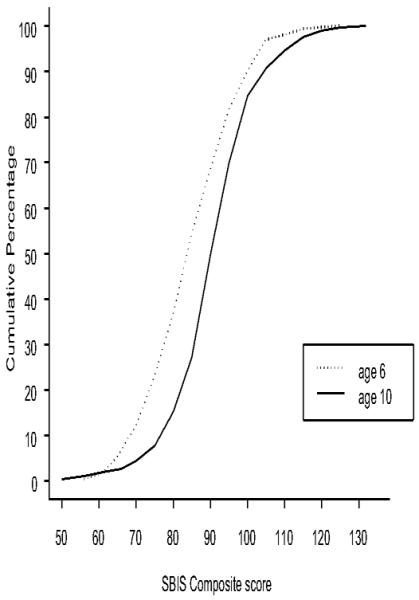
Objective: This study investigates change in IQ scores among 290 children born to teenage mothers and identifies social, economic, and environmental variables that may be associated with change in intelligence test performance.
Methods: The children of 290 teenage mothers (72% African-American and 28% European American) were assessed with the Stanford-Binet Intelligence Scale-4th Edition at ages 6 and 10.
Results: The mean composite score at age 6 was 84.8 and 91.2 at age 10, an improvement of 6.4 points. Significant cross-sectional predictors at both ages 6 and 10 of higher Stanford-Binet Intelligence Scale scores were maternal cognitive ability, school grade, white ethnicity, and caregiver education. Having more children in the household significantly predicted lower Stanford-Binet Intelligence Scale scores at age 6. Higher satisfaction with maternal social support predicted higher Stanford-Binet Intelligence Scale scores at age 10. Change in IQ scores was not related to maternal socioeconomic status, social support, home environment, ethnicity, or family interactions. Custodial stability was associated with an improvement in IQ scores, whereas increase in caregiver depression was related to decline in IQ scores.
Conclusions: Our findings suggest that improvement in IQ scores of offspring of teenage mothers may be related to stability of maternal custody. More research is needed to determine the impact of the maturation of adolescent mothers' parenting and the role of early education on improvement in cognitive abilities.
References
-
- Centers for Disease Control and Prevention . Sexually Transmitted Disease Surveillance, 2004. Atlanta, GA: 2005.
-
- Panchaud C, Singh S, Feivelson D, et al. Sexually transmitted diseases among adolescents in developed countries. Int Fam Plan Perspect. 2003;32:24–32. - PubMed
-
- Hamilton B, Martin J, Ventura S. National Vital Statistics Reports. Available at: http://www.cdc.gov. Accessed September 1, 2008.
-
- Culp MA, Osofsky JD, O'Brien M. Language patterns of adolescent and older mothers and their one-year-old children: A comparison study. First Language. 1996;16:61–75.
-
- Sommer KS, Whitman TL, Borkowski JG, et al. Prenatal maternal predictors of cognitive and emotional delays in children of adolescent mothers. J Adolesc. 2000;35:87–112. - PubMed
Publication types
MeSH terms
Grants and funding
LinkOut - more resources
Full Text Sources
Medical
