


Favorably skewed X-inactivation accounts for neurological sparing in female carriers of Menkes disease
- PMID: 20497190
- PMCID: PMC3099248
- DOI: 10.1111/j.1399-0004.2010.01451.x
Favorably skewed X-inactivation accounts for neurological sparing in female carriers of Menkes disease
Abstract
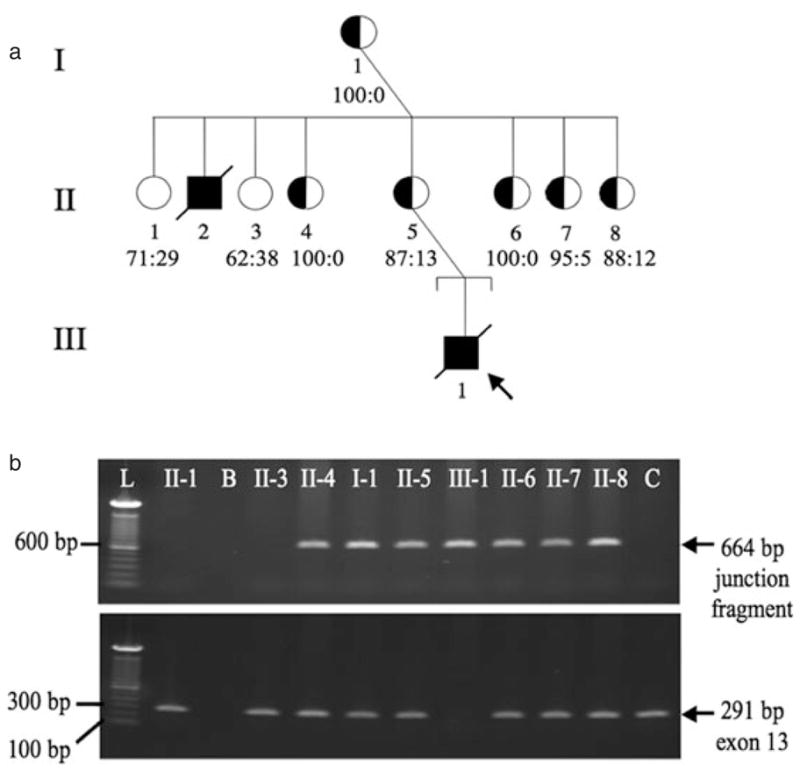
Classical Menkes disease is an X-linked recessive neurodegenerative disorder caused by mutations in ATP7A, which is located at Xq13.1-q21. ATP7A encodes a copper-transporting P-type ATPase and plays a critical role in development of the central nervous system. With rare exceptions involving sex chromosome aneuploidy or X-autosome translocations, female carriers of ATP7A mutations are asymptomatic except for subtle hair and skin abnormalities, although the mechanism for this neurological sparing has not been reported. We studied a three-generation family in which a severe ATP7A mutation, a 5.5-kb genomic deletion spanning exons 13 and 14, segregated. The deletion junction fragment was amplified from the proband by long-range polymerase chain reaction and sequenced to characterize the breakpoints. We screened at-risk females in the family for this junction fragment and analyzed their X-inactivation patterns using the human androgen-receptor (HUMARA) gene methylation assay. We detected the junction fragment in the proband, two obligate heterozygotes, and four of six at-risk females. Skewed inactivation of the X chromosome harboring the deletion was noted in all female carriers of the deletion (n = 6), whereas random X-inactivation was observed in all non-carriers (n = 2). Our results formally document one mechanism for neurological sparing in female carriers of ATP7A mutations. Based on review of X-inactivation patterns in female carriers of other X-linked recessive diseases, our findings imply that substantial expression of a mutant ATP7A at the expense of the normal allele could be associated with neurologic symptoms in female carriers of Menkes disease and its allelic variants, occipital horn syndrome, and ATP7A-related distal motor neuropathy.
© 2010 John Wiley & Sons A/S.
Conflict of interest statement
No conflicts of interest related to this work are noted by any of the six authors.
Figures


References
-
- Heard E, Clerc P, Avner P. X-chromosome inactivation in mammals. Ann Rev Genet. 1997;31:571–610. - PubMed
-
- Clerc P, Avner P. Random X-chromosome inactivation: skewing lessons for mice and men. Curr Opin Genet Dev. 2006;16:246–253. - PubMed
-
- Migeon BR. Non-random X chromosome inactivation in mammalian cells. Cytogenet Cell Genet. 1998;80:142–148. - PubMed
-
- Van den Veyver IB. Skewed X inactivation in X-linked disorders. Semin Repro Med. 2001;19:183–191. - PubMed
-
- Lexner MO, Bardow A, Juncker I, et al. X-linked hypohidrotic ectodermal dysplasia. Genetic and dental findings in 67 Danish patients from 19 families. Clin Genet. 2008;74:252–259. - PubMed
Publication types
MeSH terms
Substances
Grants and funding
LinkOut - more resources
Full Text Sources
Other Literature Sources
Medical
