


Pharyngeal oxygen administration increases the time to serious desaturation at intubation in acute lung injury: an experimental study
- PMID: 20497538
- PMCID: PMC2911730
- DOI: 10.1186/cc9027
Pharyngeal oxygen administration increases the time to serious desaturation at intubation in acute lung injury: an experimental study
Abstract
Introduction: Endotracheal intubation in critically ill patients is associated with severe life-threatening complications in about 20%, mainly due to hypoxemia. We hypothesized that apneic oxygenation via a pharyngeal catheter during the endotracheal intubation procedure would prevent or increase the time to life-threatening hypoxemia and tested this hypothesis in an acute lung injury animal model.
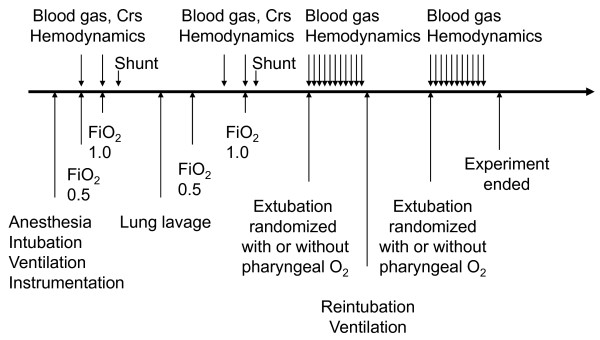
Methods: Eight anesthetized piglets with collapse-prone lungs induced by lung lavage were ventilated with a fraction of inspired oxygen of 1.0 and a positive end-expiratory pressure of 5 cmH2O. The shunt fraction was calculated after obtaining arterial and mixed venous blood gases. The trachea was extubated, and in randomized order each animal received either 10 L oxygen per minute or no oxygen via a pharyngeal catheter, and the time to desaturation to pulse oximeter saturation (SpO2) 60% was measured. If SpO2 was maintained at over 60%, the experiment ended when 10 minutes had elapsed.
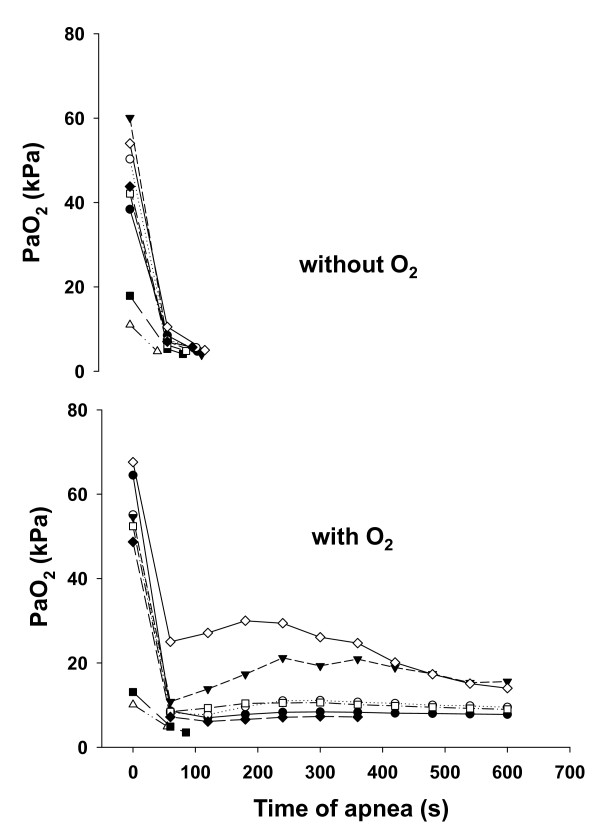
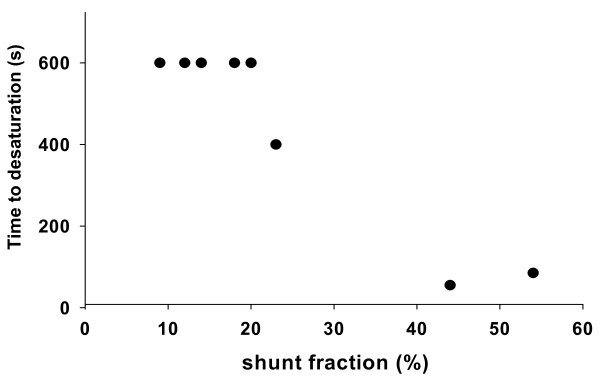
Results: Without pharyngeal oxygen, the animals desaturated after 103 (88-111) seconds (median and interquartile range), whereas with pharyngeal oxygen five animals had a SpO2 > 60% for the 10-minute experimental period, one animal desaturated after 7 minutes, and two animals desaturated within 90 seconds (P < 0.016, Wilcoxon signed rank test). The time to desaturation was related to shunt fraction (R2 = 0.81, P = 0.002, linear regression); the animals that desaturated within 90 seconds had shunt fractions >40%, whereas the others had shunt fractions <25%.
Conclusions: In this experimental acute lung injury model, pharyngeal oxygen administration markedly prolonged the time to severe desaturation during apnea, suggesting that this technique might be useful when intubating critically ill patients with acute respiratory failure.
Figures
Comment in
-
Preventing severe hypoxia during emergent intubation: is nasopharyngeal oxygenation the answer?Crit Care. 2010;14(6):1005. doi: 10.1186/cc9197. Epub 2010 Nov 3. Crit Care. 2010. PMID: 21092147 Free PMC article. Review.
References
-
- Jaber S, Amraoui J, Lefrant J-Y, Arich C, Cohendy R, Landreau L, Calvet Y, Capdevila X, Mahamat A, Eledjam JJ. Clinical practice and risk factors for immediate complications of endotracheal intubation in the intensive care unit: A prospective, multiple-center study. Crit Care Med. 2006;34:2355–2361. doi: 10.1097/01.CCM.0000233879.58720.87. - DOI - PubMed
-
- Jaber S, Jung B, Corne P, Sebbane M, Muller L, Chanques G, Verzilli D, Jonquet O, Eledjam J-J, Lefrant J-Y. An intervention to decrease complications related to endotracheal intubation in the intensive care unit: a prospective, multiple-center study. Intensive Care Med. 2010;36:248–255. doi: 10.1007/s00134-009-1717-8. - DOI - PubMed
Publication types
MeSH terms
Substances
LinkOut - more resources
Full Text Sources
Medical
