. 2010 Jun 8;107(23):10644-8.
doi: 10.1073/pnas.0914347107. Epub 2010 May 24.

B-lymphoid cells with attributes of dendritic cells regulate T cells via indoleamine 2,3-dioxygenase

Affiliations

B-lymphoid cells with attributes of dendritic cells regulate T cells via indoleamine 2,3-dioxygenase

Burles A Johnson 3rd et al. Proc Natl Acad Sci U S A. .

Abstract

A discrete population of splenocytes with attributes of dendritic cells (DCs) and coexpressing the B-cell marker CD19 is uniquely competent to express the T-cell regulatory enzyme indoleamine 2,3-dioxygenase (IDO) in mice treated with TLR9 ligands (CpGs). Here we show that IDO-competent cells express the B-lineage commitment factor Pax5 and surface immunoglobulins. CD19 ablation abrogated IDO-dependent T-cell suppression by DCs, even though cells with phenotypic attributes matching IDO-competent cells developed normally and expressed IDO in response to interferon gamma. Consequently, DCs and regulatory T cells (Tregs) did not acquire T-cell regulatory functions after TLR9 ligation, providing an alternative perspective on the known T-cell regulatory defects of CD19-deficient mice. DCs from B-cell-deficient mice expressed IDO and mediated T-cell suppression after TLR9 ligation, indicating that B-cell attributes were not essential for B-lymphoid IDO-competent cells to regulate T cells. Thus, IDO-competent cells constitute a distinctive B-lymphoid cell type with quintessential T-cell regulatory attributes and phenotypic features of both B cells and DCs.


Conflict of interest statement

Conflict of interest statement: D.H.M. and A.L.M. receive consulting income and research support from NewLink Genetics Inc., which has licensed patent rights based on intellectual property emanating from their laboratories.

Figures
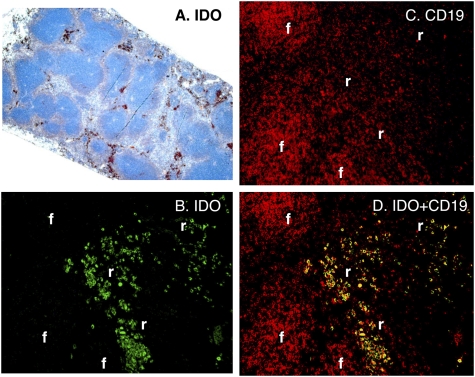
Fig. 1.
Fig. 1.
IDO-competent cells are a distinct subset of CD19+ splenocytes. B6 mice were treated with CpGs (100 μg, i.v.) for 24 h and spleen sections were stained with anti-IDO Ab (A) or to detect cells expressing IDO and CD19 (BD). Stained cells were visualized using immunohistochemical (A, red) and immunofluorescence (BD) methods to detect IDO (B, green), CD19 (C, red), and IDO/CD19 (D, merged images). Original magnifications, 25× (A), 400× (BD). f, follicles; r, red pulp.
Fig. 2.
Fig. 2.
IDO-competent cells express Pax5. (A) Flow cytometric analyses of hCD2 reporter gene expression by splenic B cells and CD11c+ DC subsets from Pax5ihCD2/ihCD2 knockin mice gated as indicated in the dot plot. Numbers are the mean fluorescence intensities of hCD2+ cells in each gated subset. (B) FACS-sorted GFP+ and GFPneg DCs from CpG-treated Pax5iGFP2/iGFP knockin mice were cultured with responder BM3 T cells (±D-1MT), and T-cell proliferation was assessed after 96 h. Data are representative of at least two experiments.
Fig. 3.
Fig. 3.
Phenotypic and functional analyses of IDO-competent cells. (AE) Splenocytes from untreated B6 mice were stained with CD11c and CD19 (A) and B-cell (D) and non-B-cell markers (E). (A) B cells (CD11cnegCD19+), IDO-competent cells (CD19+CD11chigh; shown in red), and mDCs (CD11chighCD19neg) were gated as indicated. (B and C) Forward and side light scatter (FSC, SSC) properties of gated B cells (B) and IDO-competent cells (C). (D and E) Histograms of markers expressed by gated cells. (F) Graded numbers of sorted B cells and IDO-competent cells from untreated mice were cultured with BM3 responder T cells (96 h) and T-cell proliferation was assessed. Data are representative of two or more experiments.
Fig. 4.
Fig. 4.
Defective IDO induction in CD19-deficient mice. (A) Magnetic-activated cell sorted (MACS)-enriched splenic DCs from CpG-treated B6 and CD19-KO mice were cultured with BM3 T cells ± D-1MT as before. (B) Sorted B220+ and B220neg DCs were incubated with IFNγ (200 U/mL, 24 h) and cytospins were stained to detect IDO; original magnifications, 1,000×. (C) Graded numbers of MACS-enriched Tregs from CpG-treated B6 (closed symbols) and CD19-KO (open symbols) mice were cultured with responder T cells and stimulator APCs (72 h) before assessing T-cell proliferation. Data are representative of two or more experiments.
Fig. 5.
Fig. 5.
IDO-competent cells develop in B-cell-deficient mice. (A) B-cell development is blocked after the pro-B-cell stage in μMT-KO and JH-KO mice due to defective BCR expression. (B and C) MACS-enriched splenic DCs from CpG-treated mice were cultured with BM3 T cells (96 h, ± D-1MT). Data are representative of two or more experiments. (D) IDO-expressing cells (stained red) in spleen of CpG-treated mice (24 h). Original magnifications, 200× (Top and Middle) and 600× (Bottom).

References

    1. Mellor AL, Munn DH. Creating immune privilege: Active local suppression that benefits friends, but protects foes. Nat Rev Immunol. 2008;8:74–80. - PubMed
    1. Munn DH, Mellor AL. Indoleamine 2,3-dioxygenase and tumor-induced tolerance. J Clin Invest. 2007;117:1147–1154. - PMC - PubMed
    1. Popov A, et al. Indoleamine 2,3-dioxygenase-expressing dendritic cells form suppurative granulomas following Listeria monocytogenes infection. J Clin Invest. 2006;116:3160–3170. - PMC - PubMed
    1. van der Sluijs KF, et al. Influenza-induced expression of indoleamine 2,3-dioxygenase enhances interleukin-10 production and bacterial outgrowth during secondary pneumococcal pneumonia. J Infect Dis. 2006;193:214–222. - PubMed
    1. Boasso A, Shearer GM. How does indoleamine 2,3-dioxygenase contribute to HIV-mediated immune dysregulation. Curr Drug Metab. 2007;8:217–223. - PubMed

Publication types

LinkOut - more resources
