. 2010 Jun 8;107(23):10737-42.
doi: 10.1073/pnas.1004604107. Epub 2010 May 24.

Inhibition of lung tumor growth by complex pulmonary delivery of drugs with oligonucleotides as suppressors of cellular resistance

Affiliations

Inhibition of lung tumor growth by complex pulmonary delivery of drugs with oligonucleotides as suppressors of cellular resistance

Olga B Garbuzenko et al. Proc Natl Acad Sci U S A. .

Abstract

Development of cancer cell resistance, low accumulation of therapeutic drug in the lungs, and severe adverse treatment side effects represent main obstacles to efficient chemotherapy of lung cancer. To overcome these difficulties, we propose inhalation local delivery of anticancer drugs in combination with suppressors of pump and nonpump cellular resistance. To test this approach, nanoscale-based delivery systems containing doxorubicin as a cell death inducer, antisense oligonucleotides targeted to MRP1 mRNA as a suppressor of pump resistance and to BCL2 mRNA as a suppressor of nonpump resistance, were developed and examined on an orthotopic murine model of human lung carcinoma. The experimental results show high antitumor activity and low adverse side effects of proposed complex inhalatory treatment that cannot be achieved by individual components applied separately. The present work potentially contributes to the treatment of lung cancer by describing a unique combinatorial local inhalation delivery of drugs and suppressors of pump and nonpump cellular resistance.


Conflict of interest statement

The authors declare no conflict of interest.

Figures
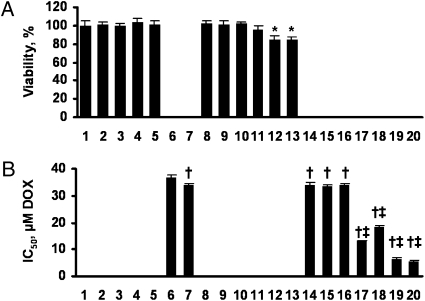
Fig. 1.
Fig. 1.
Viability of human lung cancer cells incubated 48 h with the indicated formulations. (A) Cytotoxicity of formulations that do not contain DOX. (B) Cytotoxicity of formulations that contain DOX. Concentration of DOX, antisense oligonulcleotides (ASO), and sense oligonucleotides (SO) and composition of liposomes in all formulations and their mixtures were the same. Mean ± SD are shown. 1, control (fresh media); 2, empty liposomes; 3, MRP1 ASO; 4, BCL2 ASO; 5, MRP1 ASO+BCL2 ASO; 6, DOX; 7, liposomal-DOX; 8, liposomal-MRP1 SO; 9, liposomal-BCL2 SO; 10, liposomal-MRP1 SO-BCL2 SO; 11, liposomal-MRP1 ASO; 12, liposomal-BCL2 ASO; 13, liposomal-MRP1 ASO-BCL2 ASO; 14, liposomal-DOX-MRP1 SO; 15, liposomal-DOX-BCL2 SO; 16, liposomal-DOX-MRP1 SO-BCL2 SO; 17, liposomal-DOX-MRP1 ASO; 18, liposomal-DOX-BCL2 ASO; 19, mixture: liposomal-DOX-MRP1 ASO + liposomal-DOX-BCL2 ASO; 20, complex DDS: liposomal-DOX-MRP1 ASO-BCL2 ASO. *P < 0.05 when compared with control; P < 0.05 when compared with DOX; P < 0.05 when compared with liposomal DOX.
Fig. 2.
Fig. 2.
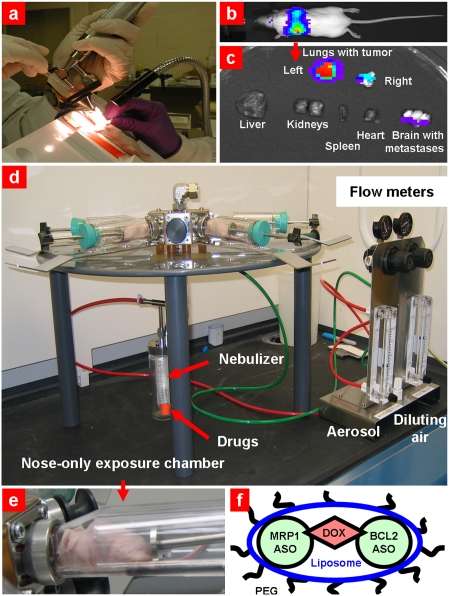
Orthotopic lung tumor model and inhalation treatment of lung caner. (A) Human A549 lung cancer cells transfected with luciferase were intratracheally injected into the lungs of nude mice. (B) Typical bioluminescent image of a mouse with lung tumor 4 weeks after instillation of cancer cells. Intensity of bioluminescence is expressed by different colors, with blue reflecting the lowest intensity and red indicating the highest intensity. (C) Bioluminescence of excised organs from mice. (D) Installation for inhalation treatment. (E) Mouse inside the nose-only exposure chamber. (F) PEGylated liposomal drug delivery system containing anticancer drug (DOX) and suppressors of pump (antisense oligonucleotides targeted to MRP1 mRNA) and nonpump (antisense oligonucleotides targeted to MRP1 mRNA) resistance.
Fig. 3.
Fig. 3.
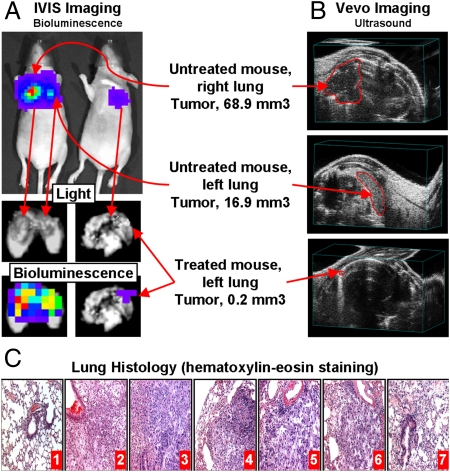
Inhalation treatment of mice with orthotopic human lung tumor by DOX combined with inhibitors of pump and nonpump cellular resistance significantly decreases tumor size. Typical bioluminescent (A, IVIS imaging system) and ultrasound (B, Vevo imaging system) images of mice (untreated and treated within 4 weeks). Untreated mouse had tumors in both left and right lungs (16.9 and 68.9 mm3, respectively). Treated mouse had one small (~0.2 mm3) tumor in left lung only. (C) Lung tissue histology (H&E staining). 1, control (no tumor); 2, untreated tumor; 3, DOX (i.v.); 4, liposomal-DOX (i.v.); 5, liposomal-DOX (inhalation); 6, mixture: liposomal-DOX-MRP1 ASO + liposomal-DOX-BCL2 ASO (inhalation); 7, complex DDS: liposomal-DOX-MRP1-BCL2 ASO (inhalation).
Fig. 4.
Fig. 4.
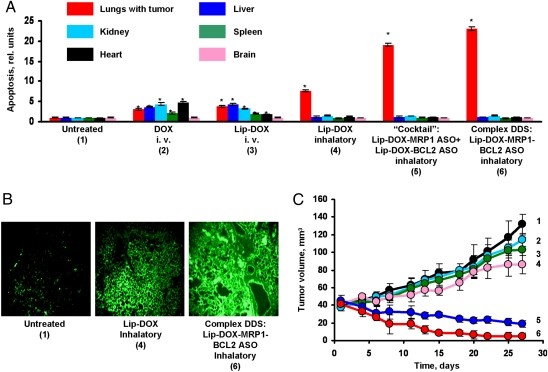
Local inhalation codelivery of anticancer drug and suppressors of pump and nonpump cellular resistance enhances apoptosis induction in the lung tumor, decreases tumor size, and prevents adverse side effects of treatment on healthy organs. An orthotopic lung tumor model was created by intratracheal instillation of human A549 lung cancer cells in nude mice. Untreated mice (1), mice treated by i.v injection of DOX (2), by i.v. injection of liposomal DOX (3), by inhalation with liposomal DOX (4), by inhalation with a mixture of the two systems (liposomal DOX + ASO targeted to MRP1 mixed with liposomal DOX + ASO targeted to BCL2 mRNA) (5), and by inhalation with one complex liposomal delivery system containing DOX, ASO targeted to MRP1, and BCL2 mRNA (6). (A) Apoptosis induction in the lungs with tumor and other organs 4 weeks after beginning of treatment. Enrichment of histone-associated DNA fragments (mono- and oligonucleosomes) per gram tissue in the tumor and organs of control animals was set to unit 1, and the degree of apoptosis was expressed in relative units. Apoptosis measurements were performed 24 h after last treatment. (B) Typical fluorescent microscopy images of tumor tissue slides labeled by TUNEL 24 h after last treatment. (C) Changes in tumor volume after beginning of treatment. Mice were treated on days 0, 3, 7, 11, 14, 17, 21, and 24. Mean ± SD are shown. *P < 0.05 when compared with untreated animals.
Fig. 5.
Fig. 5.
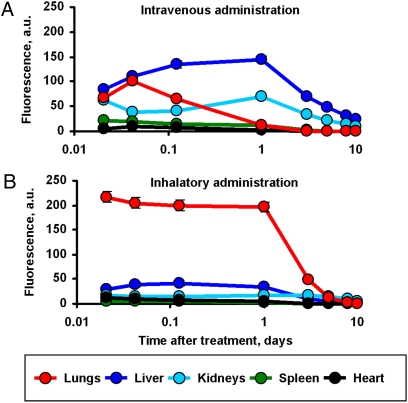
Inhalation delivery enhances lung exposure to liposomal ASO and limits their content in other organs. ASO were labeled with FITC and delivered by i.v. route (A) or by inhalation (B) into the mice. Fluorescence of ASO in different organs was measured using IVIS Xenogen imaging system. Mean ± SD are shown.
Fig. 6.
Fig. 6.
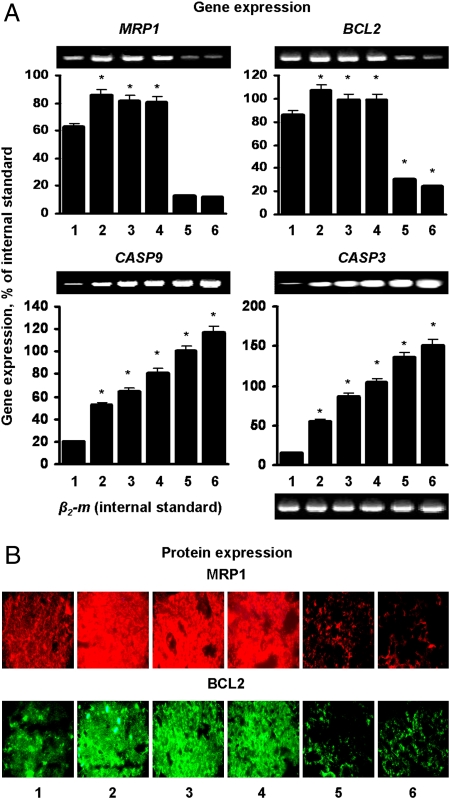
Local inhalation codelivery of anticancer drug and antisense oligonucleotides enhances suppression of targeted mRNA and proteins and activation of caspase-dependent signaling pathways of apoptosis in lung tumor. Untreated mice (1), mice treated by i.v. injection of DOX (2), by i.v. injection of liposomal DOX (3), by inhalation with liposomal DOX (4), by inhalation with a mixture of the two systems (liposomal DOX + ASO targeted to MRP1 mixed with liposomal DOX + ASO targeted to BCL2 mRNA) (5), and by inhalation with one complex liposomal delivery system containing DOX, ASO targeted to MRP1, and BCL2 mRNA (6). (A) Gene expression was measured by RT-PCR and calculated as a ratio of band intensity of studied gene to that in internal standard [β2-microglobulin (β2-m)]. (B) Protein expression was examined using immunohistochemistry. Measurements were performed 24 h after last treatment. Means ± SD are shown.*P < 0.05 when compared with untreated animals.

References

    1. Molina JR, Yang P, Cassivi SD, Schild SE, Adjei AA. Non-small cell lung cancer: Epidemiology, risk factors, treatment, and survivorship. Mayo Clin Proc. 2008;83:584–594. - PMC - PubMed
    1. Anonymous . Health, United States, 2004. Hyattsville, MD: National Center for Health Statistics; 2004. p. 498.
    1. Yang P. Epidemiology of lung cancer prognosis: Quantity and quality of life. Methods Mol Biol. 2009;471:469–486. - PMC - PubMed
    1. Youlden DR, Cramb SM, Baade PD. The international epidemiology of lung cancer: Geographical distribution and secular trends. J Thorac Oncol. 2008;3:819–831. - PubMed
    1. Melani AS. Inhalatory therapy training: A priority challenge for the physician. Acta Biomed. 2007;78:233–245. - PubMed

Publication types

MeSH terms

Substances