Obesity-related glomerulopathy: body mass index and proteinuria
- PMID: 20498244
- PMCID: PMC2924407
- DOI: 10.2215/CJN.01370210
Obesity-related glomerulopathy: body mass index and proteinuria
Abstract
Background and objectives: Obesity-related glomerulopathy (ORG) is an increasing cause of end-stage renal disease, but evidence concerning the effects of treatments is rather limited. This study was aimed at exploring the renoprotective effects of weight loss on patients with ORG.
Design, setting, participants, & measurements: A total of 63 patients with renal biopsy-proven ORG had food and exercise intervention in the physician-supervised weight loss program and were divided into three groups on the basis of the percentage of weight change from baseline to follow-up: significant weight loss (>3% reduction in body mass index [BMI]), stable weight, or significant weight gain (>3% increase). Metabolic parameters and renal lesions were evaluated regularly for 2 years.
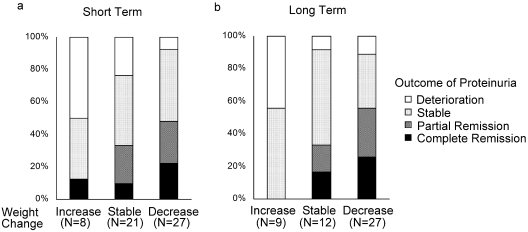
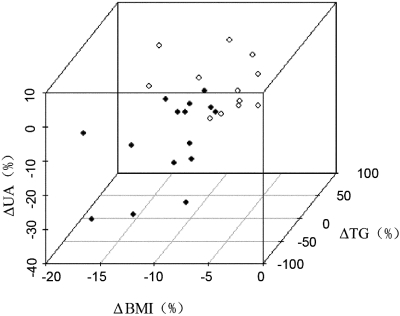
Results: After 6 months, 27 patients lost weight by 8.29 +/- 4.00%, with a mean decrease in proteinuria of 35.3%, whereas 24 months later, 27 patients achieved a 9.20 +/- 3.78% reduction in BMI and a 51.33% reduction in urine protein secretion. The levels of serum triglyceride, serum uric acid, and BP were also decreased. Contrarily, in patients with increased BMI, urine protein was increased by 28.78%. Correlation analysis showed proteinuria was associated with BMI, serum triglyceride, and uric acid, and multivariate regression analysis indicated the changes in BMI were the only predictor of proteinuria (P < 0.01).
Conclusions: Weight loss intervention benefited remission of proteinuria in patients with ORG, whose function could not be replaced by conventional pharmacotherapy.
Figures

Comment in
-
Weight loss: a tool to reduce proteinuria.Curr Hypertens Rep. 2011 Apr;13(2):96-8. doi: 10.1007/s11906-010-0178-3. Curr Hypertens Rep. 2011. PMID: 21210306 No abstract available.
References
-
- Yang J, Lu F, Zhang C, Liu Z, Zhao Y, Gao F, Sun S, Zhang Y: Prevalence of prehypertension and hypertension in a Chinese rural area from 1991 to 2007. Hypertens Res 33: 331–337, 2010 - PubMed
-
- Hsu CY, McCulloch CE, Iribarren C, Darbinian J, Go AS: Body mass index and risk for end-stage renal disease. Ann Intern Med 144: 21–28, 2006 - PubMed
-
- Tozawa M, Iseki K, Iseki C, Oshiro S, Ikemiya Y, Takishita S: Influence of smoking and obesity on the development of proteinuria. Kidney Int 62: 956–962, 2002 - PubMed
-
- Jacobs M, Bisland W, Gomez E, Plasencia G, Mederos R, Celaya C, Fogel R: Laparoscopic sleeve gastrectomy: A retrospective review of 1- and 2-year results. Surg Endosc 24: 781–785, 2010 - PubMed
-
- Monteiro FC, Jr, Silva WS, Jr, Salgado Filho N, Ferreira PA, Araujo GF, Mandarino NR, Barbosa JB, Lages JS, Lima Jde R, Monteiro CC: Effects of weight loss induced by bariatric surgery on the prevalence of metabolic syndrome. Arq Bras Cardiol 92: 418–422, 435–439, 452–456, 2009 - PubMed