. 2010 Aug;78(8):3585-94.
doi: 10.1128/IAI.01353-09. Epub 2010 May 24.

Secreted Aspergillus fumigatus protease Alp1 degrades human complement proteins C3, C4, and C5

Affiliations

Secreted Aspergillus fumigatus protease Alp1 degrades human complement proteins C3, C4, and C5

Judith Behnsen et al. Infect Immun. 2010 Aug.

Abstract

The opportunistic human pathogenic fungus Aspergillus fumigatus is a major cause of fungal infections in immunocompromised patients. Innate immunity plays an important role in the defense against infections. The complement system represents an essential part of the innate immune system. This cascade system is activated on the surface of A. fumigatus conidia and hyphae and enhances phagocytosis of conidia. A. fumigatus conidia but not hyphae bind to their surface host complement regulators factor H, FHL-1, and CFHR1, which control complement activation. Here, we show that A. fumigatus hyphae possess an additional endogenous activity to control complement activation. A. fumigatus culture supernatant efficiently cleaved complement components C3, C4, C5, and C1q as well as immunoglobulin G. Secretome analysis and protease inhibitor studies identified the secreted alkaline protease Alp1, which is present in large amounts in the culture supernatant, as the central molecule responsible for this cleavage. An alp1 deletion strain was generated, and the culture supernatant possessed minimal complement-degrading activity. Moreover, protein extract derived from an Escherichia coli strain overproducing Alp1 cleaved C3b, C4b, and C5. Thus, the protease Alp1 is responsible for the observed cleavage and degrades a broad range of different substrates. In summary, we identified a novel mechanism in A. fumigatus that contributes to evasion from the host complement attack.


Figures
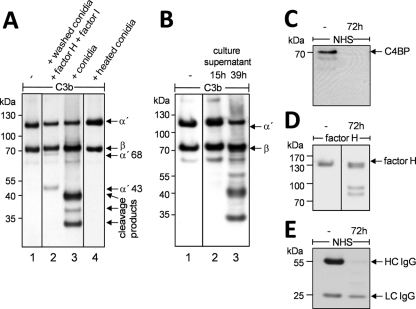
FIG. 1.
FIG. 1.
Degradation of complement components by A. fumigatus. (A) C3b inactivation on human host tissues is mediated by the human serine protease factor I in conjunction with the cofactor factor H. The degradation products of the α chain (115 kDa) of C3b are 68 kDa and 43 kDa in size (lane 2). When C3b was incubated together with A. fumigatus conidia, C3b was degraded even in the absence of factor I and factor H (lane 3). Incubation of C3b with PBS (lane 1) or heat-inactivated spores (lane 4) left C3b intact. (B) Degradation of C3b by culture supernatant. Samples of culture supernatant were taken after 15 h and 39 h of cultivation of A. fumigatus and were incubated with C3b. Degradation of C3b was analyzed by reducing SDS-PAGE and Western blotting. Degradation products were visible only after incubation in the older culture supernatant (lane 3). (C to E) Degradation of complement regulators and IgG. Culture supernatant of a nonshaking culture incubated for 72 h was incubated with NHS or purified factor H. In controls (−), NHS or factor H was incubated with PBS instead of culture supernatant. Detection of cleavage fragments was performed with polyclonal antiserum directed against C4BP, IgG, or factor H. C4BP (C) and the heavy chains of IgG (E) were absent after incubation with culture supernatant. Factor H (D) was also cleaved but was still detectable.
FIG. 2.
FIG. 2.
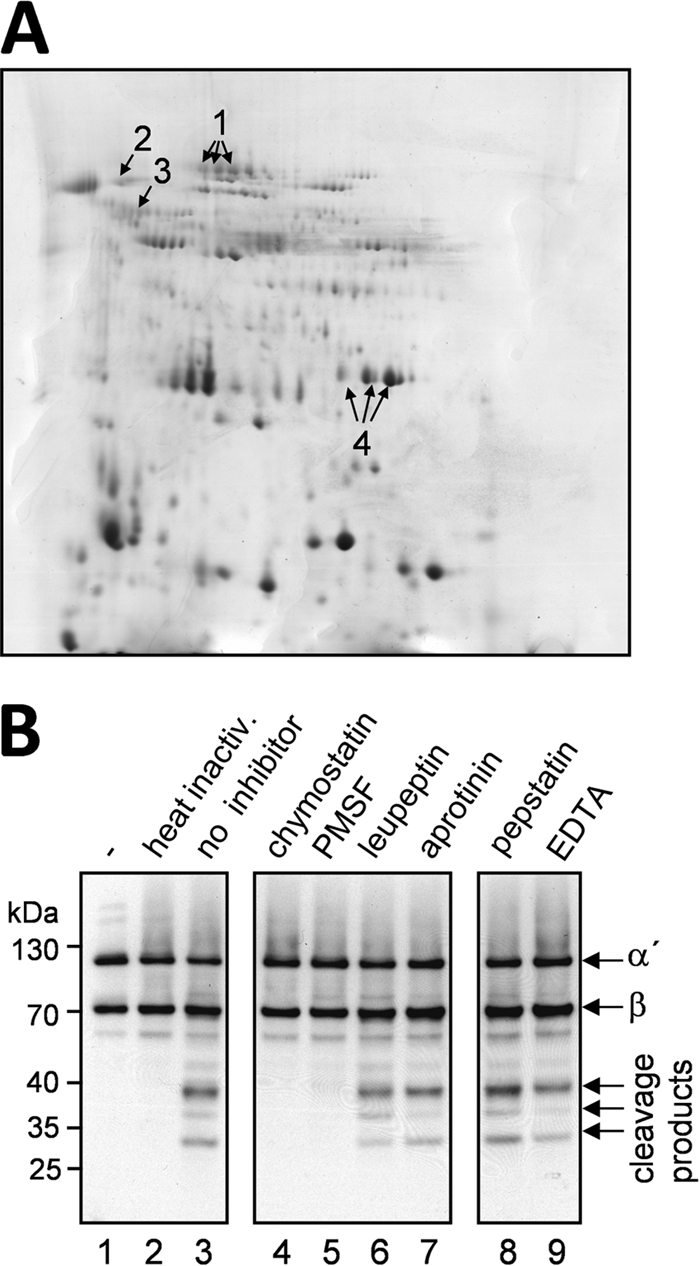
Secretome analysis and protease inhibitor studies. (A) Secretome analysis. Proteins in the culture supernatant of a 50-h-old A. fumigatus culture grown in AMM were precipitated with TCA and separated by 2D gel electrophoresis, and all detectable protein spots were subjected to mass spectrometry (MS) analysis. All spots representing proteases are marked with arrows. Arrow 1, secreted dipeptidyl peptidase; arrow 2, aspartic type endoprotease AP3; arrow 3, aminopeptidase Y; arrow 4, alkaline serine protease Alp1. (B) Protease inhibitor studies. Supernatant of a 39-h-old culture of A. fumigatus was incubated with different protease inhibitors prior to incubation with purified C3b. Addition of chymostatin, PMSF, leupeptin, or aprotinin should inhibit serine proteases (lanes 4 to 7). Incubation of supernatant with pepstatin (lane 8) and EDTA (lane 9) should block aspartic acid proteases and metalloproteases, respectively. C3b incubated with PBS (lane 1), with heat-inactivated culture supernatant (lane 2), and with untreated culture supernatant (lane 3) served as controls. Samples were subjected to reducing SDS-PAGE and Western blot analysis for the detection of C3b.
FIG. 3.
FIG. 3.
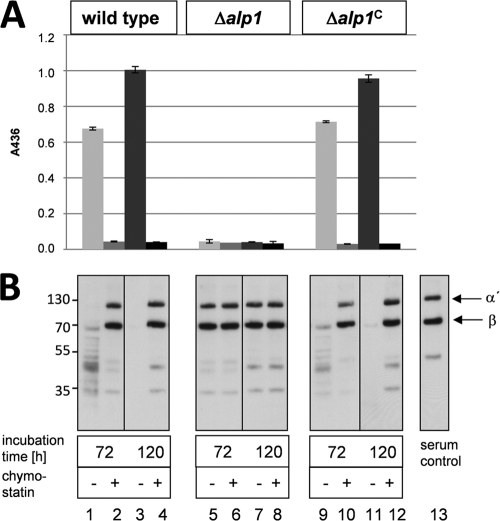
Protease activity and C3b degradation after growth in AMM. The wild-type, Δalp1, and Δalp1C strains were grown for 72 h and 120 h in AMM. Samples of the culture supernatants were either assayed directly or preincubated with the protease inhibitor chymostatin. (A) The proteolytic activities of supernatants of all cultures were measured with an azocasein assay. Error bars indicate standard deviations. (B) C3b degradation by culture supernatants was analyzed by Western blot analysis.
FIG. 4.
FIG. 4.
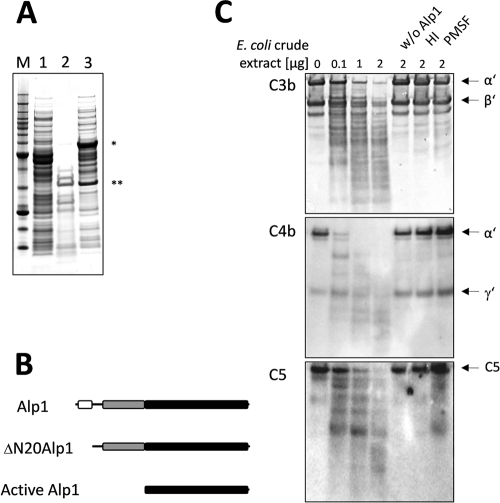
Presence of active ΔN20Alp1 in E. coli crude extract and cleavage of C3b, C4b, and C5 in vitro. (A) SDS-PAGE demonstrating the autocatalytic activation of MBP-fused ΔN20Alp1 during heterologous expression in E. coli BL21(DE3). Mass spectrometry analysis revealed the cleavage of an N-terminal peptidase inhibitor sequence (*, MBP fused to the Alp1 prepropeptide; **, active Alp1). Lanes: M, molecular weight marker proteins; 1, soluble protein fraction of E. coli BL21(DE3) cells without ΔN20Alp1-encoding vector; 2, soluble protein fraction of ΔN20Alp1-overproducing E. coli BL21(DE3) cells without PMSF; 3, after addition of 2 mM PMSF. (B) Schematic depiction of Alp1 in accordance with SignalP and Pfam. The domains represent the signal peptide (white), the peptidase inhibitor domain (gray), and the peptidase domain (black). (C) Western blot analysis showing the degradation of C3b, C4b, and C5 by increasing concentrations of E. coli BL21(DE3) crude extract containing active processed protease Alp1. As negative controls, Alp1 activity was inactivated by heat (HI) or by the addition of PMSF. Incubation of complement proteins with E. coli BL21(DE3) protein extract (w/o Alp1) did not lead to complement degradation.
FIG. 5.
FIG. 5.
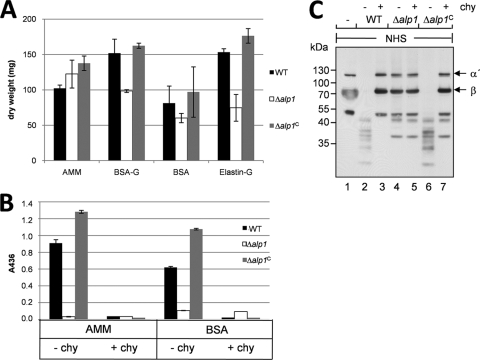
Growth and C3b degradation of the Δalp1 strain on different carbon and nitrogen sources. (A) Dry weight measurement after growth in different media. The wild-type (WT), Δalp1, and Δalp1C strains were grown in AMM, AMM−N supplemented with 10 mM glucose and 1% (wt/vol) BSA (BSA-G), AMM−N with 1% (wt/vol) BSA (BSA), or AMM−N with 10 mM glucose and 0.4% (wt/vol) elastin (Elastin-G). Dry weight was measured after 72 h of incubation. Error bars indicate standard deviations. (B) Protease activity after growth in BSA medium compared to AMM. Protease activity in the culture supernatants after 72 h of incubation was measured with an azocasein assay. Alp1 protease activity was inhibited by addition of chymostatin to the culture supernatants (+chy). (C) Degradation of C3b after growth in BSA medium. The wild-type, Δalp1, and Δalp1C strains were grown in AMM−N with 1% (wt/vol) BSA as the sole carbon and nitrogen source for 67 h. Culture supernatants were incubated with NHS, and C3b cleavage was analyzed by Western blotting.
FIG. 6.
FIG. 6.
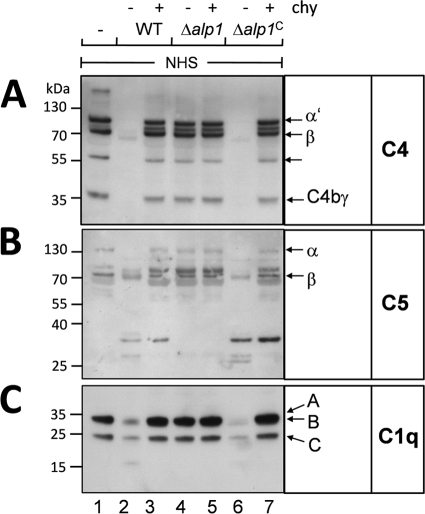
Degradation of other complement proteins after growth in AMM. The wild-type, Δalp1, and Δalp1C strains were grown in AMM for 72 h without shaking. Culture supernatant of each strain was either pretreated with chymostatin (chy) or incubated directly with NHS for 60 min. Detection of cleavage fragments was performed by Western blotting with polyclonal antibodies directed against C4 (A), C5 (B), or C1q (C).
FIG. 7.
FIG. 7.
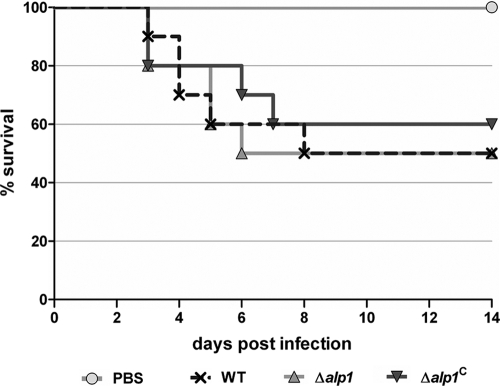
Animal experiments. Virulence of the Δalp1 strain as well as the corresponding wild-type and reconstituted strains was tested in a cortisone acetate mouse infection model. Mice (n = 10) were immunosuppressed with cortisone acetate on days −3 and 0 and were infected intranasally with 1 × 10⁵ spores of each strain in a 20-μl total volume. Immunosuppressed mice inoculated with PBS served as controls. Survival was monitored for 14 days.

References

    1. Alitalo, A., T. Meri, L. Ramo, T. S. Jokiranta, T. Heikkila, I. J. Seppala, J. Oksi, M. Viljanen, and S. Meri. 2001. Complement evasion by Borrelia burgdorferi: serum-resistant strains promote C3b inactivation. Infect. Immun. 69:3685-3691. - PMC - PubMed
    1. Behnsen, J., A. Hartmann, J. Schmaler, A. Gehrke, A. A. Brakhage, and P. F. Zipfel. 2008. The opportunistic human pathogenic fungus Aspergillus fumigatus evades the host complement system. Infect. Immun. 76:820-827. - PMC - PubMed
    1. Bergmann, A., T. Hartmann, T. Cairns, E. M. Bignell, and S. Krappmann. 2009. A regulator of Aspergillus fumigatus extracellular proteolytic activity is dispensable for virulence. Infect. Immun. 77:4041-4050. - PMC - PubMed
    1. Blom, A. M., T. Hallstrom, and K. Riesbeck. 2009. Complement evasion strategies of pathogens—acquisition of inhibitors and beyond. Mol. Immunol. 46:2808-2817. - PubMed
    1. Bolger, M. S., D. S. Ross, H. Jiang, M. M. Frank, A. J. Ghio, D. A. Schwartz, and J. R. Wright. 2007. Complement levels and activity in the normal and LPS-injured lung. Am. J. Physiol. Lung Cell Mol. Physiol. 292:L748-L759. - PubMed

Publication types

MeSH terms

LinkOut - more resources