. 2010 Jul 30;285(31):23799-809.
doi: 10.1074/jbc.M110.133553. Epub 2010 May 24.

Partitioning of tRNA-dependent editing between pre- and post-transfer pathways in class I aminoacyl-tRNA synthetases

Affiliations

Partitioning of tRNA-dependent editing between pre- and post-transfer pathways in class I aminoacyl-tRNA synthetases

Morana Dulic et al. J Biol Chem. .

Abstract

Hydrolytic editing activities are present in aminoacyl-tRNA synthetases possessing reduced amino acid discrimination in the synthetic reactions. Post-transfer hydrolysis of misacylated tRNA in class I editing enzymes occurs in a spatially separate domain inserted into the catalytic Rossmann fold, but the location and mechanisms of pre-transfer hydrolysis of misactivated amino acids have been uncertain. Here, we use novel kinetic approaches to distinguish among three models for pre-transfer editing by Escherichia coli isoleucyl-tRNA synthetase (IleRS). We demonstrate that tRNA-dependent hydrolysis of noncognate valyl-adenylate by IleRS is largely insensitive to mutations in the editing domain of the enzyme and that noncatalytic hydrolysis after release is too slow to account for the observed rate of clearing. Measurements of the microscopic rate constants for amino acid transfer to tRNA in IleRS and the related valyl-tRNA synthetase (ValRS) further suggest that pre-transfer editing in IleRS is an enzyme-catalyzed activity residing in the synthetic active site. In this model, the balance between pre-transfer and post-transfer editing pathways is controlled by kinetic partitioning of the noncognate aminoacyl-adenylate. Rate constants for hydrolysis and transfer of a noncognate intermediate are roughly equal in IleRS, whereas in ValRS transfer to tRNA is 200-fold faster than hydrolysis. In consequence, editing by ValRS occurs nearly exclusively by post-transfer hydrolysis in the editing domain, whereas in IleRS both pre- and post-transfer editing are important. In both enzymes, the rates of amino acid transfer to tRNA are similar for cognate and noncognate aminoacyl-adenylates, providing a significant contrast with editing DNA polymerases.


Figures

FIGURE 1.
FIGURE 1.
A, schematic presentation of editing pathways 1–4. Pre-transfer editing occurs through enhanced dissociation (pathway 2) of noncognate aminoacyl-adenylate or its enzymatic hydrolysis (pathways 1 and 3), which may be tRNA-independent (pathway 1) or tRNA-dependent (pathway 3). After transfer, mischarged tRNA can be deacylated through post-transfer editing (pathway 4). The central pathway of the scheme (colored in black) represents amino acid activation, tRNA binding, and aminoacylation of both cognate and noncognate amino acid. Pathways described in the upper or lower part of the scheme refer only to noncognate amino acid. B, crystal structure of Staphylococcus aureus IleRS in complex with tRNA (Protein Data Bank code 1QU2 (6)). tRNA is shown in green, CP1 domain in pink, and the Rossmann fold in blue, and the rest of the protein is represented in gray. The 3′-end of tRNAIle is disordered in the crystal structure.
FIGURE 2.
FIGURE 2.
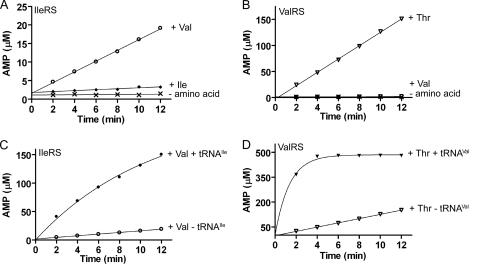
Pre-transfer and overall editing by WT IleRS and WT ValRS. A, AMP formation by 500 nm WT IleRS in the presence of 20 mm valine and lacking tRNAIle (○). Control reactions were performed with 0.5 mm isoleucine (♦) and in the absence of amino acid (×). B, AMP formation by 500 nm WT ValRS in the presence of 80 mm threonine and lacking tRNAVal (▿). Control reactions were performed with 6 mm valine (□) and in the absence of amino acid (×). C, AMP formation by 500 nm WT IleRS with 20 mm valine and in the presence (●) or absence (○) of 8 μm tRNAIle. D, AMP formation by 500 nm WT ValRS with 80 mm threonine and in the presence (▾) or absence (▿) of 10 μm tRNAVal. C and D, high concentrations of enzymes are used to most clearly depict the effect of tRNA. Enzyme concentrations giving linear product accumulation are used to determine kcat and Km values (see “Experimental Procedures”).
FIGURE 3.
FIGURE 3.
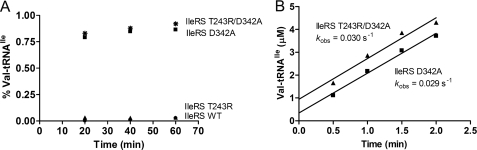
A, plateau aminoacylation of tRNAIle with Val using IleRS WT (●), T243R (▴), D342A (■), and T243R/D342A (*). tRNA was 5 μm; [14C]Val was 100 μm, and enzymes were 5 μm. B, steady-state aminoacylation of tRNAIle with Val using IleRS D342A (■) and T243R/D342A (▴). tRNA was 10 μm; [14C]Val was 100 μm, and enzymes were 1 μm.
FIGURE 4.
FIGURE 4.
Single turnover aminoacyl transfer of cognate and noncognate amino acids by IleRS D342A and ValRS D286A. A, transfer of Ile (■) and Val (▴) by IleRS D342A. tRNAIle was present at 1 μm, and IleRS D342A:AA-AMP was present at 10 μm. B, transfer of Val (■) and Thr (▴) by ValRS D286A. tRNAVal was present at 1 μm and ValRS D286A:AA-AMP was present at 20 μm.
FIGURE 5.
FIGURE 5.
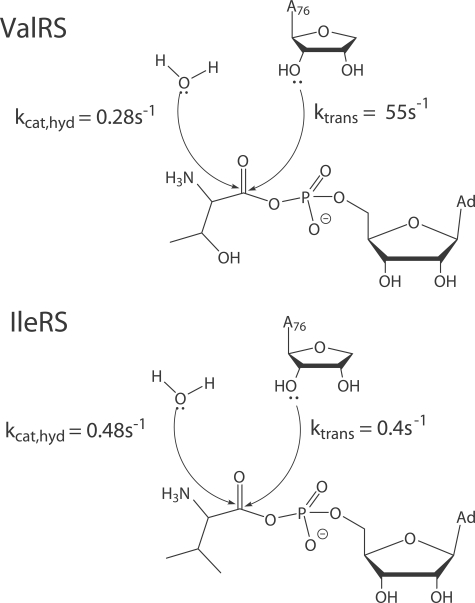
Active site partitioning of noncognate AA-AMP within the synthetic site. Fast transfer of threonine to tRNAVal predominates in the synthetic site of ValRS. In contrast, water competes efficiently with the tRNA for nucleophilic attack on carbonyl carbon atom of Val-AMP in IleRS.

References

    1. Ibba M., Soll D. (2000) Annu. Rev. Biochem. 69, 617–650 - PubMed
    1. Fersht A. R. (1977) Biochemistry 16, 1025–1030 - PubMed
    1. Fersht A. R., Kaethner M. M. (1976) Biochemistry 15, 3342–3346 - PubMed
    1. Englisch S., Englisch U., von der Haar F., Cramer F. (1986) Nucleic Acids Res. 14, 7529–7539 - PMC - PubMed
    1. Ling J., Reynolds N., Ibba M. (2009) Annu. Rev. Microbiol. 63, 61–78 - PubMed

Publication types

LinkOut - more resources