Impact of hookworm infection and deworming on anaemia in non-pregnant populations: a systematic review
- PMID: 20500563
- PMCID: PMC2916221
- DOI: 10.1111/j.1365-3156.2010.02542.x
Impact of hookworm infection and deworming on anaemia in non-pregnant populations: a systematic review
Abstract
Objectives: To summarise age- and intensity-stratified associations between human hookworm infection and anaemia and to quantify the impact of treatment with the benzimidazoles, albendazole and mebendazole, on haemoglobin and anaemia in non-pregnant populations.
Methods: Electronic databases (MEDLINE, EMBASE, PubMed) were searched for relevant studies published between 1980 and 2009, regardless of language, and researchers contacted about potential data. Haemoglobin concentration (Hb) was compared between uninfected individuals and individuals harbouring hookworm infections of different intensities, expressed as standardised mean differences (SMD) and 95% confidence intervals (CI). Meta-analysis of randomised control trials (RCTs) investigated the impact of treatment on Hb and anaemia.
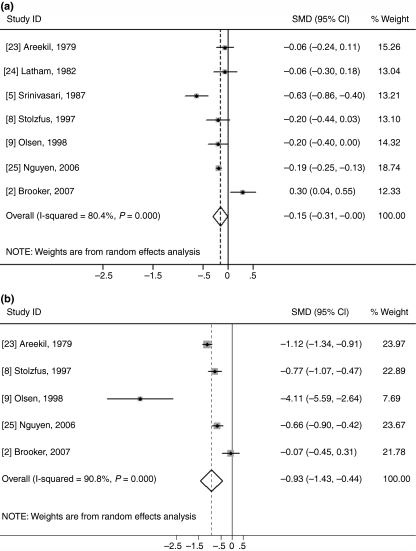
Results: Twenty-three cross-sectional studies, six pre- and post-intervention studies and 14 trials were included. Among cross-sectional studies, moderate- and heavy-intensity hookworm infections were associated with lower Hb in school-aged children, while all levels of infection intensity were associated with lower Hb in adults. Among RCTs using albendazole, impact of treatment corresponded to a 1.89 g/l increase (95%CI: 0.13-3.63) in mean Hb while mebendazole had no impact. There was a positive impact of 2.37 g/l (95%CI: 1.33-3.50) on mean Hb when albendazole was co-administered with praziquantel, but no apparent additional benefit of treatment with benzimidazoles combined with iron supplementation. The mean impact of treatment with benzimidazoles alone on moderate anaemia was small (relative risk (RR) 0.87) with a larger effect when combined with praziquantel (RR 0.61).
Conclusions: Anaemia is most strongly associated with moderate and heavy hookworm infection. The impact of anthelmintic treatment is greatest when albendazole is co-administered with praziquantel.
Figures


References
-
- Adams EJ, Stephenson LS, Latham MC, Kinoti SN. Physical activity and growth of Kenyan school children with hookworm, Trichuris trichiura and Ascaris lumbricoides infections are improved after treatment with albendazole. Journal of Nutrition. 1994;124:1199–1206. - PubMed
-
- Albonico M, Stoltzfus RJ, Savioli L, et al. Epidemiological evidence for a differential effect of hookworm species, Ancylostoma duodenale or Necator americanus, on iron status of children. International Journal of Epidemiology. 1998;27:530–537. - PubMed
-
- Anderson RM, May RM. Helminth infections of humans: mathematical models, population dynamics, and control. Advances in Parasitology. 1985;24:1–101. - PubMed
-
- Anderson RM, Schad GA. Hookworm burdens and faecal egg counts: an analysis of the biological basis of variation. Transactions of the Royal Society of Tropical Medicine and Hygiene. 1985;79:812–825. - PubMed
Publication types
MeSH terms
Substances
Grants and funding
LinkOut - more resources
Full Text Sources
Medical