


To bite or not to bite! A questionnaire-based survey assessing why some people are bitten more than others by midges
- PMID: 20500852
- PMCID: PMC2893461
- DOI: 10.1186/1471-2458-10-275
To bite or not to bite! A questionnaire-based survey assessing why some people are bitten more than others by midges
Abstract
Background: The Scottish biting midge, Culicoides impunctatus, responsible for more than 90% of biting attacks on human beings in Scotland, is known to demonstrate a preference for certain human hosts over others.
Methods: In this study we used a questionnaire-based survey to assess the association between people's perception of how badly they get bitten by midges and their demographic, lifestyle and health related characteristics.
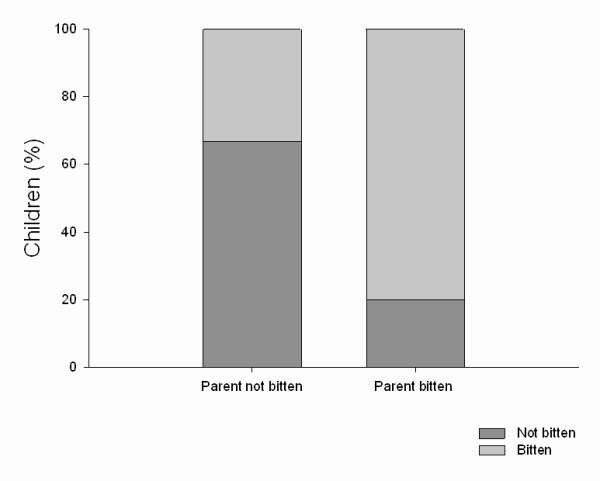
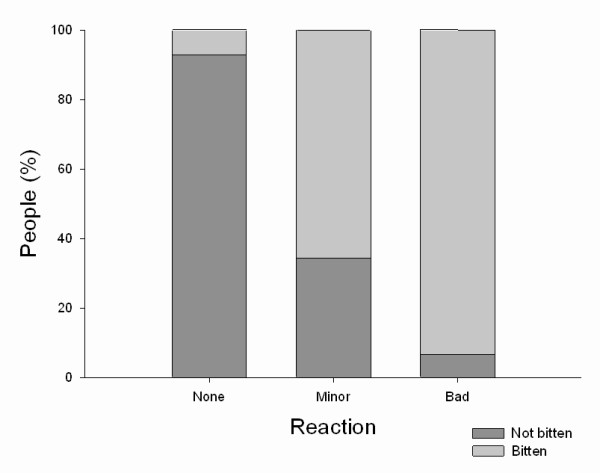
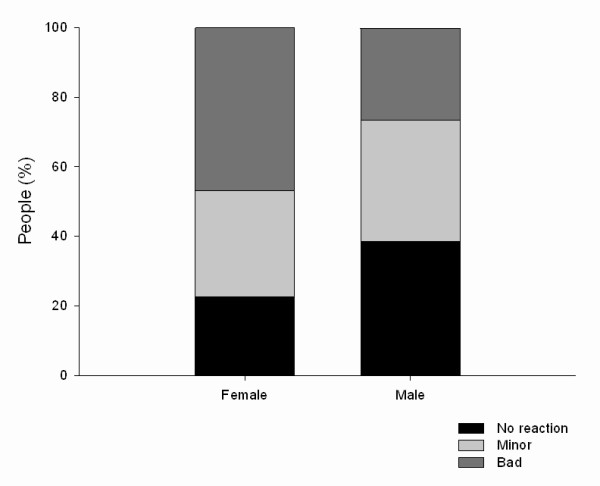
Results: Most people (85.8%) reported being bitten sometimes, often or always with only 14.2% reporting never being bitten by midges when in Scotland. There was no association between level of bites received and age, smoking, diet, exercise, medication, eating strongly flavoured foods or alcohol consumption. However, there was a strong association between the probability of being bitten and increasing height (in men) and BMI (in women). A large proportion of participants (33.8%) reported experiencing a bad/severe reaction to midge bites while 53.1% reported a minor reaction and 13.1% no reaction at all. Also, women tend to react more than men to midge bites. Additionally, the results indicated that the susceptibility to being bitten by midges is hereditary.
Conclusions: This study suggests that midges prefer to bite men that are tall and women that have a large BMI, and that the tendency for a child to be bitten or not could be inherited from their parent. The study is questionnaire-based; therefore, the interpretation of the results may be limited by the subjectivity of the answers given by the respondents. Although the results are relevant only to the Scottish biting midge, the approach used here could be useful for investigating human-insect interactions for other insects, particularly those which transmit pathogens that cause disease.
Figures

References
-
- Blackwell A, Wadhams LJ, Mordue W. Electrophysiological and behavioural studies of the biting midge, Culicoides impunctatus Goetghebuer (Diptera: Ceratopogonidae): Interactions between some plant-derived repellent compounds and a host-odour attractant, 1-octen-3-ol. Physiological Entomology. 1997;22(2):102–108. doi: 10.1111/j.1365-3032.1997.tb01146.x. - DOI
-
- Hendry G, Godwin G. Biting midges in Scottish forestry: a costly irritant or a trivial nuisance? Scottish Forestry. 1988;42:113–119.
-
- Mordue (Luntz) AJ. Biting midge chemical ecology. Biologist. 2003;50(4):159–162.
-
- Logan JG, Seal NJ, Cook JI, Stanczyk NM, Birkett MA, Clark SJ, Gezan SA, Wadhams LJ, Pickett JA, Mordue J. Identification of Human-Derived Volatile Chemicals That Interfere With Attraction of the Scottish Biting Midge and Their Potential Use as Repellents. J Med Entomol. 2009;46(2):208–219. doi: 10.1603/033.046.0205. - DOI - PubMed
Publication types
MeSH terms
Grants and funding
LinkOut - more resources
Full Text Sources
Medical
Research Materials
