


Early tumor dissemination, but late metastasis: insights into tumor dormancy
- PMID: 20501952
- PMCID: PMC2877965
- DOI: 10.1172/JCI43424
Early tumor dissemination, but late metastasis: insights into tumor dormancy
Abstract
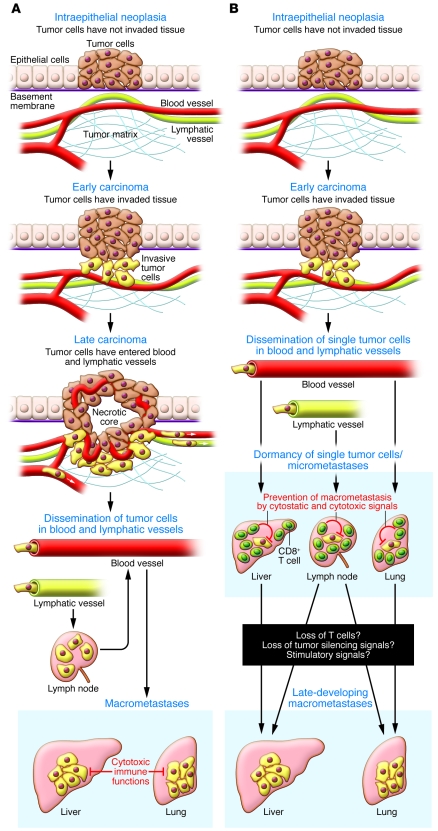
The classical model of metastasis is that tumor cell dissemination occurs late in tumor development, after the primary tumor has grown, and that only then will tumor cells invade the local tissue, enter the blood or lymphatic vessels, and colonize new sites to cause metastases. However, evidence increasingly indicates that single tumor cells spread to distant sites much earlier than previously believed. In this issue of the JCI, Eyles and colleagues provide new insight into the mechanisms underlying early tumor cell dissemination, formation of metastases, and tumor immunosurveillance using transgenic mice that spontaneously develop melanomas of the uvea. The authors provide striking evidence that tumor cells start to disseminate during the initial steps of tumor development, that late appearing metastases arise from these early disseminated tumor cells, and that CD8+ T cells inhibit the growth of disseminated tumor cells, surprisingly, not by cytotoxic effects, but through cytostatic effects.
Figures
Comment on
-
Tumor cells disseminate early, but immunosurveillance limits metastatic outgrowth, in a mouse model of melanoma.J Clin Invest. 2010 Jun;120(6):2030-9. doi: 10.1172/JCI42002. Epub 2010 May 24. J Clin Invest. 2010. PMID: 20501944 Free PMC article.
References
Publication types
MeSH terms
LinkOut - more resources
Full Text Sources
Medical
Research Materials
