. 2010 May 20;6(5):e1000912.
doi: 10.1371/journal.ppat.1000912.

The Plasmodium falciparum-specific human memory B cell compartment expands gradually with repeated malaria infections

Affiliations

The Plasmodium falciparum-specific human memory B cell compartment expands gradually with repeated malaria infections

Greta E Weiss et al. PLoS Pathog. .

Abstract

Immunity to Plasmodium falciparum (Pf) malaria is only acquired after years of repeated infections and wanes rapidly without ongoing parasite exposure. Antibodies are central to malaria immunity, yet little is known about the B-cell biology that underlies the inefficient acquisition of Pf-specific humoral immunity. This year-long prospective study in Mali of 185 individuals aged 2 to 25 years shows that Pf-specific memory B-cells and antibodies are acquired gradually in a stepwise fashion over years of repeated Pf exposure. Both Pf-specific memory B cells and antibody titers increased after acute malaria and then, after six months of decreased Pf exposure, contracted to a point slightly higher than pre-infection levels. This inefficient, stepwise expansion of both the Pf-specific memory B-cell and long-lived antibody compartments depends on Pf exposure rather than age, based on the comparator response to tetanus vaccination that was efficient and stable. These observations lend new insights into the cellular basis of the delayed acquisition of malaria immunity.


Conflict of interest statement

The authors have declared that no competing interests exist.

Figures
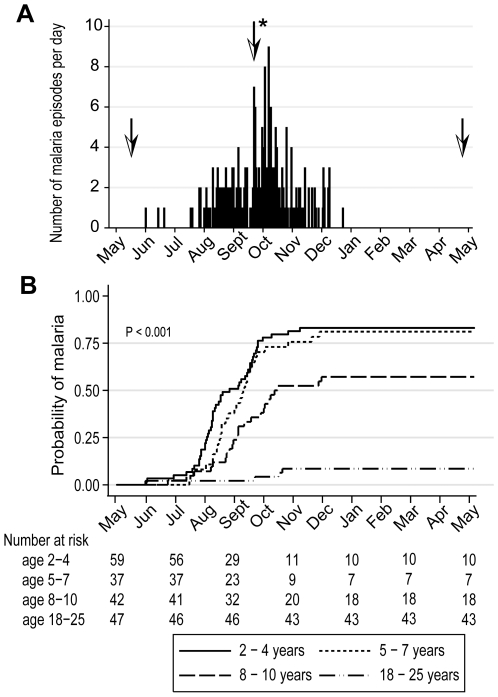
Figure 1
Figure 1. Malaria immunity is acquired gradually despite intense annual exposure to the Pf parasite.
(A) Number of malaria episodes per day during the study period. Over a one-year surveillance period 185 individuals experienced 219 malaria episodes during a sharply-demarcated six-month malaria season. Malaria episodes were defined as fever ≥37.5°C and Pf asexual parasitemia ≥5000/µL blood. To track the B-cell response to acute malaria, and after a period of reduced Pf exposure, PBMCs and plasma were collected at points indicated by the arrows: before the malaria season, two weeks after the first malaria episode (arrow with asterisk indicates the mean time to first malaria episode, 132 days from enrollment), and six months after the end of the malaria season. (B) Kaplan-Meier estimates of the cumulative probability of malaria over the study period, according to age category. The number of individuals at risk over the study period is shown below the graph. The P value was obtained using the log rank test.
Figure 2
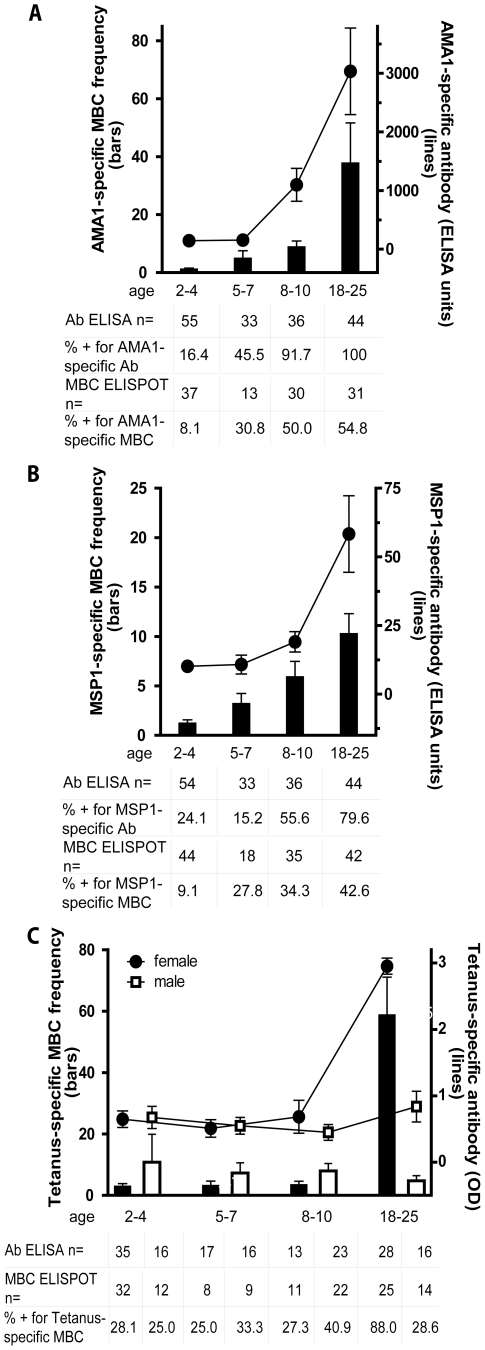
Figure 2. The Pf-specific MBC and long-lived antibody compartments expand gradually with age.
Shown are the MBC frequencies (bars, left axis) and antibody levels (lines, right axis) specific for AMA1 (A) and MSP1 (B) by age category; and TT (C) by age category and gender; before the malaria season in Pf-uninfected individuals. The frequency of AMA1- and MSP1-specific MBCs increased with age (P<0.001 for both trends), as did the level of AMA1- and MSP1-specific antibodies (P<0.001 for both trends). There were no significant differences by gender for the AMA1- and MSP1-specific responses (not shown). To determine if the expansion of Pf-specific MBCs with age was driven by exposure to antigen or simply a function of age, we measured the TT-specific MBC and antibody response with age. In Mali, infants are vaccinated with TT, and females receive a TT booster around the age of 15 years to prevent neonatal tetanus. In contrast to AMA1 and MSP1, the frequency of TT-specific MBCs and the level of TT-specific antibodies for males did not change significantly from age 2 to 25 years (P = 0.80 and P = 0.44, respectively). However, the frequency of TT-specific MBCs and the level of TT-specific antibodies was higher in female adults compared to female children (P<0.001 for both comparisons). MBC frequencies were determined by ELISPOT and are expressed per million PBMC. The number of individual samples assayed and the percent of individual samples that exceeded the limit of detection (i.e. those considered positive) is indicated below the graph. The discrepancy in the sample size for ELISA data among 2–4 year olds is due to technical error during the performance of the ELISA. P values were obtained by the Kruskal-Wallis test. Data are shown as mean ± s.e.m.
Figure 3
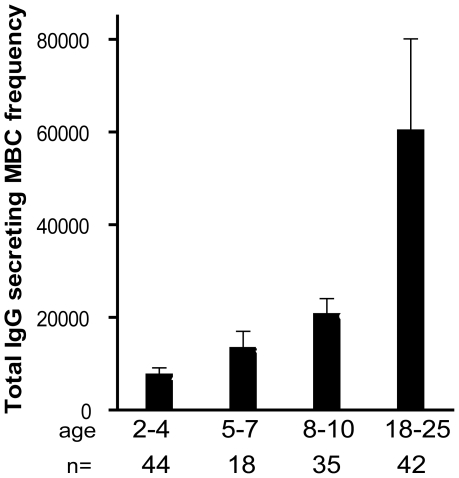
Figure 3. The size of total IgG+ MBC compartment expands gradually with age.
The frequency of IgG+ MBCs per million PBMCs measured before the malaria season increased with age (P<0.001). The number of individuals in each age category is indicated. The P value was obtained by the Kruskal-Wallis test. Data are shown as mean ± s.e.m.
Figure 4
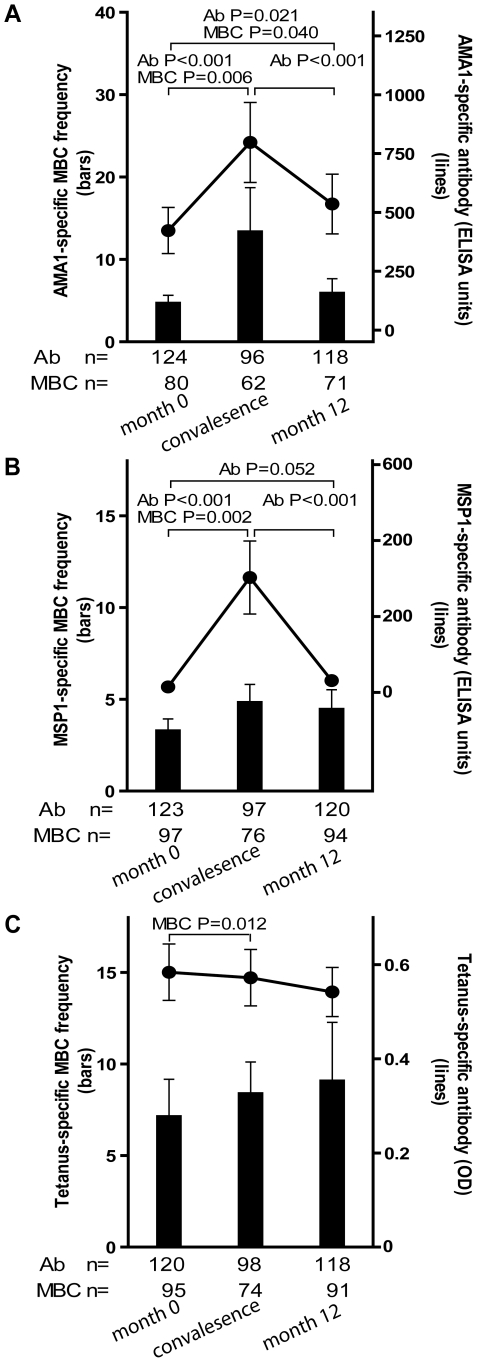
Figure 4. Longitudinal analysis of the Pf- and TT-specific MBC and antibody response.
Compared to month zero, the MBC frequencies and antibody levels specific for AMA1 (A) and MSP1 (B) increased two weeks after the first episode of malaria and then contracted to a point slightly higher than pre-infection levels after a six-month period of decreased Pf exposure. Compared to month zero, there was a small but statistically significant increase in TT-specific MBC two weeks after the first episode of malaria (C), whereas the level of TT-specific antibodies did not change. The number of individuals in each age category is indicated. Only statistically significant P values are shown. P values were obtained by the Wilcoxon matched-pairs signed-rank test. Data are shown as mean ± s.e.m.
Figure 5
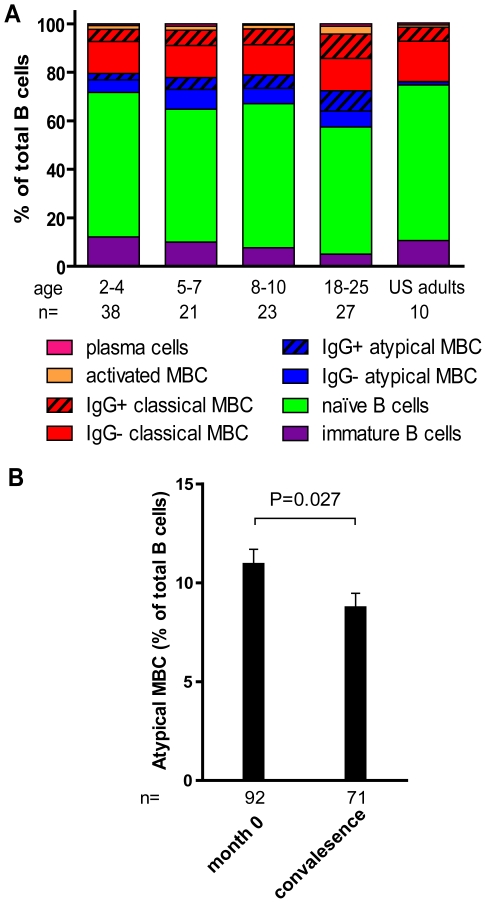
Figure 5. Profile of B-cell subsets before the malaria season in children and adults.
(A) By flow cytometry the following B cell subsets were quantified from samples collected before the malaria season: immature B cells CD19+ CD10+, naïve B cells CD19+ CD27 CD21+ CD10, atypical MBCs CD19+ CD27 CD21 CD10, classical MBCs CD19+ CD27+ CD21+, activated MBCs CD19+ CD21 CD27+ CD20+, and PCs CD19+ CD21 CD20 CD10. As a percentage of CD19+ B cells, immature B cells (P<0.001) and naïve B cells (P = 0.047) decreased with age, while atypical MBCs (P = 0.002), IgG+ atypical MBCs (P<0.001), IgG+ classical MBCs (P<0.001)), activated MBCs (P = 0.001), IgG+ activated MBCs (P<0.001) and PCs (P = 0.046) increased with age. P values were obtained by the Kruskal-Wallis test. (B) As a percentage of CD19+ B cells, atypical MBCs decreased 14 days after acute malaria in children aged 2–10 years compared to the percentage before the malaria season. The P value was obtained by the Wilcoxon matched-pairs signed-rank test. Data are shown as mean ± s.e.m.

References

    1. Plotkin SA. Vaccines: correlates of vaccine-induced immunity. Clin Infect Dis. 2008;47:401–409. - PubMed
    1. Vekemans J, Ballou WR. Plasmodium falciparum malaria vaccines in development. Expert Rev Vaccines. 2008;7:223–240. - PubMed
    1. Marsh K, Kinyanjui S. Immune effector mechanisms in malaria. Parasite Immunol. 2006;28:51–60. - PubMed
    1. Cohen S, Mc GI, Carrington S. Gamma-globulin and acquired immunity to human malaria. Nature. 1961;192:733–737. - PubMed
    1. Langhorne J, Ndungu FM, Sponaas AM, Marsh K. Immunity to malaria: more questions than answers. Nat Immunol. 2008;9:725–732. - PubMed

Publication types

MeSH terms