Clinical Trial
. 2010 May 26:9:123.
doi: 10.1186/1476-4598-9-123.

MicroRNAs involvement in fludarabine refractory chronic lymphocytic leukemia

Affiliations
Clinical Trial

MicroRNAs involvement in fludarabine refractory chronic lymphocytic leukemia

Manuela Ferracin et al. Mol Cancer. .

Abstract

Background: Fludarabine, is one of the most active single agents in the treatment of chronic lymphocytic leukemia (CLL). Over time, however, virtually all CLL patients become fludarabine-refractory. To elucidate whether microRNAs are involved in the development of fludarabine resistance, we analyzed the expression of 723 human miRNAs before and 5-days after fludarabine mono-therapy in 17 CLL patients which were classified as responder or refractory to fludarabine treatment based on NCI criteria.

Results: By comparing the expression profiles of these two groups of patients, we identified a microRNA signature able to distinguish refractory from sensitive CLLs. The expression of some microRNAs was also able to predict fludarabine resistance of 12 independent CLL patients. Among the identified microRNAs, miR-148a, miR-222 and miR-21 exhibited a significantly higher expression in non-responder patients either before and after fludarabine treatment. After performing messenger RNA expression profile of the same patients, the activation of p53-responsive genes was detected in fludarabine responsive cases only, therefore suggesting a possible mechanism linked to microRNA deregulation in non-responder patients. Importantly, inhibition of miR-21 and miR-222 by anti-miRNA oligonucleotides induced a significant increase in caspase activity in fludarabine-treated p53-mutant MEG-01 cells, suggesting that miR-21 and miR-222 up-regulation may be involved in the establishment of fludarabine resistance.

Conclusions: This is the first report that reveals the existence of a microRNA profile that differentiate refractory and sensitive CLLs, either before and after fludarabine mono-therapy. A p53 dysfunctional pathway emerged in refractory CLLs and could contribute in explaining the observed miRNA profile. Moreover, this work indicates that specific microRNAs can be used to predict fludarabine resistance and may potentially be used as therapeutic targets, therefore establishing an important starting point for future studies.


Figures
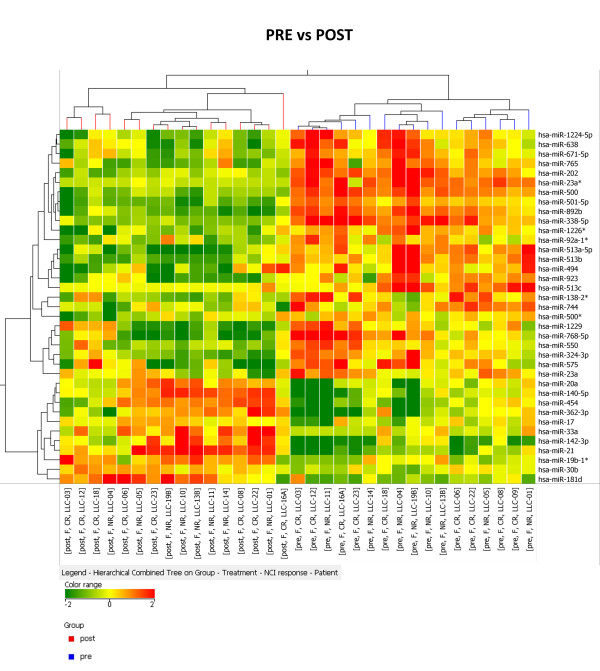
Figure 1
Figure 1
MiRNAs modulated by fludarabine. Cluster analysis of 17 CLL patients based on 37 miRNAs differentially expressed pre and post fludarabine treatment. Statistical analysis revealed that 37 miRNAs are modulated by the drug both in sensitive (CR) and refractory (NR) patients. The expression values of the genes represented on the heatmap correspond to the values normalized on miRNA mean expression across all samples. CLL pre treatment are colored in blue, post treatment in red.
Figure 2
Figure 2
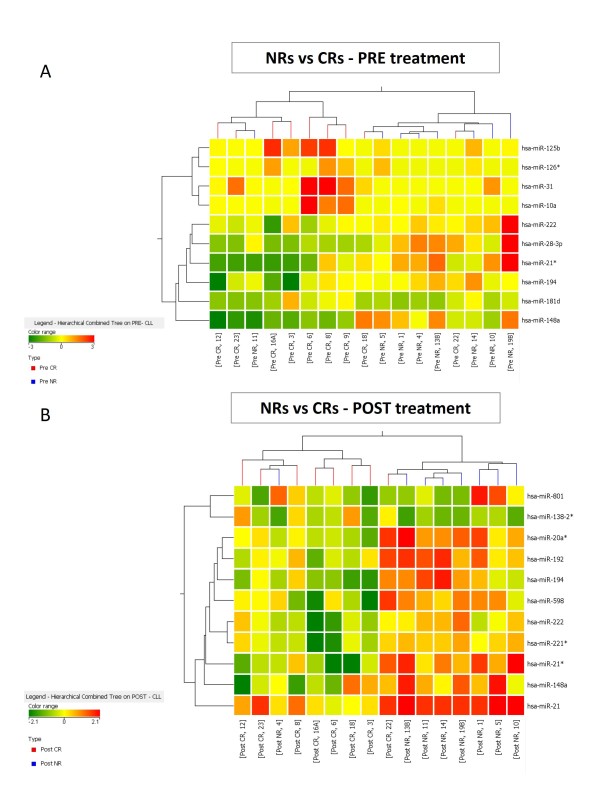
Classification of CLL patients in accordance to miRNAs that differentiate fludarabine responders from not responders. A) Eleven miRNAs are significantly (p < 0.05) modulated before fludarabine treatment between resistant and sensitive CLLs and were used for sample classification; cluster analysis revealed a good separation between the two classes. (B) Expression profile after fludarabine treatment; Ten miRNAs are differentially expressed (p < 0.05) in patients that will respond or not to chemotherapy; again, a good separation was achieved.
Figure 3
Figure 3
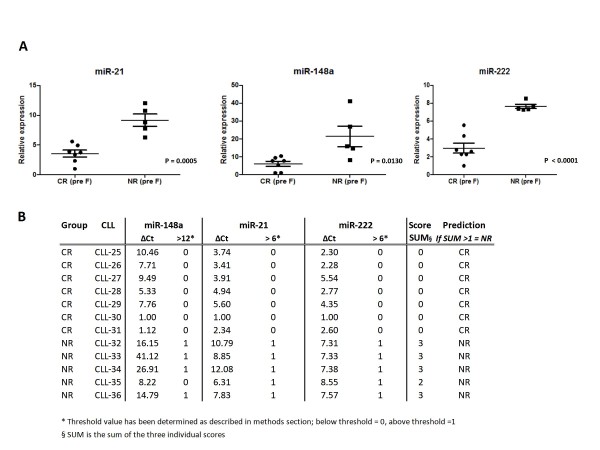
Quantitative RT-PCR validation for miR-222, miR148a and miR-21 in independent CLL patients. A) MiRNAs expression in a novel cohort of not responder (NR) and complete responder (CR) patients, before fludarabine treatment, quantified by using TaqMan reverse transcription qPCR. Each expression data is normalized on endogenous U6 RNA levels by 2-ΔCt method. Each sample has been analyzed in triplicate. Data are displayed using vertical scatter plot (GraphPad v.5), bars represent means ± SEM. Two-tailed t-test was used to determine the p-values. B) Prediction of response to treatment in newly diagnosed CLL patients in accordance to a 3 miRNAs-based score. A threshold useful to predict response to therapy was established based on miRNA relative expression. Each patient with a final score >1 was classified as refractory.
Figure 4
Figure 4
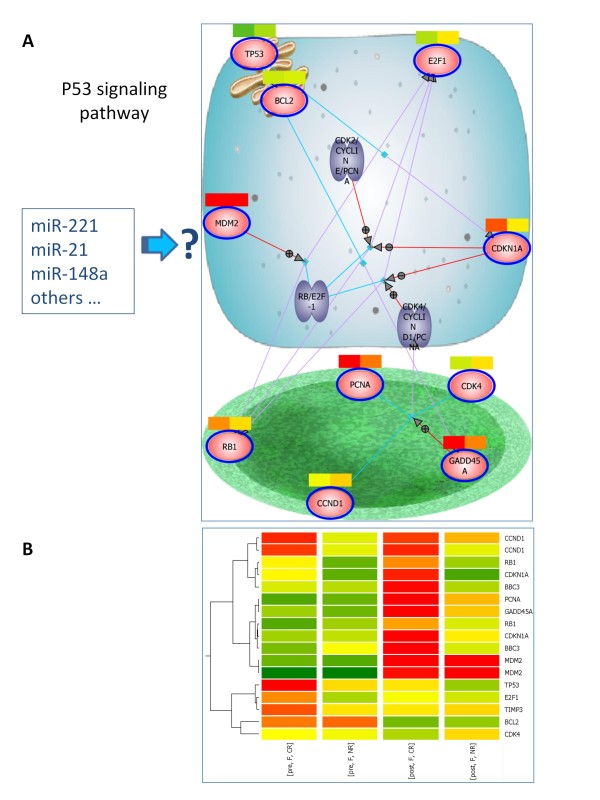
Differential expression of p53-pathway genes in sensitive and refractory CLLs. (A) Cellular representation of BioCarta p53 signaling pathway. Genes involved in p53 pathway were colored in accordance to microarray expression data for post CLLs normalized on matched pre samples. Average expression in CR patients is on the right part of the colorbar, NR patients on the left part. Genes like p21, GADD45A, PCNA are up-modulated only in sensitive CLLs. (B) Average expression of all the genes involved in p53 pathways (cell cycle control and apoptosis) in pre/post CR and pre/post NR groups. Puma/BBC3 gene is induced only in sensitive CLLs.
Figure 5
Figure 5
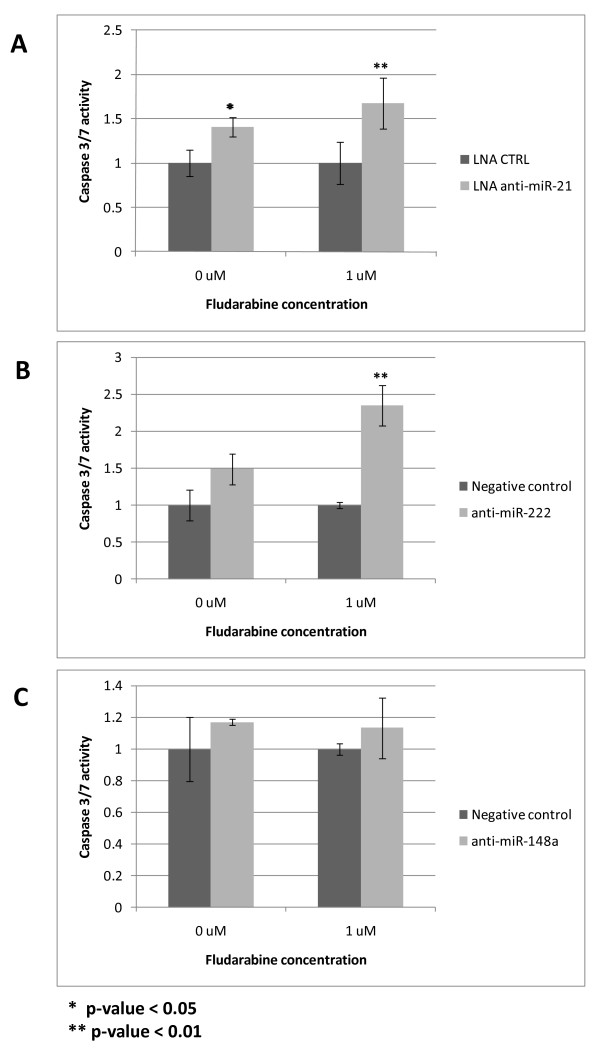
Impact of anti-miRNAs on MEG-01 fludarabine sensitivity. Caspase 3/7 activity after anti-miR-21, 222, 148a treatment of MEG-01 cells, in absence or presence of fludarabine (1 μM). LNA-anti-miR-21 and anti-miR-222, but not anti-miR-148a, were able to induce increase apoptosis in MEG-01 cells, which harbor a mutant p53 protein. The inhibition of miR-21 and miR-222 sensitizes the cells to fludarabine action, leading to an increased caspase activation when fludarabine 1 μM is added after 24 hours.

References

    1. Tam CS, Keating MJ. Chemoimmunotherapy of chronic lymphocytic leukemia. Best Pract Res Clin Haematol. 2007;20:479–498. doi: 10.1016/j.beha.2007.02.004. - DOI - PubMed
    1. Eichhorst BF, Busch R, Hopfinger G, Pasold R, Hensel M, Steinbrecher C, Siehl S, Jager U, Bergmann M, Stilgenbauer S. Fludarabine plus cyclophosphamide versus fludarabine alone in first-line therapy of younger patients with chronic lymphocytic leukemia. Blood. 2006;107:885–891. doi: 10.1182/blood-2005-06-2395. - DOI - PubMed
    1. Montserrat E, Moreno C, Esteve J, Urbano-Ispizua A, Gine E, Bosch F. How I treat refractory CLL. Blood. 2006;107:1276–1283. doi: 10.1182/blood-2005-02-0819. - DOI - PubMed
    1. Turgut B, Vural O, Pala FS, Pamuk GE, Tabakcioglu K, Demir M, Ongoren S, Soysal T, Algunes C. 17p Deletion is associated with resistance of B-cell chronic lymphocytic leukemia cells to in vitro fludarabine-induced apoptosis. Leuk Lymphoma. 2007;48:311–320. doi: 10.1080/10428190601059829. - DOI - PubMed
    1. Dohner H, Fischer K, Bentz M, Hansen K, Benner A, Cabot G, Diehl D, Schlenk R, Coy J, Stilgenbauer S. p53 gene deletion predicts for poor survival and non-response to therapy with purine analogs in chronic B-cell leukemias. Blood. 1995;85:1580–1589. - PubMed

Publication types

MeSH terms