


Expression signatures of TP53 mutations in serous ovarian cancers
- PMID: 20504346
- PMCID: PMC2893110
- DOI: 10.1186/1471-2407-10-237
Expression signatures of TP53 mutations in serous ovarian cancers
Abstract
Background: Mutations in the TP53 gene are extremely common and occur very early in the progression of serous ovarian cancers. Gene expression patterns that relate to mutational status may provide insight into the etiology and biology of the disease.
Methods: The TP53 coding region was sequenced in 89 frozen serous ovarian cancers, 40 early stage (I/II) and 49 advanced stage (III/IV). Affymetrix U133A expression data was used to define gene expression patterns by mutation, type of mutation, and cancer stage.
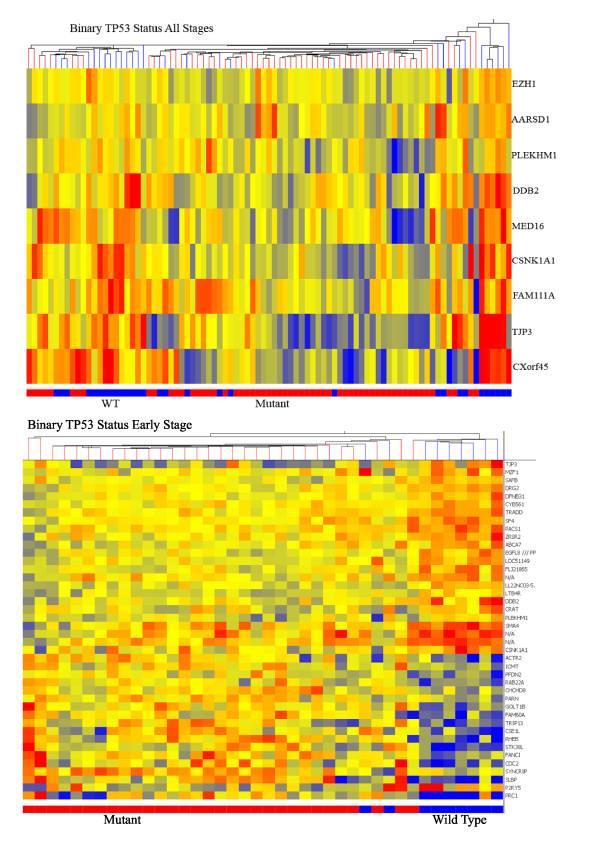
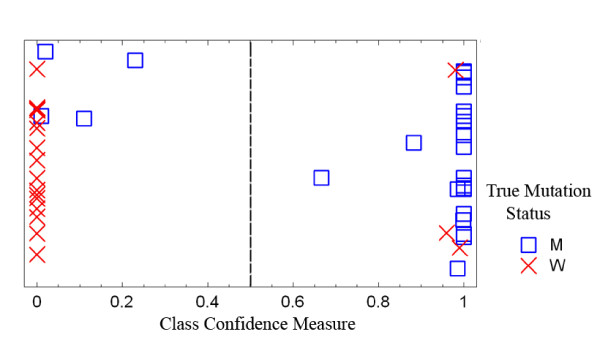
Results: Missense or chain terminating (null) mutations in TP53 were found in 59/89 (66%) ovarian cancers. Early stage cancers had a significantly higher rate of null mutations than late stage disease (38% vs. 8%, p < 0.03). In advanced stage cases, mutations were more prevalent in short term survivors than long term survivors (81% vs. 30%, p = 0.0004). Gene expression patterns had a robust ability to predict TP53 status within training data. By using early versus late stage disease for out of sample predictions, the signature derived from early stage cancers could accurately (86%) predict mutation status of late stage cancers.
Conclusions: This represents the first attempt to define a genomic signature of TP53 mutation in ovarian cancer. Patterns of gene expression characteristic of TP53 mutation could be discerned and included several genes that are known p53 targets or have been described in the context of expression signatures of TP53 mutation in breast cancer.
Figures
References
-
- Carlson JW, Miron A, Jarboe EA, Parast MM, Hirsch MS, Lee Y, Muto MG, Kindelberger D, Crum CP. Serous tubal intraepithelial carcinoma: its potential role in primary peritoneal serous carcinoma and serous cancer prevention. J Clin Oncol. 2008;26(25):4160–4165. doi: 10.1200/JCO.2008.16.4814. - DOI - PMC - PubMed
Publication types
MeSH terms
Substances
Grants and funding
LinkOut - more resources
Full Text Sources
Medical
Research Materials
Miscellaneous
