Review
. 2010 Jul-Aug;2(4):365-78.
doi: 10.4161/mabs.12187. Epub 2010 Jul 1.

Mining human antibody repertoires

Affiliations
Review

Mining human antibody repertoires

Roger R Beerli et al. MAbs. 2010 Jul-Aug.

Abstract

Human monoclonal antibodies (mAbs) have become drugs of choice for the management of an increasing number of human diseases. Human antibody repertoires provide a rich source for human mAbs. Here we review the characteristics of natural and non-natural human antibody repertoires and their mining with non-combinatorial and combinatorial strategies. In particular, we discuss the selection of human mAbs from naïve, immune, transgenic, and synthetic human antibody repertoires using methods based on hybridoma technology, clonal expansion of peripheral B cells, single-cell PCR, phage display, yeast display, and mammalian cell display. Our reliance on different strategies is shifting as we gain experience and refine methods to the efficient generation of human mAbs with superior pharmacokinetic and pharmacodynamic properties.


Figures
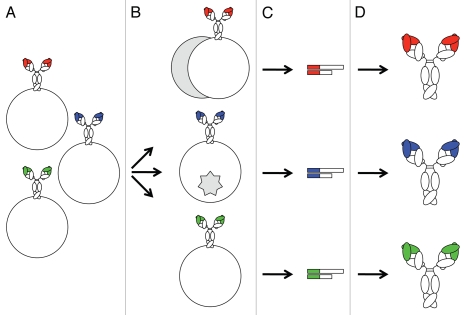
Figure 1
Figure 1
Non-combinatorial mining of human antibody repertoires. (A) Human antibody repertoires consist of polyclonal mixtures of a variety of B cells that express functional human antibodies, including naive and post-GC B cells that represent naïve and immune repertoires, respectively. Post-GC B cells, which differentiate into antibody secreting cells and memory B cells, provide a human antibody repertoire that has been extensively mined with non-combinatorial strategies. (B) Hybridoma technology (top), EBV immortalization (center), and single-cell sorting (bottom) allow the isolation and expansion of monoclonal B cells which are then screened with an antigen of interest. Cell surface Ig can be utilized to first enrich B cells that express human antibodies to the antigen of interest. (C) Heavy and light chain cDNAs are amplified from mRNA of monoclonal B cells and B-cell lines by RT-PCR. (D) After cloning heavy and light chain cDNAs into ectopic expression vectors, human mAbs are purified from the supernatant of transfected mammalian cells (typically Chinese hamster ovary CHO or mouse myeloma NS0 cells) in high yields.
Figure 2
Figure 2
Combinatorial mining of human antibody repertoires. Polyclonal or oligoclonal mixtures of human B cells (A) are used in bulk to isolate mRNA and amplify cDNA of heavy and light chains (B). (C) Heavy and light chain cDNAs are cloned into display vectors that afford antibody libraries with a physical linkage of genotype (cDNA) and phenotype (protein). Shown as examples are filamentous phage that encode and display Fab (top) and virus-infected mammalian cells that express and display scFv (bottom). Note that heavy and light chains are randomly combined. (D) Antibody libraries are then selected by several rounds of panning on immobilized antigen (top) or screened by a single round of FACS using fluorescently labeled antigen (bottom). (See text for details). The physical linkage of genotype and phenotype allows the enrichment and amplification of displayed antibodies. (E) Human mAbs from antibody libraries are manufactured the same way as human mAbs from monoclonal B cells and B-cell lines.

References

    1. Hwang WY, Foote J. Immunogenicity of engineered antibodies. Methods. 2005;36:3–10. - PubMed
    1. Weiner LM. Fully human therapeutic monoclonal antibodies. J Immunother. 2006;29:1–9. - PubMed
    1. Swann PG, Tolnay M, Muthukkumar S, Shapiro MA, Rellahan BL, Clouse KA. Considerations for the development of therapeutic monoclonal antibodies. Curr Opin Immunol. 2008;20:493–499. - PubMed
    1. Weiner LM, Dhodapkar MV, Ferrone S. Monoclonal antibodies for cancer immunotherapy. Lancet. 2009;373:1033–1040. - PMC - PubMed
    1. Kohler G, Milstein C. Continuous cultures of fused cells secreting antibody of predefined specificity. Nature. 1975;256:495–497. - PubMed

Publication types

LinkOut - more resources
