


Synthesized Population Databases: A US Geospatial Database for Agent-Based Models
- PMID: 20505787
- PMCID: PMC2875687
- DOI: 10.3768/rtipress.2009.mr.0010.0905
Synthesized Population Databases: A US Geospatial Database for Agent-Based Models
Abstract
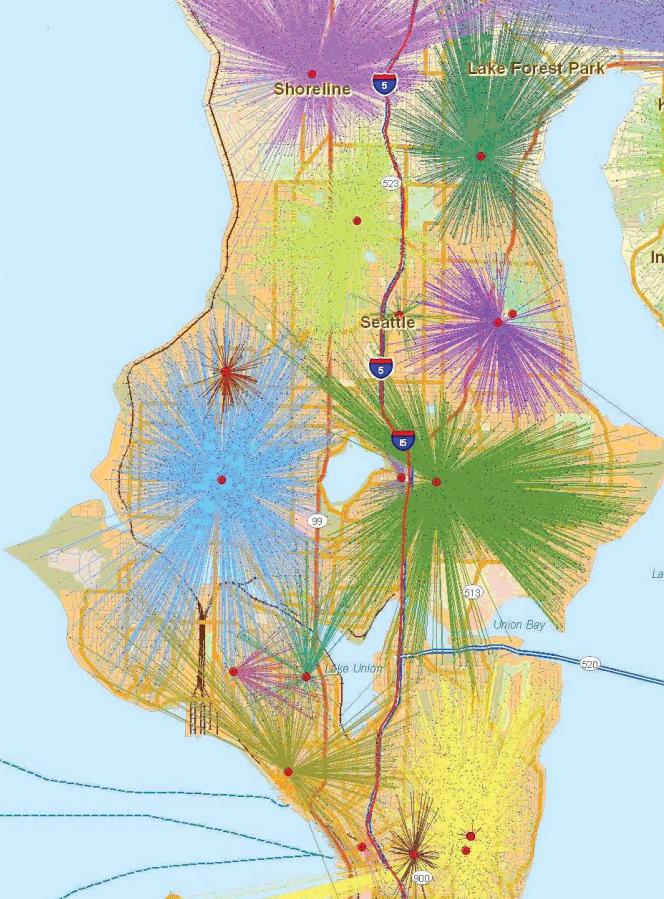
Agent-based models simulate large-scale social systems. They assign behaviors and activities to "agents" (individuals) within the population being modeled and then allow the agents to interact with the environment and each other in complex simulations. Agent-based models are frequently used to simulate infectious disease outbreaks, among other uses.RTI used and extended an iterative proportional fitting method to generate a synthesized, geospatially explicit, human agent database that represents the US population in the 50 states and the District of Columbia in the year 2000. Each agent is assigned to a household; other agents make up the household occupants.For this database, RTI developed the methods for generating synthesized households and personsassigning agents to schools and workplaces so that complex interactions among agents as they go about their daily activities can be taken into accountgenerating synthesized human agents who occupy group quarters (military bases, college dormitories, prisons, nursing homes).In this report, we describe both the methods used to generate the synthesized population database and the final data structure and data content of the database. This information will provide researchers with the information they need to use the database in developing agent-based models.Portions of the synthesized agent database are available to any user upon request. RTI will extract a portion (a county, region, or state) of the database for users who wish to use this database in their own agent-based models.
Figures





Similar articles
-
Including the Group Quarters Population in the US Synthesized Population Database.Methods Rep RTI Press. 2011 Feb 1;20(1102):1-26. doi: 10.3768/rtipress.2011.mr.0020.1102. Methods Rep RTI Press. 2011. PMID: 21841972 Free PMC article.
-
Folic acid supplementation and malaria susceptibility and severity among people taking antifolate antimalarial drugs in endemic areas.Cochrane Database Syst Rev. 2022 Feb 1;2(2022):CD014217. doi: 10.1002/14651858.CD014217. Cochrane Database Syst Rev. 2022. PMID: 36321557 Free PMC article.
-
The future of Cochrane Neonatal.Early Hum Dev. 2020 Nov;150:105191. doi: 10.1016/j.earlhumdev.2020.105191. Epub 2020 Sep 12. Early Hum Dev. 2020. PMID: 33036834
-
Synthesized Population Databases: A Geospatial Database of US Poultry Farms.Methods Rep RTI Press. 2012 Jan 1;MR-0023-1201:1-24. doi: 10.3768/rtipress.2012.mr.0023.1201. Methods Rep RTI Press. 2012. PMID: 25364787 Free PMC article.
-
Tuberculosis.In: Holmes KK, Bertozzi S, Bloom BR, Jha P, editors. Major Infectious Diseases. 3rd edition. Washington (DC): The International Bank for Reconstruction and Development / The World Bank; 2017 Nov 3. Chapter 11. In: Holmes KK, Bertozzi S, Bloom BR, Jha P, editors. Major Infectious Diseases. 3rd edition. Washington (DC): The International Bank for Reconstruction and Development / The World Bank; 2017 Nov 3. Chapter 11. PMID: 30212088 Free Books & Documents. Review.
Cited by
-
Systems Modeling to Advance the Promise of Data Science in Epidemiology.Am J Epidemiol. 2019 May 1;188(5):862-865. doi: 10.1093/aje/kwy262. Am J Epidemiol. 2019. PMID: 30877289 Free PMC article.
-
Including the Group Quarters Population in the US Synthesized Population Database.Methods Rep RTI Press. 2011 Feb 1;20(1102):1-26. doi: 10.3768/rtipress.2011.mr.0020.1102. Methods Rep RTI Press. 2011. PMID: 21841972 Free PMC article.
-
A synthetic population for agent-based modelling in Canada.Sci Data. 2023 Mar 21;10(1):148. doi: 10.1038/s41597-023-02030-4. Sci Data. 2023. PMID: 36941294 Free PMC article.
-
Planning as Inference in Epidemiological Dynamics Models.Front Artif Intell. 2022 Mar 31;4:550603. doi: 10.3389/frai.2021.550603. eCollection 2021. Front Artif Intell. 2022. PMID: 35434605 Free PMC article.
-
Mailed FIT (fecal immunochemical test), navigation or patient reminders? Using microsimulation to inform selection of interventions to increase colorectal cancer screening in Medicaid enrollees.Prev Med. 2019 Dec;129S:105836. doi: 10.1016/j.ypmed.2019.105836. Epub 2019 Oct 18. Prev Med. 2019. PMID: 31635848 Free PMC article.
References
-
- Lin F, Lin S. Enhancing the supply chain performance by integrating simulated and physical agents into organizational information systems. Journal of Artificial Societies and Social Simulation. 2006;9(4):1.
-
- Sallach D, Macal C. The simulation of social agents: an introduction. Special Issue of Social Science Computer Review. 2001;19(3):245–8.
-
- Eubank S. Network-based models of infectious disease spread. Jap J Infect Dis. 2005;58(6):S9–13. - PubMed
-
- Longini IM, Halloran ME, Nizam A, Yang Y, Xu S, Burke D, et al. Containing a large bioterrorist smallpox attack: A computer simulation approach. Int J Infect Dis. 2007 Mar;11(2):98–108. - PubMed
Grants and funding
LinkOut - more resources
Full Text Sources