


Interaction between oxidative stress and high-density lipoprotein cholesterol is associated with severity of coronary artery calcification in rheumatoid arthritis
- PMID: 20506360
- PMCID: PMC2933413
- DOI: 10.1002/acr.20237
Interaction between oxidative stress and high-density lipoprotein cholesterol is associated with severity of coronary artery calcification in rheumatoid arthritis
Abstract
Objective: To test the hypothesis that oxidative stress is increased in patients with rheumatoid arthritis (RA) due to increased inflammation and contributes to the pathogenesis of atherosclerosis.
Methods: The independent association between urinary F₂-isoprostane excretion, a measure of oxidative stress, and RA was tested using multiple linear regression models in 169 patients with RA and 92 control subjects, frequency matched for age, race, and sex. The relationship between F₂-isoprostane excretion and coronary calcium, a marker of atherosclerosis, was examined in multivariable proportional odds logistic regression models that also assessed the interactions between oxidative stress and low-density lipoprotein and high-density lipoprotein (HDL) cholesterol.
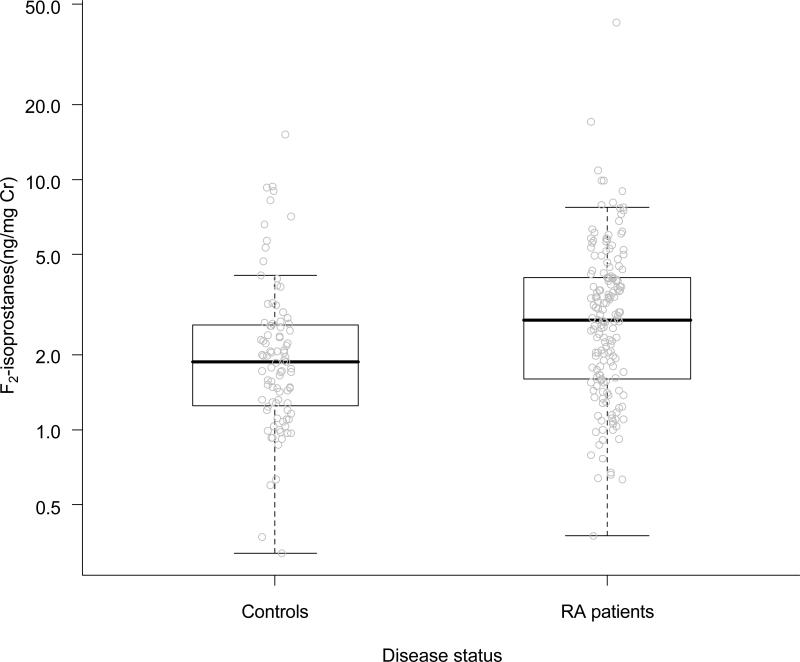
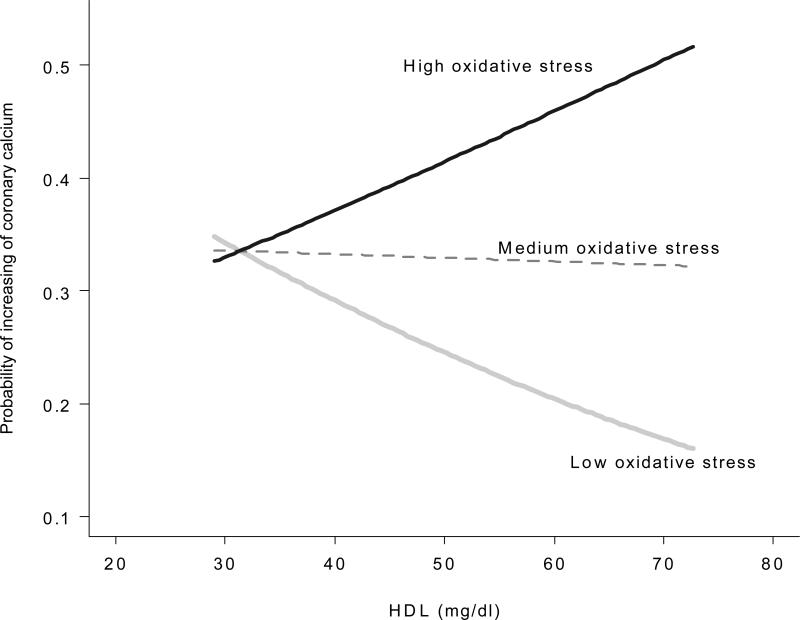
Results: F₂-isoprostane excretion was significantly higher in patients with RA (median 2.75 [interquartile range (IQR) 1.60-4.06] ng/mg creatinine) than in control subjects (median 1.86 [IQR 1.25-2.62] ng/mg creatinine; adjusted P = 0.006). In patients with RA, F₂-isoprostanes were positively correlated with body mass index (P < 0.001), but not with disease activity or mediators of inflammation such as the Disease Activity Score in 28 joints or serum tumor necrosis factor α, interleukin-6, and C-reactive protein concentrations in adjusted multivariable models (P > 0.05 for all). In patients with RA, F₂-isoprostanes significantly modified the effect of HDL cholesterol on coronary calcification (P = 0.02 for interaction) after adjustment for age, sex, and race. As F₂-isoprostane levels increased, HDL lost its protective effect against coronary calcification.
Conclusion: Oxidative stress measured as F₂-isoprostane excretion was higher in patients with RA than in control subjects. Among patients with RA, higher F₂-isoprostane excretion and HDL cholesterol concentrations interacted significantly and were positively associated with the severity of coronary calcification.
Figures
References
-
- Montuschi P, Barnes P, Roberts LJ. Insights into oxidative stress: the isoprostanes. Curr Med Chem. 2007;14(6):703–17. - PubMed
-
- Stocker R, Keaney JF., Jr. Role of oxidative modifications in atherosclerosis. Physiol Rev. 2004;84(4):1381–478. - PubMed
-
- Mapp PI, Grootveld MC, Blake DR. Hypoxia, oxidative stress and rheumatoid arthritis. Br Med Bull. 1995;51(2):419–36. - PubMed
-
- Rodriguez-Garcia J, Requena JR, Rodriguez-Segade S. Increased concentrations of serum pentosidine in rheumatoid arthritis. Clin Chem. 1998;44(2):250–5. - PubMed
Publication types
MeSH terms
Substances
Grants and funding
LinkOut - more resources
Full Text Sources
Medical
Research Materials
Miscellaneous
