


doi: 10.3201/eid1606.091000.
Dengue virus 3 genotype I in Aedes aegypti mosquitoes and eggs, Brazil, 2005-2006
Affiliations
- PMID: 20507754
- PMCID: PMC3086226
- DOI: 10.3201/eid1606.091000
Item in Clipboard
Dengue virus 3 genotype I in Aedes aegypti mosquitoes and eggs, Brazil, 2005-2006
Emerg Infect Dis.
2010 Jun.
Abstract
Dengue virus type 3 genotype I was detected in Brazil during epidemics in 2002-2004. To confirm this finding, we identified this virus genotype in naturally infected field-caught Aedes aegypti mosquitoes and eggs. Results showed usefulness of virus investigations in vectors as a component of active epidemiologic surveillance.
Figures
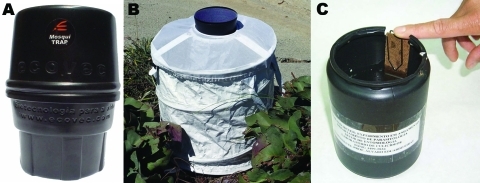
MosquiTRAP version 2.0 (Ecovec Ltd., Belo Horizonte, Brazil) (A), BG-Sentinel trap (Biogents, Regensburg, Germany) (B), and an ovitrap (C) used for obtaining mosquitoes in the northwestern borough of Belo Horizonte, Minas Gerais, Brazil.
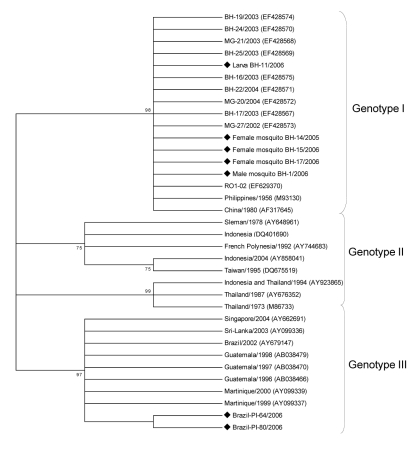
Phylogenetic tree of dengue type 3 serotypes and sequences from Aedes aegypti mosquitoes and larvae obtained in Belo Horizonte, Minas Gerais, Brazil. The tree is based on a 434-nt sequence of the capsid–premembrane gene and was generated by using neighbor-joining analysis with the Tamura-Nei model in MEGA4.1 software (Arizona State University, Tempe, AZ, USA). Numbers to the left of the nodes are bootstrap values (1,000 replicates) in support of the grouping to the right. Numbers in parentheses are GenBank accession numbers. Diamonds indicate viruses sequenced in this study.
References
-
- Secretaria de Vigilância em Saúde/Ministério da Stério da Saúde. Informe epidemiológico da dengue, boletim semana epidemiológica; 2009. p. 1–30 [cited 2009 Dec 13]. http://portal.saude.gov.br/portal/arquivos/pdf/boletim_semana_1_a_30_rev...
-
- Corrêa PR, Franca E, Bogutchi TF. Aedes aegypti infestation and occurrence of dengue in the city of Belo Horizonte, Brazil. Rev Saude Publica. 2005;39:33–40. - PubMed
Publication types
MeSH terms
Substances
LinkOut - more resources
Full Text Sources
Medical