


The effect of increased genioglossus activity and end-expiratory lung volume on pharyngeal collapse
- PMID: 20507968
- PMCID: PMC2928593
- DOI: 10.1152/japplphysiol.00373.2010
The effect of increased genioglossus activity and end-expiratory lung volume on pharyngeal collapse
Abstract
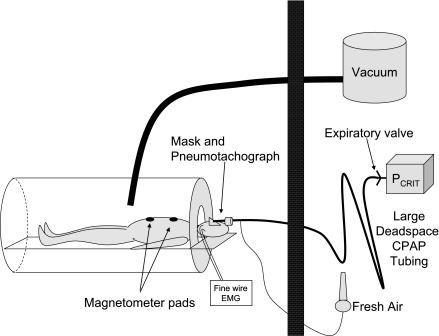
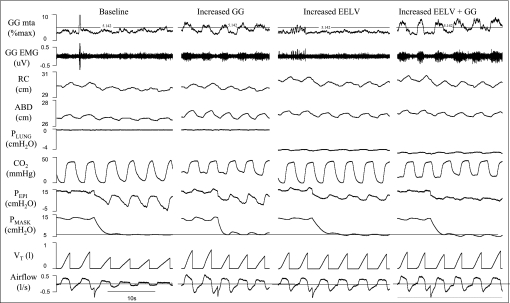
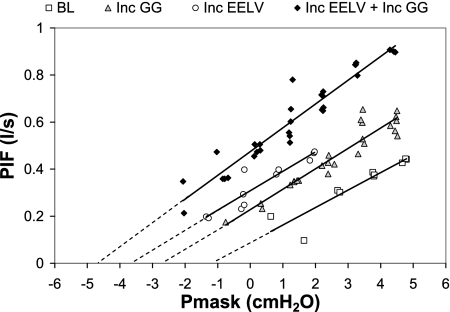
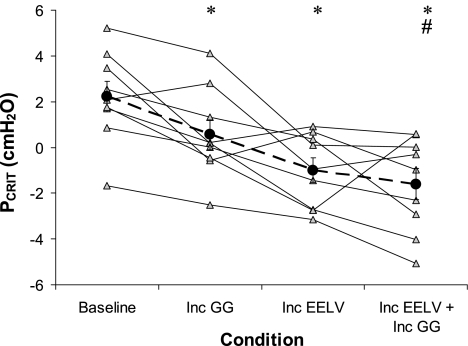
Increasing either genioglossus muscle activity (GG) or end-expiratory lung volume (EELV) improves airway patency but not sufficiently for adequate treatment of obstructive sleep apnea (OSA) in most patients. The mechanisms by which these variables alter airway collapsibility likely differ, with increased GG causing airway dilation, whereas increased EELV may stiffen the airway walls through caudal traction. We sought to determine whether the airway stabilizing effect of GG activation is enhanced when EELV is increased. To investigate this aim, 15 continuous positive airway pressure (CPAP)-treated OSA patients were instrumented with an epiglottic catheter, intramuscular GG-EMG electrodes, magnetometers, and a nasal mask/pneumotachograph. Subjects slept supine in a sealed, head-out plastic chamber in which the extra-thoracic pressure could be lowered (to raise EELV) while on nasal CPAP with a variable deadspace to allow CO(2) stimulation (and GG activation). The pharyngeal critical closing pressure (P(CRIT)) was measured by sudden reduction of CPAP for three to five breaths each minute during non-rapid eye movement (NREM) sleep in 4 conditions: a) baseline, b) 500 ml increased EELV, c) 50% increased GG, and d) conditions b and c combined. P(CRIT) was found to be reduced from 2.2 + or - 0.7 cmH(2)O at baseline to -1.0 + or - 0.5 with increased EELV, 0.6 + or - 0.7 with increased GG and -1.6 + or - 0.7 when both variables were raised (P < 0.001). The slope of the P(CRIT) curves remained unchanged in all conditions (P = 0.05). However, the CPAP level at which flow limitation developed was lower in both increased EELV conditions (P = 0.001). These findings indicate that while both increased GG and EELV improve airway collapsibility, the combination of both variables has little additional effect over increasing EELV alone.
Figures
References
-
- Al Lawati NM, Patel SR, Ayas NT. Epidemiology, risk factors, and consequences of obstructive sleep apnea and short sleep duration. Prog Cardiovasc Dis 51: 285–293, 2009 - PubMed
-
- Ballard RD, Irvin CG, Martin RJ, Pak J, Pandey R, White DP. Influence of sleep on lung volume in asthmatic patients and normal subjects. J Appl Physiol 68: 2034–2041, 1990 - PubMed
-
- Banzett RB, Mahan ST, Garner DM, Brughera A, Loring SH. A simple and reliable method to calibrate respiratory magnetometers and Respitrace. J Appl Physiol 79: 2169–2176, 1995 - PubMed
-
- Berry RB, Yamaura EM, Gill K, Reist C. Acute effects of paroxetine on genioglossus activity in obstructive sleep apnea. Sleep 22: 1087–1092, 1999 - PubMed
-
- Boudewyns A, Punjabi N, Van de Heyning PH, De Backer WA, O'Donnell CP, Schneider H, Smith PL, Schwartz AR. Abbreviated method for assessing upper airway function in obstructive sleep apnea. Chest 118: 1031–1041, 2000 - PubMed
Publication types
MeSH terms
Grants and funding
LinkOut - more resources
Full Text Sources
Medical
