


Surface immobilization of hexa-histidine-tagged adeno-associated viral vectors for localized gene delivery
- PMID: 20508598
- PMCID: PMC2932747
- DOI: 10.1038/gt.2010.81
Surface immobilization of hexa-histidine-tagged adeno-associated viral vectors for localized gene delivery
Abstract
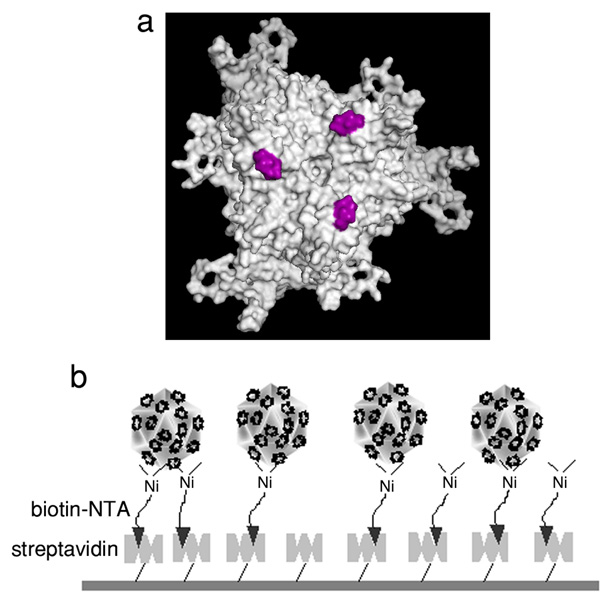
Adeno-associated viral (AAV) vectors, which are undergoing broad exploration in clinical trials, have significant promise for therapeutic gene delivery because of their safety and delivery efficiency. Gene delivery technologies capable of mediating localized gene expression may further enhance the potential of AAV in a variety of therapeutic applications by reducing spread outside a target region, which may thereby reduce off-target side effects. We have genetically engineered an AAV variant capable of binding to surfaces with high affinity through a hexa-histidine metal-binding interaction. This immobilized AAV vector system mediates high-efficiency delivery to cells that contact the surface and thus may have promise for localized gene delivery, which may aid numerous applications of AAV delivery to gene therapy.
Conflict of interest statement
There is no conflict of interest to disclose.
Figures


References
-
- Fisher KJ, Jooss K, Alston J, Yang Y, Haecker SE, High K, et al. Recombinant adeno-associated virus for muscle directed gene therapy. Nat Med. 1997;3:306–312. - PubMed
-
- Kaplitt MG, Leone P, Samulski RJ, Xiao X, Pfaff DW, O'Malley KL, et al. Long-term gene expression and phenotypic correction using adeno-associated virus vectors in the mammalian brain. Nat Genet. 1994;8:148–154. - PubMed
-
- Bainbridge JW, Smith AJ, Barker SS, Robbie S, Henderson R, Balaggan K, et al. Effect of gene therapy on visual function in Leber's congenital amaurosis. N Engl J Med. 2008;358:2231–2239. - PubMed
