


Decoding of MSTd population activity accounts for variations in the precision of heading perception
- PMID: 20510863
- PMCID: PMC2889617
- DOI: 10.1016/j.neuron.2010.04.026
Decoding of MSTd population activity accounts for variations in the precision of heading perception
Abstract
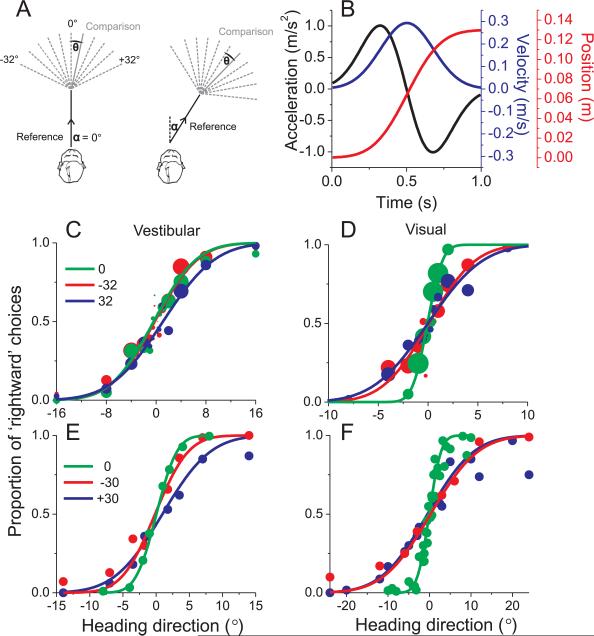
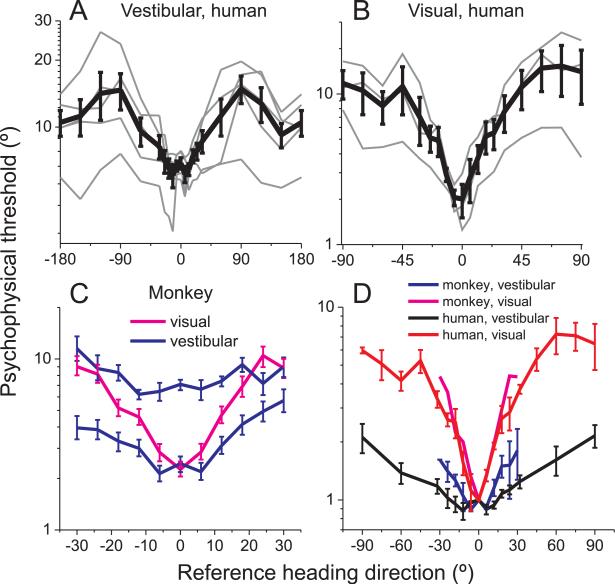
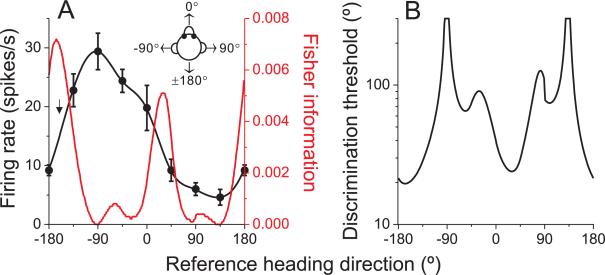
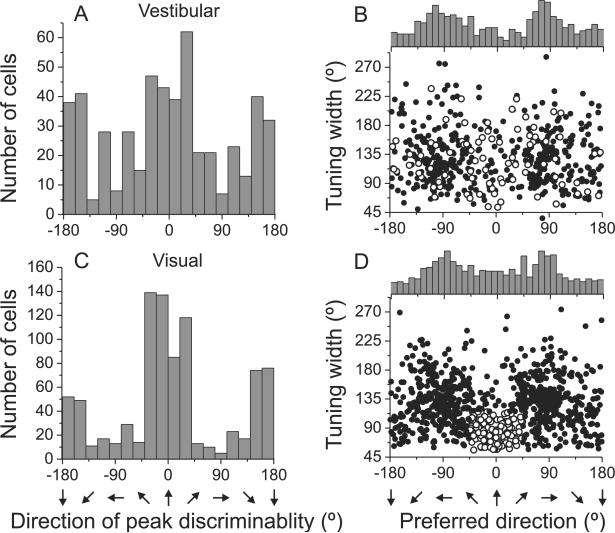
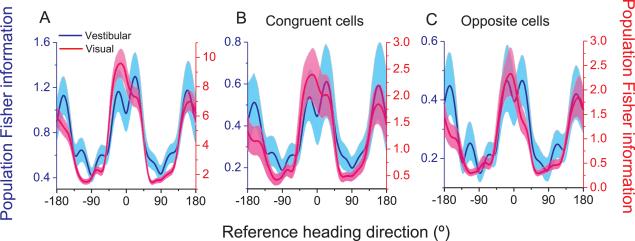
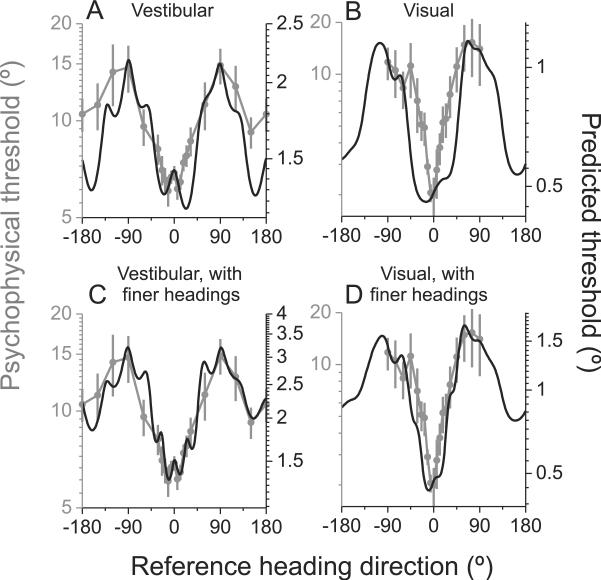
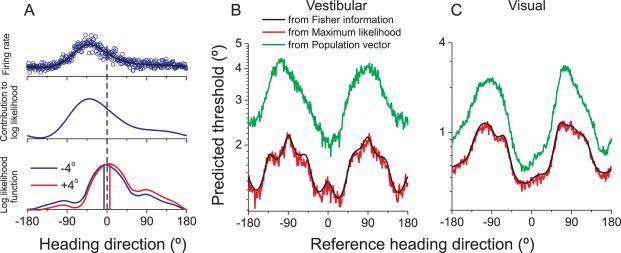
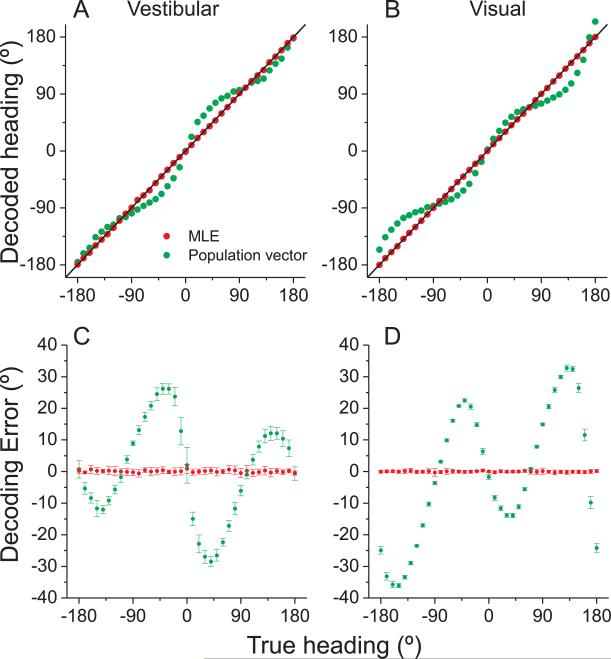
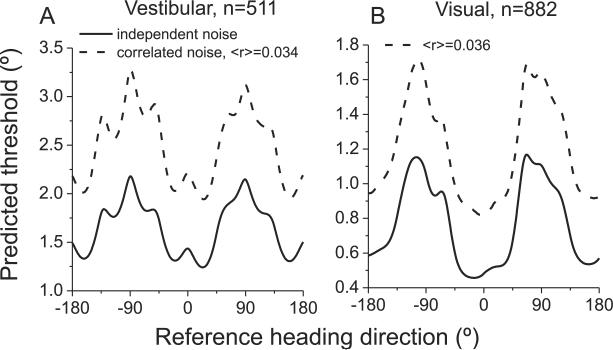
Humans and monkeys use both vestibular and visual motion (optic flow) cues to discriminate their direction of self-motion during navigation. A striking property of heading perception from optic flow is that discrimination is most precise when subjects judge small variations in heading around straight ahead, whereas thresholds rise precipitously when subjects judge heading around an eccentric reference. We show that vestibular heading discrimination thresholds in both humans and macaques also show a consistent, but modest, dependence on reference direction. We used computational methods (Fisher information, maximum likelihood estimation, and population vector decoding) to show that population activity in area MSTd predicts the dependence of heading thresholds on reference eccentricity. This dependence arises because the tuning functions for most neurons have a steep slope for directions near straight forward. Our findings support the notion that population activity in extrastriate cortex limits the precision of both visual and vestibular heading perception.
Copyright 2010 Elsevier Inc. All rights reserved.
Figures
References
-
- Abbott LF, Dayan P. The effect of correlated variability on the accuracy of a population code. Neural Comput. 1999;11:91–101. - PubMed
-
- Angelaki DE, Gu Y, DeAngelis GC. Noise correlations in area MSTd during multi-sensory heading perception. 2009 SFN abstract 558.10.
-
- Averbeck BB, Latham PE, Pouget A. Neural correlations, population coding and computation. Nat Rev Neurosci. 2006;7:358–366. - PubMed
Publication types
MeSH terms
Grants and funding
LinkOut - more resources
Full Text Sources
