Review
. 2010 Jun;39(2):255-69, table of contents.
doi: 10.1016/j.ecl.2010.02.007.

The vitamin D receptor: new paradigms for the regulation of gene expression by 1,25-dihydroxyvitamin D(3)

Affiliations
Review

The vitamin D receptor: new paradigms for the regulation of gene expression by 1,25-dihydroxyvitamin D(3)

J Wesley Pike et al. Endocrinol Metab Clin North Am. 2010 Jun.

Abstract

The actions of the vitamin D hormone 1,25-dihydroxyvitamin D(3) (1,25(OH)(2)D(3)) are mediated by the vitamin D receptor (VDR), a ligand-activated transcription factor that functions to control gene expression. After ligand activation, the VDR binds directly to specific sequences located near promoters and recruits a variety of coregulatory complexes that perform the additional functions required to modify transcriptional output. Recent advances in transcriptional regulation, which permit the unbiased identification of the regulatory regions of genes, are providing new insight into how genes are regulated. Surprisingly, gene regulation requires the orchestrated efforts of multiple modular enhancers often located many kilobases upstream, downstream, or within the transcription units themselves. These studies are transforming our understanding of how 1,25(OH)(2)D(3) regulates gene transcription.


Figures

Figure 1
Figure 1
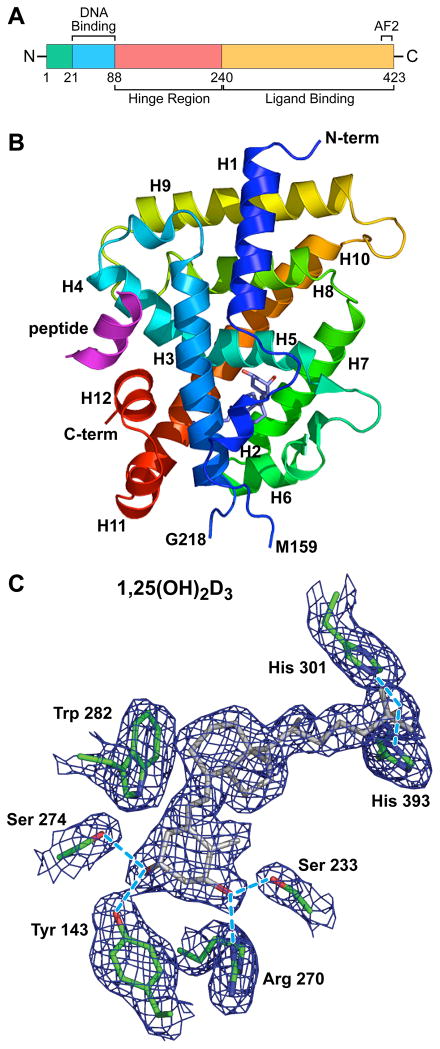
Structure and key features of the VDR. A. Schematic of the VDR protein comprised of a DNA binding domain, a large ligand binding domain and a hinge region that links the two functional domain of the protein together. N, amino terminal end; C, carboxy terminal end; AF2, activation function 2. Amino acid numbers are shown. B. Crystal structure of the VDR ligand binding domain comprised of 12 α-helices (H1–H12). The N-terminal and C-terminal portions of the molecule are show. A deletion in the molecular from G218 to M159 was required to achieve the formation of crystals. The position of 1,25(OH)2D3 is shown in the ligand binding pocket as a stick figure. The ligand binding domain was crystallized in the presence of a short peptide (indicated) representing a key LxxLL motif located in all coregulatory proteins that interact directly with the VDR. The repositioning of H12 as a consequence of 1,25(OH)2D3 binding provides the structural change necessary for interaction of the VDR with the LxxLL motif. C. An electron density map of 1,25(OH)2D3 and adjacent amino acids within the VDR protein that make direct contact with the ligand. See Vanhooke et al. (13) for details.
Figure 2
Figure 2
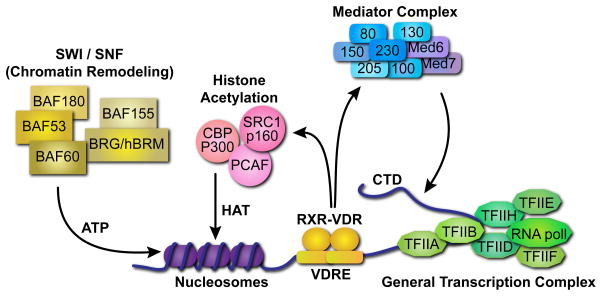
Schematic model of coregulatory complexes that are involved in mediating the actions of 1,25(OH)2D3 and the VDR. The general transcriptional apparatus is shown at the TSS and the VDR/RXR heterodimer is shown bound to its regulatory vitamin D response element or VDRE. Three regulatory complexes are shown that interact with the VDR: an ATPase-containing, chromatin remodeling complex termed SWI/SNF, a histone acetylation complex containing histone acetyltransferases (HAT) and Mediator complex. The latter facilitates the activation of RNA pol II through its C-terminal domain (CTD). Nucleosomes as well as individual proteins that comprise the individual coregulatory complexes are indicated.
Figure 3
Figure 3
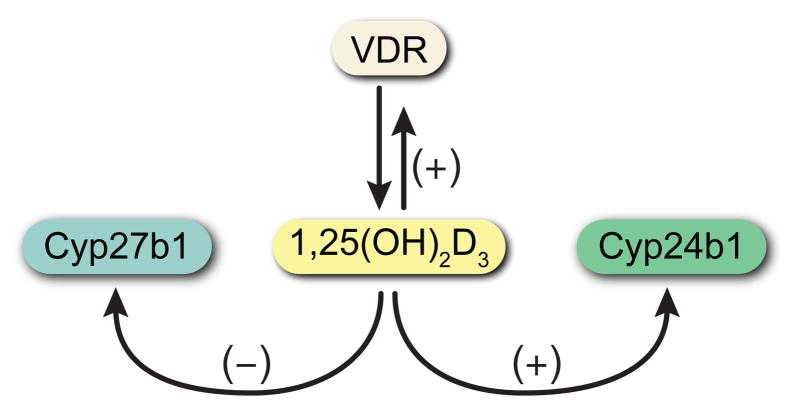
Regulatory control of the synthesis (Cyp27b1), degradation (Cyp24a1) and mediation of activity (Vdr) of 1,25(OH)2D3 The concentration of 1,25(OH)2D3 in cells is determined through its synthesis and its degradation. Its functional activity is determined by the presence and intracellular concentration of the VDR.
Figure 4
Figure 4
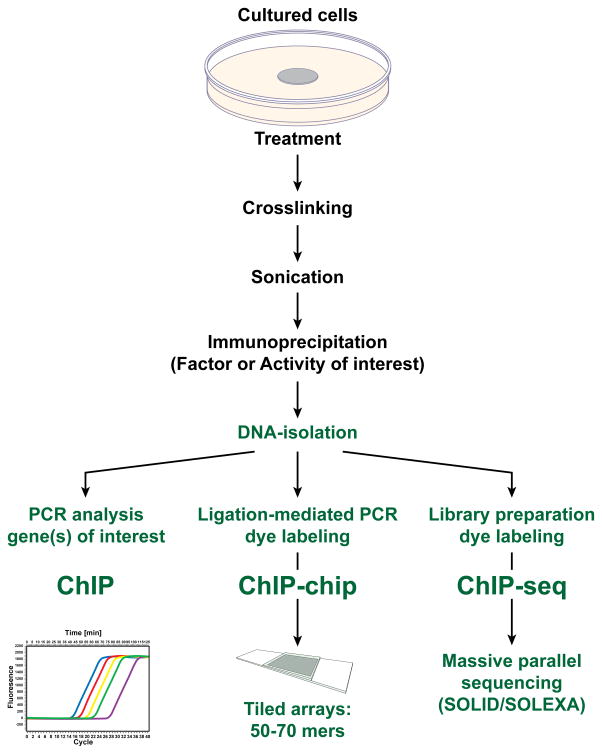
Methodology associated with chromatin immunoprecipitation (ChIP) analysis and subsequent ChIP-DNA microarray (ChIP-chip) or massive parallel sequencing (ChIP-seq) analyses. Biological samples are cross-linked, sonicated to prepare discrete size chromatin fragments, and then subjected to immunoprecipitation using selected antibodies. The precipitated DNA is then isolated and evaluated by PCR analysis or amplified and then subjected to either ChIP-chip or ChIP-seq analyses.

Republished in

References

    1. Haussler MR, Whitfield GK, Haussler CA, Hsieh JC, Thompson PD, Selznick SH, Dominguez CE, Jurutka PW. The nuclear vitamin D receptor: biological and molecular regulatory properties revealed. J Bone Miner Res. 1998 Mar;13(3):325–49. - PubMed
    1. Sutton AL, MacDonald PN. Vitamin D: more than a “bone-a-fide” hormone. Mol Endocrinol. 2003 May;17(5):777–91. - PubMed
    1. Bouillon R, Carmeliet G, Verlinden L, van Etten E, Verstuyf A, Luderer HF, Lieben L, Mathieu C, Demay M. Vitamin D and human health: lessons from vitamin D receptor null mice. Endocr Rev. 2008 Oct;29(6):726–76. - PMC - PubMed
    1. Kim S, Yamazaki M, Zella LA, Shevde NK, Pike JW. Activation of receptor activator of NF-kappaB ligand gene expression by 1,25-dihydroxyvitamin D3 is mediated through multiple long-range enhancers. Mol Cell Biol. 2006 Sep;26(17):6469–86. - PMC - PubMed
    1. Zella LA, Kim S, Shevde NK, Pike JW. Enhancers located within two introns of the vitamin D receptor gene mediate transcriptional autoregulation by 1,25-dihydroxyvitamin D3. Mol Endocrinol. 2006 Jun;20(6):1231–47. - PubMed

Publication types