


First evaluation of real-time nitric oxide changes in the coronary circulation in patients with non-ischaemic dilated cardiomyopathy using a catheter-type sensor
- PMID: 20511328
- PMCID: PMC2995954
- DOI: 10.1093/eurheartj/ehq156
First evaluation of real-time nitric oxide changes in the coronary circulation in patients with non-ischaemic dilated cardiomyopathy using a catheter-type sensor
Abstract
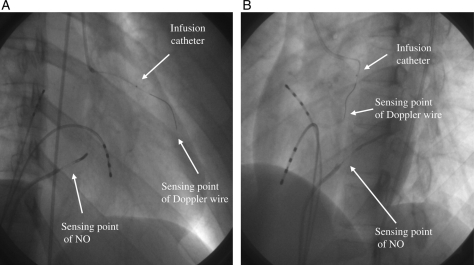
Aims: No direct method has yet been developed to measure real-time plasma nitric oxide (NO) concentration in humans. In this study, we evaluated a new method for measuring plasma NO concentration in patients with dilated cardiomyopathy (DCM) and in normal controls using a catheter-type sensor.
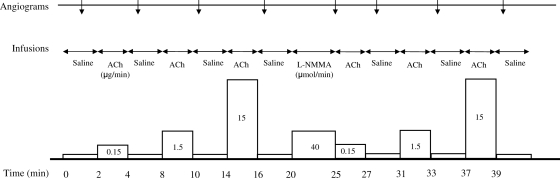
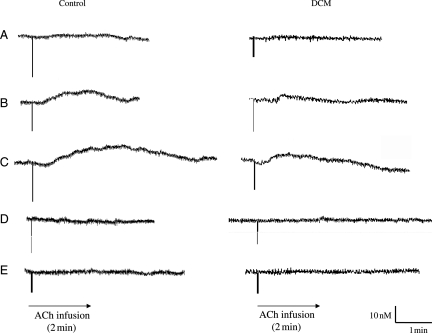
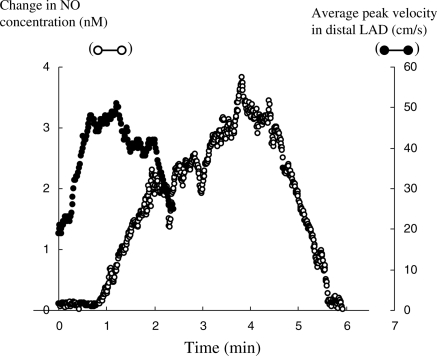
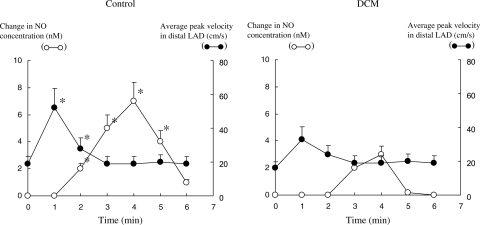
Methods and results: We simultaneously measured average peak velocity (APV) of the coronary artery flow and change in plasma NO concentration using the NO sensor placed in the great cardiac vein of 10 DCM patients and 10 control subjects. These evaluations were performed in response to sequential intracoronary infusions of acetylcholine (ACh, 10⁻⁸-10⁻⁶ M), N(G)-monomethyl-l-arginine (l-NMMA, 200 µmol) and co-infusion of ACh and l-NMMA. The change in plasma NO concentration in DCM patients was significantly impaired compared with the control group (P < 0.01). Pretreatment with l-NMMA completely suppressed the ACh-induced NO concentration, whereas APV in the left anterior descending coronary artery was partially suppressed in both groups. Plasma NO concentration reached its peak value later than the maximum APV following the injection of ACh (10⁻⁶ M) in both groups.
Conclusion: The catheter-type NO sensor could be applied to clinically evaluate the endothelial function (i.e. reduced endothelium-derived NO bioavailability) in patients with cardiovascular diseases.
Figures
Comment in
-
Simply say yes to NO? Nitric oxide (NO) sensor-based assessment of coronary endothelial function.Eur Heart J. 2010 Dec;31(23):2834-6. doi: 10.1093/eurheartj/ehq279. Epub 2010 Aug 24. Eur Heart J. 2010. PMID: 20736240 No abstract available.
References
-
- Blackman DJ, Morris-Thurgood JA, Atherton JJ, Ellis GR, Anderson RA, Cockcroft JR, Frenneaux MP. Endothelium-derived nitric oxide contributes to the regulation of venous tone in humans. Circulation. 2000;101:165–170. - PubMed
-
- Kawashima Y, Nagasawa T, Ninomiya H. Contribution of ecto-5'-nucleotidase to the inhibition of platelet aggregation by human endothelial cells. Blood. 2000;96:2157–2162. - PubMed
-
- Ouedraogo R, Gong Y, Berzins B, Wu X, Mahadev K, Hough K, Chan L, Goldstein BJ, Scalia R. Adiponectin deficiency increases leukocyte-endothelium interactions via upregulation of endothelial cell adhesion molecules in vivo. J Clin Invest. 2007;117:1718–1726. doi:10.1172/JCI29623. - DOI - PMC - PubMed
-
- Peiró C, Redondo J, Rodríguez-Martínez MA, Angulo J, Marín J, Sanchez-Ferrer CF. Influence of endothelium on cultured vascular smooth muscle cell proliferation. Hypertension. 1995;25:748–751. - PubMed
-
- Dinerman JL, Lowenstein CJ, Snyder SH. Molecular mechanisms of nitric oxide regulation. Potential relevance to cardiovascular disease. Circ Res. 1993;73:217–222. - PubMed
Publication types
MeSH terms
Substances
LinkOut - more resources
Full Text Sources
Other Literature Sources
