


Abasic sites preferentially form at regions undergoing DNA replication
- PMID: 20511393
- PMCID: PMC2996904
- DOI: 10.1096/fj.09-145276
Abasic sites preferentially form at regions undergoing DNA replication
Abstract
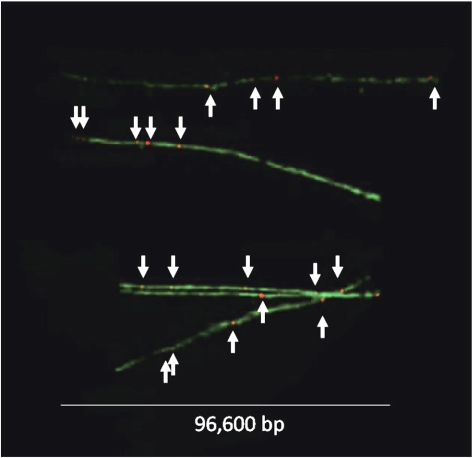
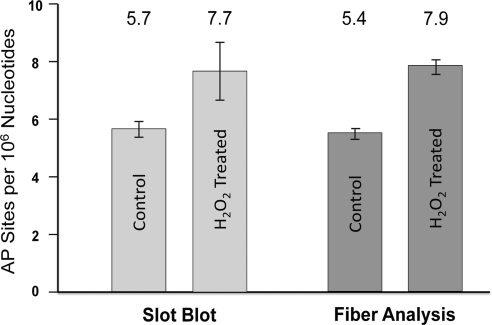
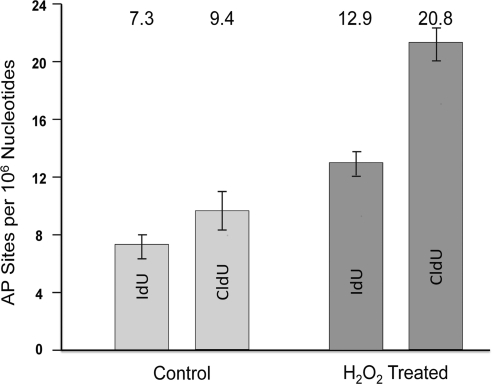
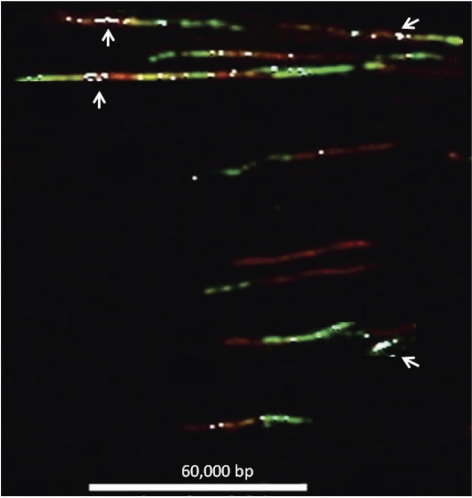
We investigated whether apurinic/apyrimidinic (AP/abasic) sites were more frequent in regions of DNA replication in cells and whether their number increased during oxidative stress. DNA fiber spreading and fluorescent immunostaining were used to detect areas of DNA replication and sites of AP lesions in extended DNA fibers. The distribution of AP sites was determined in DNA fibers from vertebrate cells maintained under normal culture conditions or stressed with exogenous H(2)O(2). AP lesions per unit length were enumerated in bulk DNA or at replication sites. The background density of AP sites in DNA fibers was 5.4 AP sites/10(6) nt, while newly replicated DNA contained 12.9 AP sites/10(6) nt. In cells exposed to 20 μM H(2)O(2), AP sites in newly replicated DNA increased to 20.8/10(6) nt. Determinations of AP site density in bulk DNA by fiber analysis or standard slot blot assays agreed to within 10%. Our findings show that the fiber assay not only accurately determines the frequency of AP sites but also shows their distribution. They also reveal that there is increased susceptibility to oxidative damage in DNA regions undergoing replication, which may explain the previously observed clustering of AP sites.
Figures
References
-
- Cooke M. S., Evans M. D., Dizdaroglu M., Lunec J. (2003) Oxidative DNA damage: mechanisms, mutation, and disease. FASEB J. 17, 1195–1214 - PubMed
-
- Chastain P. D., 2nd, Nakamura J., Swenberg J., Kaufman D. (2006) Nonrandom AP site distribution in highly proliferative cells. FASEB J. 20, 2612–2614 - PubMed
-
- Liu Y., Kao H. I., Bambara R. A. (2004) Flap endonuclease 1: a central component of DNA metabolism. Annu. Rev. Biochem. 73, 589–615 - PubMed
-
- Nakamura J., Swenberg J. A. (1999) Endogenous apurinic/apyrimidinic sites in genomic DNA of mammalian tissues. Cancer Res. 59, 2522–2526 - PubMed
Publication types
MeSH terms
Substances
Grants and funding
LinkOut - more resources
Full Text Sources
Other Literature Sources
Research Materials
